

A generator-side earth fault must be assessed through the machine’s neutral-earthing arrangement and its connected phase capacitances. A GSU delta winding changes which zero-sequence quantities can appear at external terminals. It does not make the machine-side fault disappear. Apply sequence analysis to the actual winding connection [1].
Draw a source-return loop rather than marking only the faulted phase. Include generator neutral equipment, connected cables and bus capacitances, instrument transformers and the GSU winding connection. Define the actual fault location relative to the generator breaker; a breaker can divide the connected zone and its capacitance.
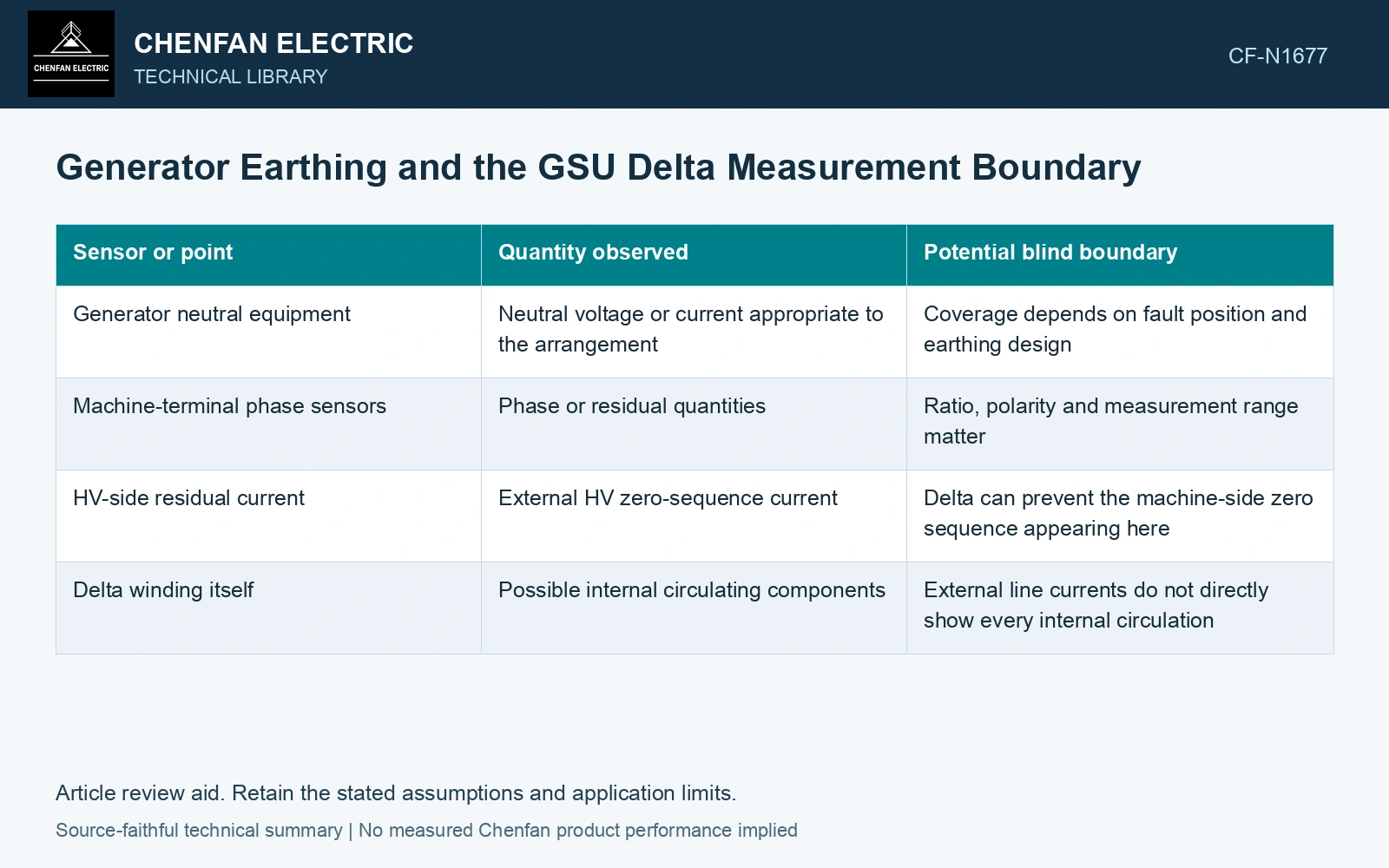
Match each sensor to a quantity it can observe
| Sensor or point | Quantity observed | Potential blind boundary |
|---|---|---|
| Generator neutral equipment | Neutral voltage or current appropriate to the arrangement | Coverage depends on fault position and earthing design |
| Machine-terminal phase sensors | Phase or residual quantities | Ratio, polarity and measurement range matter |
| HV-side residual current | External HV zero-sequence current | Delta can prevent the machine-side zero sequence appearing here |
| Delta winding itself | Possible internal circulating components | External line currents do not directly show every internal circulation |
Keep negative sequence out of the zero-sequence explanation
The blocking statement concerns external zero sequence, whose three phase currents are in phase. Negative-sequence currents have a different phasor pattern and can transfer through the transformer. Calling a delta a barrier to “all unbalance” confuses fault studies and relay interpretation.
Ground-fault current magnitude also depends on how the generator neutral is earthed. High-resistance, impedance and other arrangements cannot share one assumed current. Connected capacitance and the fault location influence the measured quantities. Use the plant model rather than a generic winding diagram.
Check the residual at the observable terminal
Assume three in-phase zero-sequence currents of 6 A at an observable terminal. Their residual is 18 A. A delta can carry internal circulation without external zero-sequence line current. Verify the machine-side fault using the actual local neutral measurement.
Use the diagram to test visibility
Place a proposed earth fault at several points within the protected zone and calculate the quantities at each sensor. Include the generator-breaker states that alter the zone. Identify any interval where the chosen measurement has low sensitivity, then address it in the machine protection design.
This visibility map provides an explanation for a missing HV residual-current indication. It does not establish the absence of a generator-side earth fault. The protection settings, injection tests and coverage acceptance require the approved plant study and actual measurement equipment.
Apply the plant isolation procedure to every identified energy source [2].
References
- Amberg, A., and Rangel, A., Tutorial on Symmetrical Components, Part 2: Answer Key, Schweitzer Engineering Laboratories, revision 20201019, 2020, Sections I and III.
- U.S. Occupational Safety and Health Administration, 29 CFR 1910.147, The control of hazardous energy (lockout/tagout), official text accessed 2026-10-24.