

A gas-transformer maintenance record can contain tank pressure, cylinder weight and recovered gas. Pressure is a state measurement; kilograms are inventory. Reconcile one mass boundary with uncertainties before assigning a discrepancy [1].
Start with a closed accounting boundary
List the transformer compartments, connecting equipment and service hoses included in the maintenance balance. Decide whether a recovery cart or storage cylinder is inside or outside that boundary. Changing the boundary halfway through can make a transfer look like a loss.
A simple reconciliation is mfinal = minitial + madd − mout − msample − munexplained. All masses are in kilograms. The unexplained term is a balancing discrepancy, not a direct measurement of release to atmosphere. Measurement uncertainty, residual gas and unrecorded transfers must be investigated before assigning it a physical meaning.
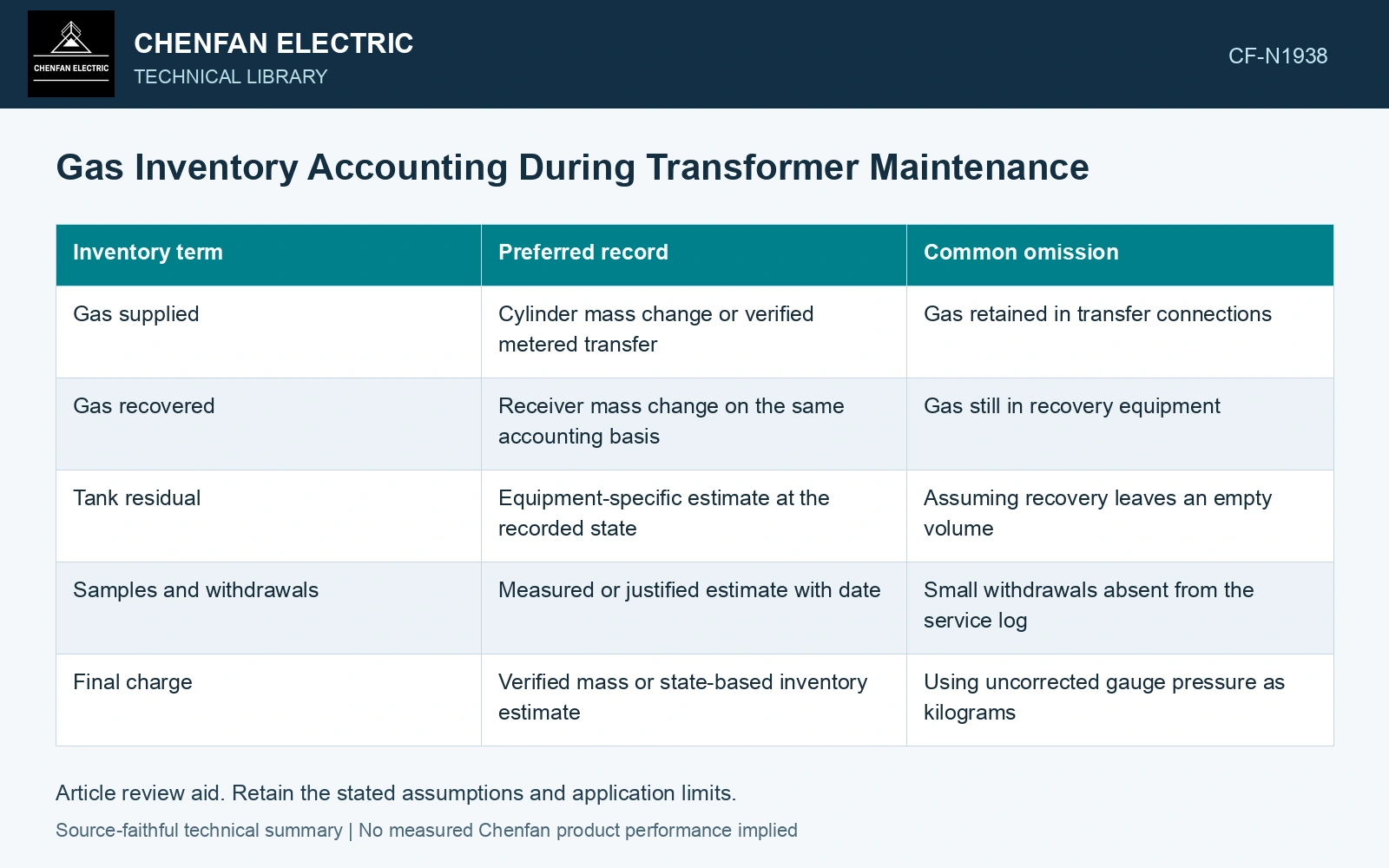
| Inventory term | Preferred record | Common omission |
|---|---|---|
| Gas supplied | Cylinder mass change or verified metered transfer | Gas retained in transfer connections |
| Gas recovered | Receiver mass change on the same accounting basis | Gas still in recovery equipment |
| Tank residual | Equipment-specific estimate at the recorded state | Assuming recovery leaves an empty volume |
| Samples and withdrawals | Measured or justified estimate with date | Small withdrawals absent from the service log |
| Final charge | Verified mass or state-based inventory estimate | Using uncorrected gauge pressure as kilograms |
Cylinder weighing needs its own boundary
Compare cylinder measurements with the same accessories and weighing convention. A valve guard, hose or changed tare basis can create a mass difference unrelated to transferred gas. Record scale uncertainty and whether the cylinder was fully disconnected from external forces during weighing.
Keep gas identity and originating equipment attached to the transfer. IEC 60480 addresses reuse specifications for SF6 and its mixtures [2]; a closed mass balance alone does not establish reuse quality.
Treat residual gas as inventory
Recovery leaves a state that must be measured or estimated. Residual mass depends on volume, gas identity, temperature and absolute pressure, with the appropriate gas-property model. Include service equipment that remains connected. A perfect-looking balance based on zero residual can hide an incorrect assumption rather than demonstrate high recovery efficiency.
For an independent teaching ledger, assume initial inventory 100 kg, recovery 94 kg, estimated residual 3 kg and documented samples/transfers 1 kg: discrepancy is 2 kg. Assume independent standard uncertainties 0.5/0.5/0.3/0.1 kg, giving combined u = √0.60 = 0.775 kg and a k = 2 interval 0.451–3.549 kg [1]. It remains positive in this uncertainty model: investigate tare, trapped inventory and transfer records. This does not identify an atmospheric release or its route. Keep later fresh charging outside this recovery balance.
Show the uncertainty of the major terms beside the final discrepancy. If the discrepancy is smaller than the combined measurement capability, report it as unresolved within that capability. If it is larger, trace the transfer history before classifying it. Current local handling and reporting obligations then apply to the verified activities and quantities, rather than to an unsupported interpretation of the balance.
References
- B. N. Taylor and C. E. Kuyatt, NIST Technical Note 1297, Guidelines for Evaluating and Expressing the Uncertainty of NIST Measurement Results, 1994, sections 5 and 6.
- IEC, IEC 60480:2019, Specifications for the re-use of sulphur hexafluoride (SF6) and its mixtures in electrical equipment.