

A cooling-related pressure fall does not by itself measure gas loss. DOE’s thermodynamics text distinguishes absolute/gauge pressure and ideal-gas state relations [1]. Interpret the same identified compartment using composition, temperature and a valid real-gas model.
Density relates gas mass to volume. For a known gas and volume, it is a useful inventory-related quantity, while the dielectric and cooling assessment still needs the qualified operating state.
Establish the pressure reference
Absolute pressure equals gauge pressure plus the relevant atmospheric pressure. Gauge pressure is therefore not the complete thermodynamic input. Instrument reference, altitude and external atmospheric variation can influence what a displayed value means.
For an ideal gas, ρ = PabsM/(RT), derived from Pv = RT using a consistent gas constant [1]. Use Pabs in Pa, M in kg/mol, molar R in J/(mol·K), T in K and ρ in kg/m³. An actual mixture may need a nonideal model.
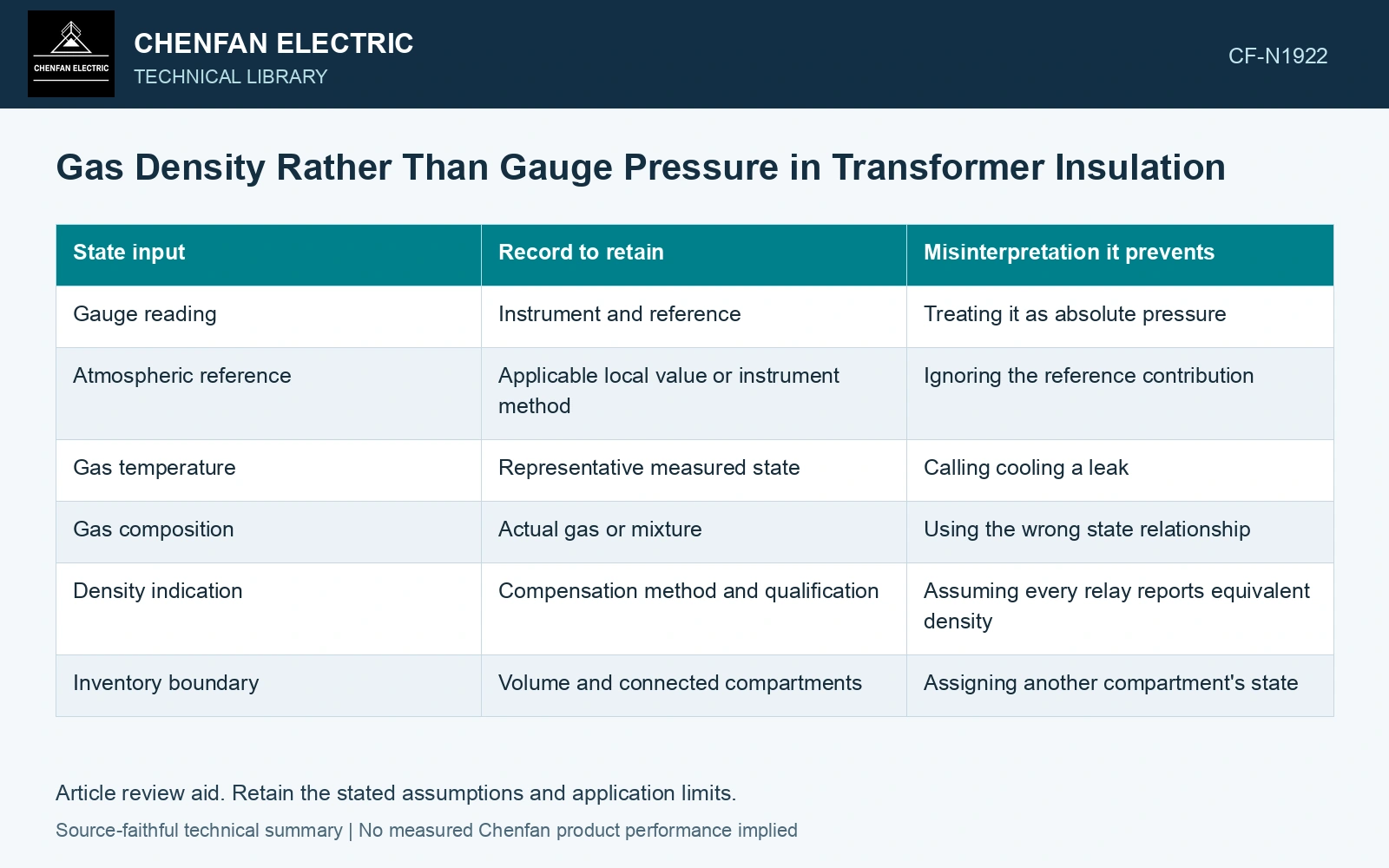
| State input | Record to retain | Misinterpretation it prevents |
|---|---|---|
| Gauge reading | Instrument and reference | Treating it as absolute pressure |
| Atmospheric reference | Applicable local value or instrument method | Ignoring the reference contribution |
| Gas temperature | Representative measured state | Calling cooling a leak |
| Gas composition | Actual gas or mixture | Using the wrong state relationship |
| Density indication | Compensation method and qualification | Assuming every relay reports equivalent density |
| Inventory boundary | Volume and connected compartments | Assigning another compartment’s state |
Know what compensation does
A density monitor may compensate a pressure-related measurement to a defined reference condition. Its operation and accuracy need manufacturer evidence. The word density does not guarantee correct behavior with a changed gas mixture or a large temperature gradient.
Compare stable, identified states
A large tank can have nonuniform temperature during load or cooldown. A single local sensor may not represent every gas region. Preserve the timing and thermal condition of observations, and use the qualified method for inventory or condition assessment.
If the gas type, compartment volume or monitoring component changes, review the conversion and thresholds. A retained pressure label does not validate a new state model.
Assume sealed fixed-volume gas has 300 kPa absolute pressure at 293.15 K. At 333.15 K, the ideal pressure is 340.93 kPa with unchanged inventory and density. Conversely, a constant 300 kPa reading at that higher temperature would imply 293.15/333.15 = 0.8799 of the initial ideal density at the same volume. Interpret pressure with temperature, composition and the applicable equation of state; a pressure-only alarm cannot be assigned the same density meaning at every thermal condition.
Cooling and gas loss can both lower a pressure display. Correct its reference, representative temperature, composition and volume before attributing a discrepancy. Propagate the actual instrument and state-model uncertainties, including covariance where relevant [2], then investigate rather than naming the raw drop a measured leak.
References
- U.S. Department of Energy, DOE-HDBK-1012/1-92, Thermodynamics, Heat Transfer, and Fluid Flow, Volume 1, 1992, Compression Processes.
- B. N. Taylor and C. E. Kuyatt, NIST Technical Note 1297, Guidelines for Evaluating and Expressing the Uncertainty of NIST Measurement Results, 1994, sections 5 and 6.