

An electric boiler transformer should be specified from the boiler’s electrical technology and control method. A continuously connected resistive heater, an electrode system and a power-electronically controlled heating system can impose different supply duties. The process heat requirement alone does not establish transformer current, power factor, harmonics or the duration of maximum electrical demand.
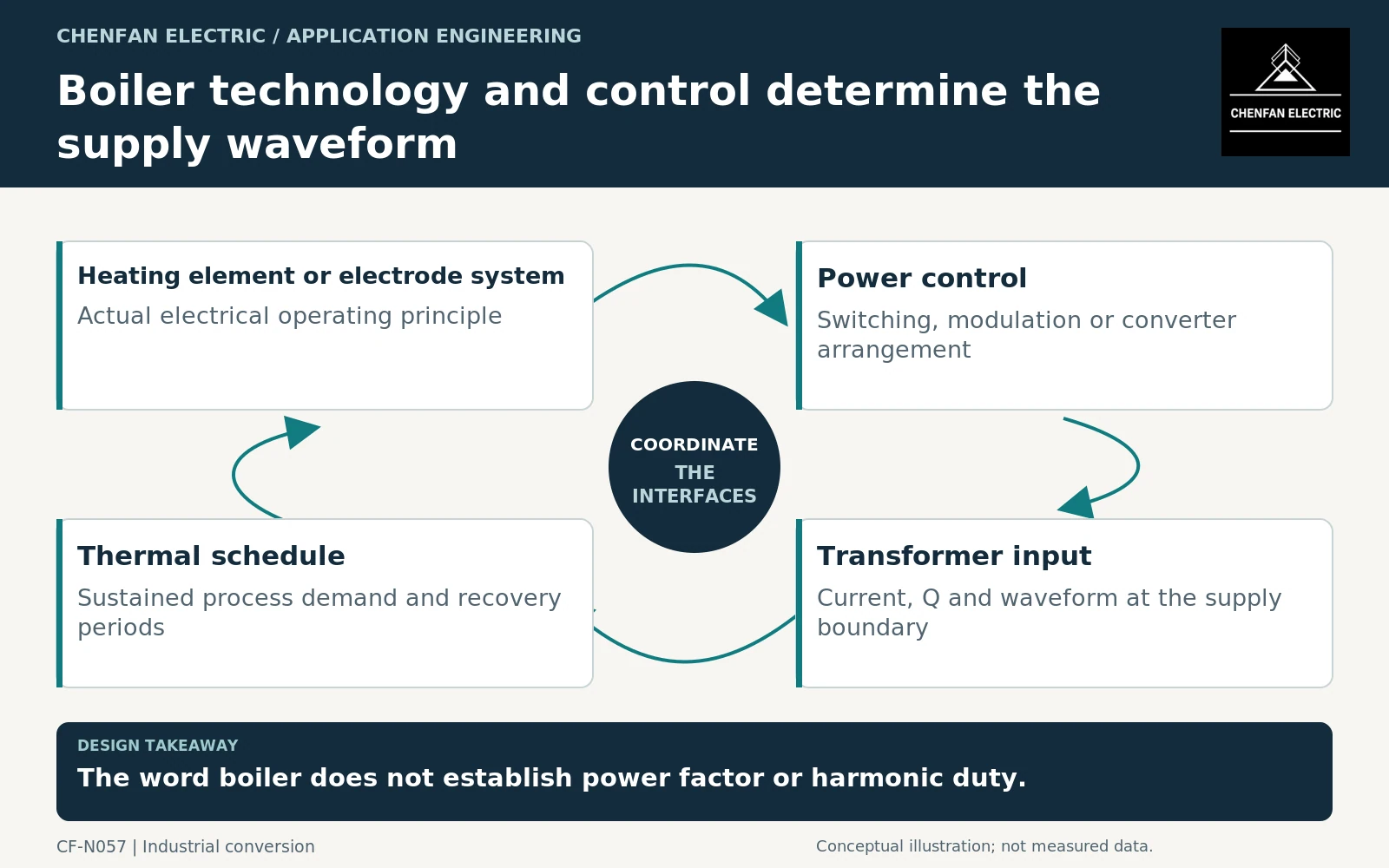
Identify the heating and regulation arrangement
Ask the boiler supplier to describe the electrical power stage and how output is controlled. Distinguish staged switching, time-proportioned operation, phase-controlled equipment and other converter arrangements where used. Do not assume that every electric boiler is a unity-power-factor load under all operating modes.
The transformer interface should be stated in alternating current (AC) input quantities: voltage range, continuous and temporary current, reactive behavior and relevant waveform data. Auxiliary pumps, controls and water-treatment equipment may have separate duties even when supplied from the same transformer.
General transformer application guidance addresses operating conditions and ratings. Where semiconductor conversion creates specialized requirements, converter-transformer application guidance may also be relevant. [1] [2]
Separate steady process heat from electrical cycling
A process requesting a steady average heat output can still be supplied through electrical switching or modulation. The transformer assessment needs the actual current sequence, not only the thermal output averaged over a long interval.
For an illustrative ideal resistive three-phase load delivering 3 MW at unity power factor, apparent power is 3 MVA. That equality depends on the stated ideal input behavior. It should not be extended to a real controlled boiler without supplier data, nor does it include additional site auxiliaries automatically.
Record the duration of full output, repeated control cycles and the expected low-load periods. If the boiler provides continuous process heat, do not assume overnight thermal recovery simply because other factory loads decline.
Obtain the data that distinguishes the control modes
| Boiler input | Transformer assessment use |
|---|---|
| Power-stage description | Identifies whether specialized converter treatment is needed |
| AC current envelope | Defines continuous and temporary winding duty |
| Control-cycle timing | Preserves repeated electrical loading |
| Harmonic spectrum | Supports waveform-related assessment where relevant |
| Auxiliary schedule | Captures pumps and other coincident loads |
| Process continuity | Defines required sustained and contingency operation |
Harmonic guidance for nonlinear loads supports requesting actual spectra rather than relying on a generic heater label. [3] The applicable transformer assessment method must respect its equipment scope, particularly where a dedicated converter transformer is involved.
Compare the complete operating basis
Require offers to state the duty cycle, ambient conditions and cooling assumptions used. A transformer evaluated for intermittent heating should not be compared directly with one required to support sustained maximum demand.
Use the appropriate loading framework for the transformer construction. Mineral-oil loading guidance addresses loading and ambient effects within its scope; it is not a universal rating rule for every heating installation. [4]
The acceptance package should connect the boiler’s control description to the transformer’s assessed current schedule. A later change from staged control to a different power-electronic system can alter the supply duty without changing the boiler’s nominal thermal megawatts.
The useful specification describes how electrical power enters the boiler over time. Calling the process “resistive heating” is not enough when the installed control method determines the waveform, coincidence and sustained transformer duty.
Core procurement checkpoint: Translate continuous boiler duty into a released equipment design
An electric-boiler load schedule supports transformer selection, but it is not a core material specification. Once the manufacturer has approved the equipment design, identify the matching core drawing, quantities and inspection conditions. Keep loss comparisons at the same boundary and avoid presenting a core-loss figure as the total continuous electrical loss of the boiler supply installation.
For the core enquiry: Approved transformer design reference; core drawing; grade and thickness; loss-test boundary; repeat-order quantity and traceability.