

Core radiation exchanges heat with the winding, supports and enclosure that each surface sees. Include their temperatures and view geometry to determine whether each region loses or receives radiative heat. [1] [2]
For an open dry-type assembly, define visible surface regions and their temperatures before assigning a radiation boundary. A single core-to-ambient term can miss the interaction that matters most.
Construct the visibility map
For an opaque, diffuse-surface model, the view factor Fij describes the fraction of radiation leaving surface i that directly reaches surface j. The factors leaving a surface, including its view to the surrounding opening, sum to one when the geometry is fully accounted for. Area reciprocity requires AiFij = AjFji.
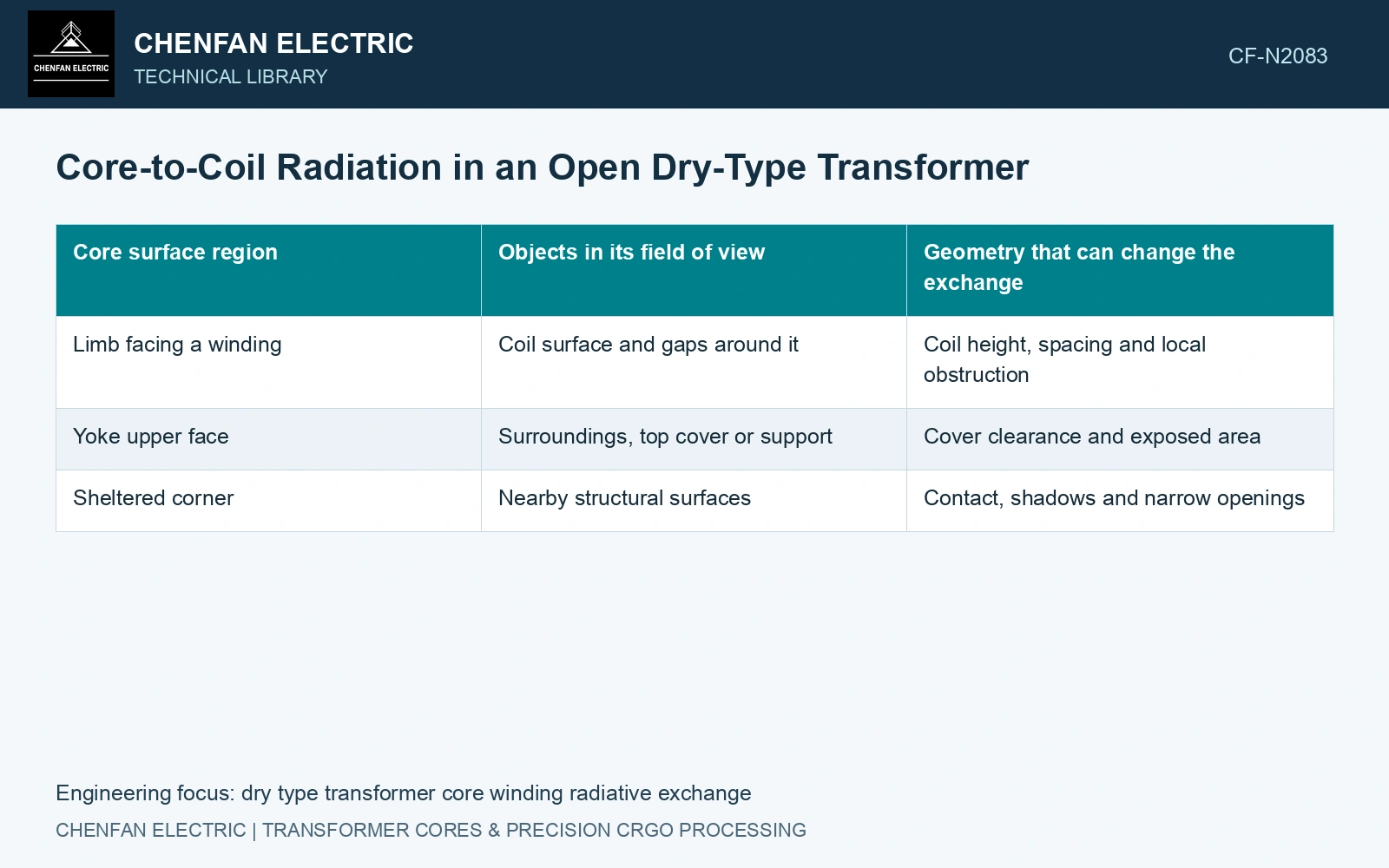
| Core surface region | Objects in its field of view | Geometry that can change the exchange |
|---|---|---|
| Limb facing a winding | Coil surface and gaps around it | Coil height, spacing and local obstruction |
| Yoke upper face | Surroundings, top cover or support | Cover clearance and exposed area |
| Sheltered corner | Nearby structural surfaces | Contact, shadows and narrow openings |
Split surfaces where temperatures or visibility differ materially. Check geometry resolution when evaluating view factors; a narrow gap omitted from the mesh can change the represented opening. Supports that block radiation should appear in the map even when they generate no electrical loss.
Use surface temperatures and absolute units
Radiative emission scales with absolute temperature to the fourth power. Use kelvin in that calculation. Surface emissivity must describe the relevant finish and temperature range; an infrared-camera setting is not automatically an independently established thermal-model input.
For two surfaces forming a complete idealized enclosure, a gray-surface resistance network can combine emission, reflection and mutual exchange. An open core-and-coil assembly also exchanges with other surfaces and the surroundings. Applying a two-surface formula with an arbitrary partial view factor can omit those reflected and external contributions.
Keep radiation separate from the airflow calculation
Natural convection transports heat through air motion. Radiation transfers energy between visible surfaces. Changing coil spacing can affect both mechanisms, but their contributions should remain separately identifiable before they are combined in the heat balance.
Use core and winding surface temperatures from a consistent coupled solution or controlled measurements. If coil temperature is prescribed, state that boundary and examine its credible range. A room-temperature winding in the model can give the core a cooling path that does not exist under load.
For an assumed 100 kg region of 23ZH90 at 1.7 T and 50 Hz, the catalogue strip-source budget is 90 W. [3] Assume a two-surface radiation screen with ideal black surfaces, view factor 0.6, area 1.0 m², core surface at 373.15 K and coil surface at 353.15 K. Using σ = 5.670374419 × 10⁻⁸ W/(m²·K⁴), net core-to-coil radiation is 130.45 W. This exceeds the 90 W assigned source, so those assumed temperatures cannot describe a steady isolated core node with only that source. Reconcile other receiving surfaces, conduction and coil heating before accepting the model; a prescribed-temperature radiation result is not an energy-balanced core prediction.
Joint quality and clamping set part of the magnetic source, while exposed packet geometry and support coverage set radiating area and view. Do not change both without rebuilding the source and surface energy balance.
Compare the complete assembly at the intended duty, including covers and screens. Report net radiative exchange by core region alongside the connected airflow.
References
- Z. Chen, Z. He and S. Wang, Transformer Iron Core Temperature Field Calculation Based on Finite Element Analysis, Energies 18, 6537, 2025. DOI: 10.3390/en18246537.
- U.S. Department of Energy, DOE-HDBK-1012/2-92, Thermodynamics, Heat Transfer, and Fluid Flow, Volume 2, 1992.
- Nippon Steel Corporation, Grain-Oriented Electrical Steel Sheets, catalogue D004je, April 2020, specification and typical-property tables.