


Transformer Core Engineering Notes · CF-N268
A transformer delivered before a building is complete can face conditions unlike its final operating environment. Rain entry, condensation, dust, vibration and nearby construction activity should be considered before the equipment arrives. Storage requirements need to be agreed with the OEM and recorded as a controlled project phase, not treated as an informal wait before commissioning.
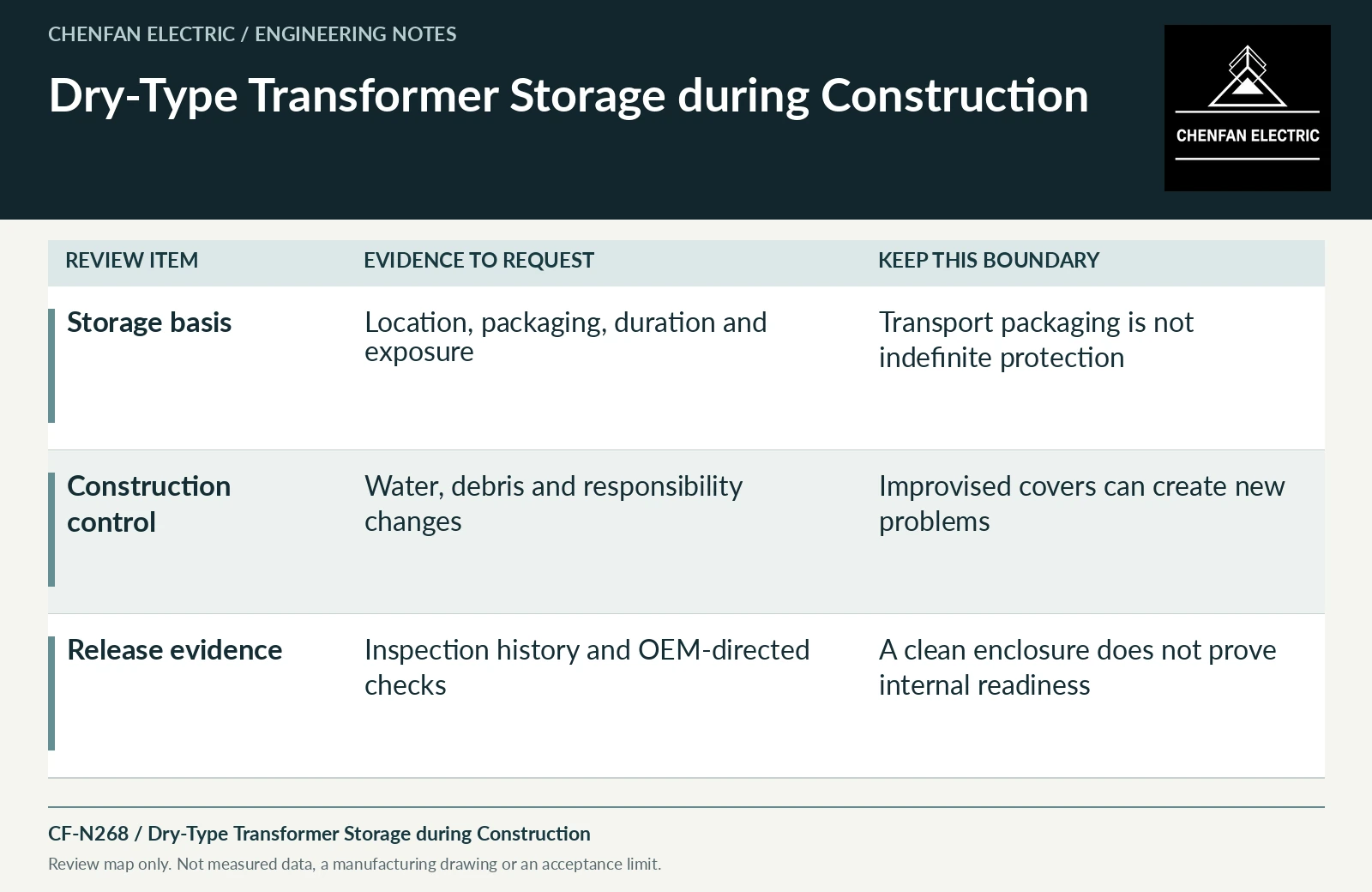
Define the storage environment separately
Specify whether the unit will remain in its transport packaging, enter a finished room or be held in temporary storage. Identify temperature, moisture and contamination exposure relevant to the equipment. Packaging designed for transport is not automatically suitable for indefinite storage. Follow the product-specific instructions and clarify any maximum duration or inspection obligations with the supplier instead of inventing one storage rule for all dry-type constructions.
Manage construction interfaces
Plan protection from water-bearing work, airborne debris and activities that could damage the enclosure or insulation. Preserve required ventilation and avoid introducing a condensation trap through improvised wrapping. Temporary heaters or other protective measures must be approved for the equipment and site. The storage plan should name the party responsible for maintaining protection when contractors change or work shifts to a different area.
Keep an exposure and inspection record
Record delivery condition, storage location changes, packaging damage and any known water or contamination event. Use the OEM’s approved inspection requirements and retain photographs with dates. An apparently clean external enclosure does not prove the internal insulation was unaffected. Report abnormal exposure promptly so the manufacturer can define the necessary assessment rather than discovering the history only on the planned energization date.
Require a release decision before commissioning
The commissioning team should review the storage history and complete the applicable product-specific checks. Cleaning, drying or diagnostic work must be specified by qualified personnel for the actual insulation system; this article provides no improvised recovery procedure. Resolve departures from the agreed storage conditions with the OEM. A completed building does not, by itself, establish that a previously exposed transformer is ready for service.
| Review item | Evidence to request | Boundary to preserve |
|---|---|---|
| Storage basis | Location, packaging, duration and exposure | Transport packaging is not indefinite protection |
| Construction control | Water, debris and responsibility changes | Improvised covers can create new problems |
| Release evidence | Inspection history and OEM-directed checks | A clean enclosure does not prove internal readiness |
References and scope
- IEC 60076-11:2018 — Dry-type transformersPublic standard abstract · Dry-type requirements and classification within the standard’s voltage/product scope; not a blanket reference for every LV product.
- Dry-Type Transformers 1000 Volts and Below — Instruction Bulletin 43006-850-01Manual listing / metadata only · Example of why handling and installation instructions must match the actual product and voltage range.
- Moisture protection of transformer insulation materialsManufacturer technical page · Moisture-sensitive handling, storage and protection of cellulosic insulation.