

A distribution SST can consume power while delivering little or no active power. Control supplies, cooling, energized magnetic components and switching can all contribute according to the actual operating mode. The relevant measurement is not automatically equivalent to a conventional transformer’s core no-load loss.
Define the state the application requires. A blocked converter, an energized ready state and an output-regulating state can have different consumption and different availability.
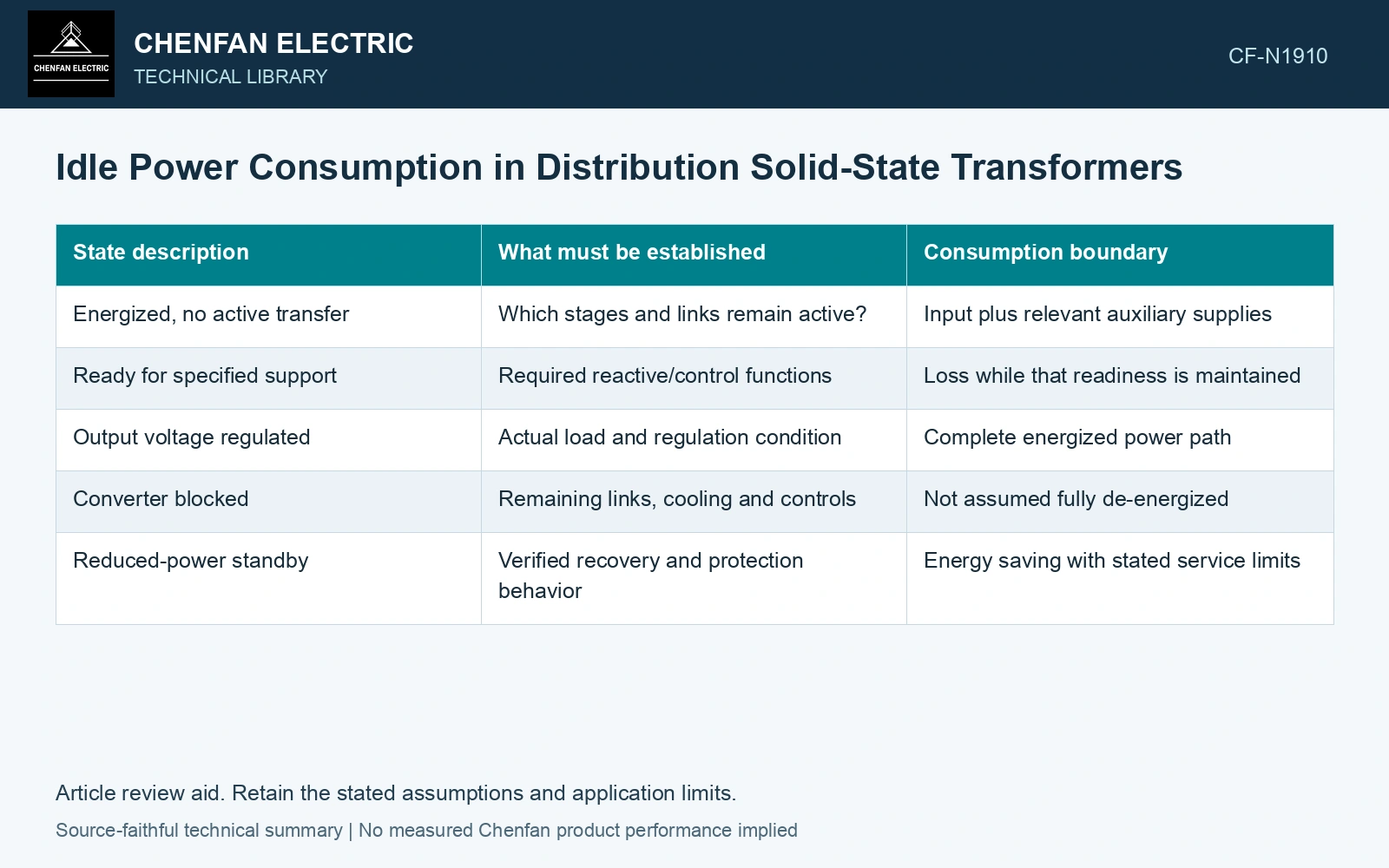
Give idle states functional names
| State description | What must be established | Consumption boundary |
|---|---|---|
| Energized, no active transfer | Which stages and links remain active? | Input plus relevant auxiliary supplies |
| Ready for specified support | Required reactive/control functions | Loss while that readiness is maintained |
| Output voltage regulated | Actual load and regulation condition | Complete energized power path |
| Converter blocked | Remaining links, cooling and controls | Not assumed fully de-energized |
| Reduced-power standby | Verified recovery and protection behavior | Energy saving with stated service limits |
The labels should follow actual hardware/control states. A brochure term such as standby is not a circuit definition.
Partition losses without assuming them
A proposed loss ledger can include auxiliary supplies, fans or pumps, semiconductor-related loss, filters and medium-frequency magnetic components. Measure or justify each contribution under the defined state. Some contributions interact, so summing separate component tests may not reproduce total installed input.
Thermal condition matters. Cooling consumption can change as the unit reaches equilibrium or follows another control mode. A short initial measurement may not represent sustained idle service.
Compare the whole readiness requirement
If one alternative enters a low-consumption blocked state but cannot immediately provide the required support, compare that service limitation with an alternative remaining active. The comparison is meaningful only when both serve the same availability objective.
Huber and Kolar discuss the loss consequence of complete conversion paths [1]. Predescu and Roșu distinguish the stages and functions in SST architectures [2]. Use those actual stage identities to name what remains enabled, then measure input and auxiliaries for the required readiness; neither review supplies this product’s standby consumption.
Turn mode time into energy
For a state consuming Pidle watts for t hours, energy is Pidle t watt-hours. With several states, sum each measured power multiplied by its actual duration: Σ(Pidle,k tk), in watt-hours. Include transition energy if frequent cycling makes it material.
The time distribution should reflect the real service, not assume the lowest-consumption mode all year. Frequent return to full operation can also change temperature and component duty.
Assume an SST consumes 300 W in an enabled idle state and 40 W in a qualified sleep state. Over an assumed 12 h daily idle window, energy is 3.60 and 0.48 kWh, a 3.12 kWh daily difference. The annual arithmetic is 1,138.8 kWh over 365 such days, excluding transitions and availability requirements. Check restart time, protection and retained service functions before selecting sleep operation; “zero load” on the output does not imply zero grid energy.
The final record should identify the modes, measured input boundary and readiness each provides. This allows a buyer to judge idle energy without confusing reduced consumption with unchanged service. A zero active output is a loading condition; it is not evidence that the SST has stopped using energy.
References
- J. E. Huber and J. W. Kolar, Solid-State Transformers: On the Origins and Evolution of Key Concepts, IEEE Industrial Electronics Magazine 10(3), 2016. DOI: 10.1109/MIE.2016.2588878.
- D.-M. Predescu and Ș.-G. Roșu, Solid State Transformers: A Review—Part I: Stages of Conversion and Topologies, Technologies 13, 74, 2025. DOI: 10.3390/technologies13020074.