

A desert transformer specification needs more than a maximum ambient-air temperature. Solar exposure, local cooling-air conditions, dust accumulation and the load schedule influence the installed thermal duty. The enquiry should describe the heat-rejection environment at the transformer, including conditions during the hours when current is highest, rather than relying on a single weather statistic.
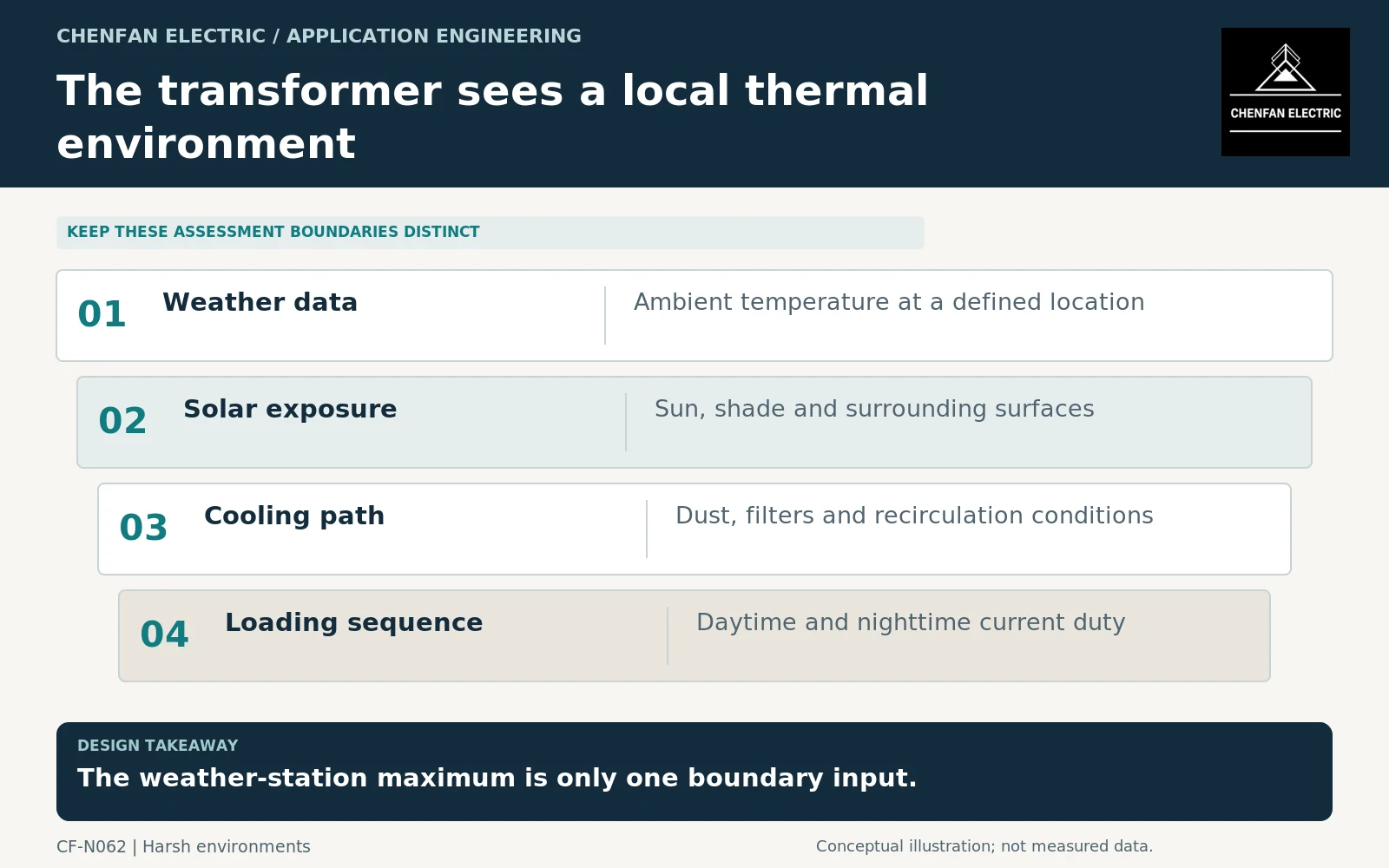
Distinguish weather data from equipment inlet conditions
State how the site temperature data were obtained and which values are used for design. Then describe the installation: direct sun or shade, open air or enclosure, nearby heat sources and possible recirculation. The transformer may not receive air at the same temperature as a remote weather sensor.
General transformer requirements provide an equipment framework. The cited IEC 60076-2 temperature-rise provisions are specifically for liquid-immersed transformers; dry-type equipment requires its own applicable framework. In either case, the project must supply unusual service and installation conditions. [1] [2]
Solar exposure is a separate heat input, not a reason to invent a fixed temperature adder for every desert installation. A shaded enclosure, an exposed tank and a tightly packed equipment yard can require different assessment. The responsible thermal design should identify the method and assumptions used.
The same discipline applies to the ground and surrounding structures. Reflective or heat-storing surfaces may affect the local environment, but a general article cannot assign their contribution without site geometry and material information.
Combine dust and cooling availability with the load sequence
Dust can affect ventilation paths, filters and heat-transfer surfaces. The specification should identify the expected exposure and the maintenance basis used to preserve cooling performance. A clean-condition rating should not silently become a guarantee under unlimited fouling.
For fan-assisted equipment, state which cooling stages are available and what happens if they are lost. The cited fan standard addresses defined accessories of liquid-immersed power transformers and reactors; they do not validate the complete site’s air path or maintenance regime. [3]
The loading schedule must include nighttime operation. Photovoltaic (PV)-associated equipment may carry reactive current after sunset, while industrial or storage duty may peak at night. Cooler air can improve the boundary condition, but it does not remove the current duty or the temperature history from the preceding day.
A useful case register combines the same timestamp for current, local cooling condition and equipment availability. Do not construct an impossible worst case by combining unrelated extremes, but do retain credible hot, dusty and high-load periods that the installation must support.
Write a maintainable thermal requirement
The enquiry should state exposure, enclosure arrangement, cooling inlet assumptions, electrical duty and the condition under which maintenance is expected. Ask the supplier to distinguish clean reference performance from any agreed fouling or reduced-cooling case.
Mineral-oil loading guidance addresses the effects of loading and ambient conditions within its scope. It should be used with actual chronological inputs, not as a source of a universal desert derating factor. [4]
Acceptance should verify the installed arrangement against the assessed one: air paths, shade features, spacing interfaces and monitoring locations. A field layout change can matter even when no electrical rating changes.
The operational handover should identify which observations indicate that the cooling assumptions may no longer hold, such as blocked airflow or unavailable equipment, and refer to the approved response. It should not rely on a vague instruction to clean equipment “regularly” without an agreed maintenance basis.
A defensible desert specification explains the local heat path and the conditions required to maintain it. “Designed for hot countries” does not provide that information, and a high ambient rating alone does not settle the effects of sun, dust and the actual load cycle.
Core procurement checkpoint: Use the desert thermal design, not a country label
A desert project should reach the core supplier as an approved equipment design with defined interfaces and inspection conditions. Keep any core-loss comparison separate from the manufacturer’s complete thermal assessment, including enclosure and solar exposure. The core order should also specify storage and packing requirements where relevant; a steel certificate is not evidence that a fan or site ventilation path can perform in dust and heat.
For the core enquiry: Approved core geometry; specified test conditions; storage/packing requirements; clamp boundary; owner of enclosure and cooling validation.