

Transformer fire behavior, room containment and data-center availability are related but distinct design questions. A dry-type designation, an insulating-liquid property or an equipment test does not establish the complete facility’s fire strategy or continuity of service. Define the equipment evidence and the building-level containment and recovery boundaries separately, then review the interfaces between them.
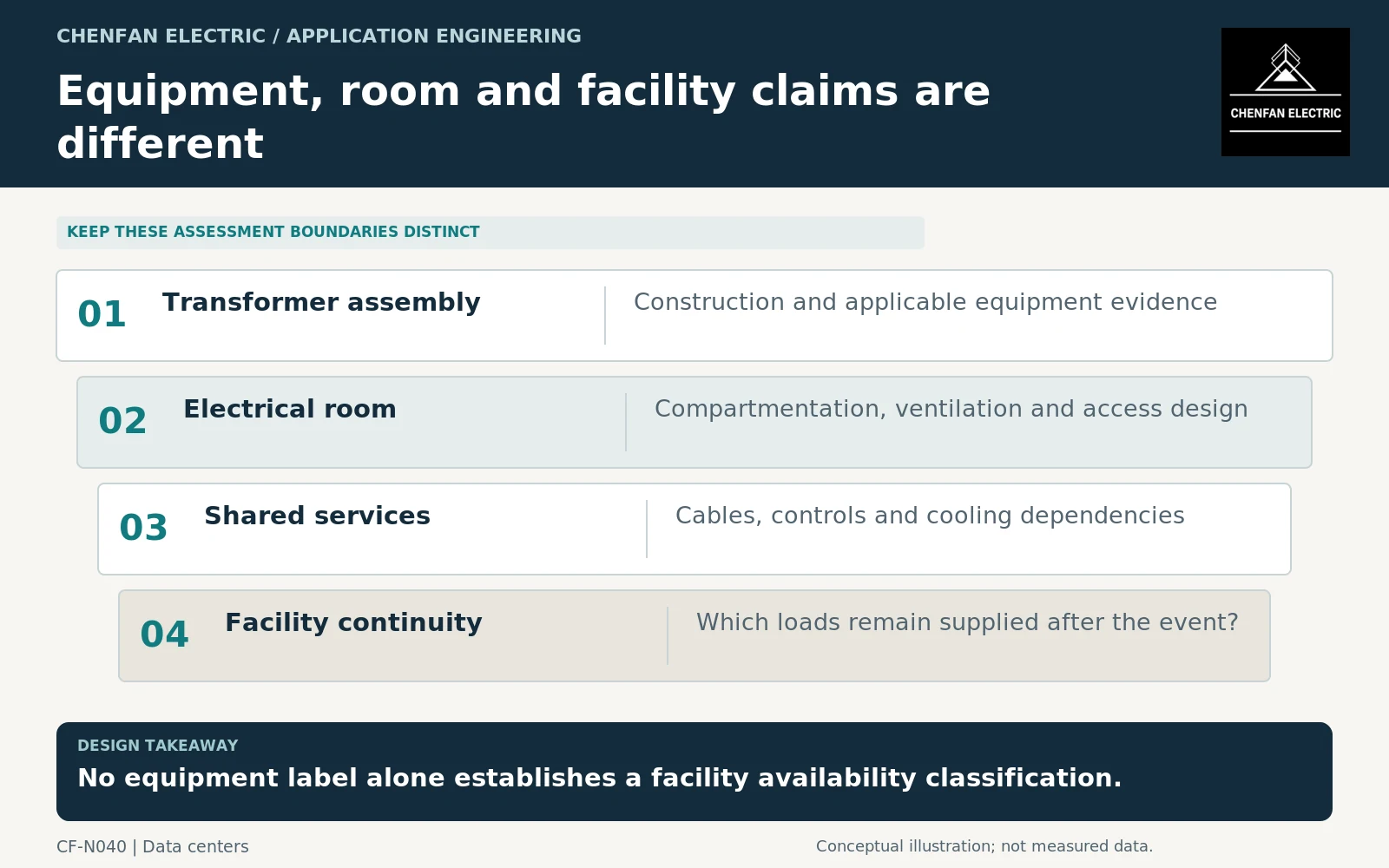
Keep the evidence at its proper level
IEC 60076-11 includes dry-type transformer requirements and relevant environmental and fire-behavior classifications within its scope. Those classifications do not certify building compartmentation, smoke management or a data-center availability level. [1]
Likewise, a favorable property of an insulating medium is not evidence that the complete installed assembly has received every required approval. Tank design, accessories, surrounding equipment and installation conditions remain relevant.
The procurement record should identify exactly what each certificate or test covers: material, component, transformer assembly or installed system. Do not extend a component claim into a facility-wide assurance.
Define the containment boundary with the building team
The electrical and fire-safety designers should coordinate room arrangement, ventilation interfaces, cable penetrations, access and any required separation. These are project-specific building and safety decisions, not dimensions that can be supplied generically in a transformer article.
Ask which event the design intends to contain and which neighboring systems must remain available. A room boundary can be compromised functionally by shared services even when the transformer units themselves are physically separate.
| Boundary | Question to resolve |
|---|---|
| Equipment | What construction and test evidence applies? |
| Room | What containment and ventilation strategy is approved? |
| Cable routes | Which essential circuits share the affected zone? |
| Cooling and controls | Which other equipment depends on common services? |
| Recovery | What inspection and restoration boundary follows an event? |
General transformer requirements establish an equipment framework. They do not replace the building’s applicable fire and installation design. [2]
Examine common-cause availability effects
Two transformers can provide electrical redundancy while sharing a room, ventilation system, cable route or auxiliary supply. An event affecting that common dependency may remove both paths. The availability review should therefore follow physical and service boundaries as well as the single-line diagram.
Do not assume that remaining transformers can accept all transferred load after an event. The surviving buses, cables, cooling and protection configuration must support that duty. Any contingency loading assessment should use the appropriate transformer construction and stated duration. [3] [4]
The goal is not to promise that no event can interrupt service. It is to identify credible common dependencies and make the resulting continuity limits visible before the layout is fixed.
Make acceptance claims narrow and testable
The equipment supplier should provide the specified construction and test evidence. The building disciplines should provide the approved installation and containment design. The facility integrator should demonstrate consistency between physical separation, electrical transfer and operational response.
Avoid statements such as “this transformer guarantees Tier-level availability” or “dry type means no fire risk.” Such claims exceed the equipment evidence and obscure the actual design responsibilities.
The useful handover is a boundary map linked to equipment certificates, room drawings, shared-service schedules and operating restrictions. It shows what is protected, what remains available and what requires assessment before restoration. That is a defensible basis for fault containment and continuity planning without turning one transformer feature into an unsupported facility guarantee.
Core procurement checkpoint: Do not turn a core certificate into a fire-performance claim
Electrical-steel and core inspection documents should be described at their actual supply boundary. They do not certify the fire behavior, fault containment or service availability of a completed data-center transformer. Any core assembly interfaces relevant to the selected equipment design should be released by the transformer manufacturer, with fire and installation acceptance addressed in the complete-equipment procurement package.
For the core enquiry: Core drawing and material specification; supplied insulation/component list; traceability requirements; explicit exclusion of complete-equipment fire qualification.