

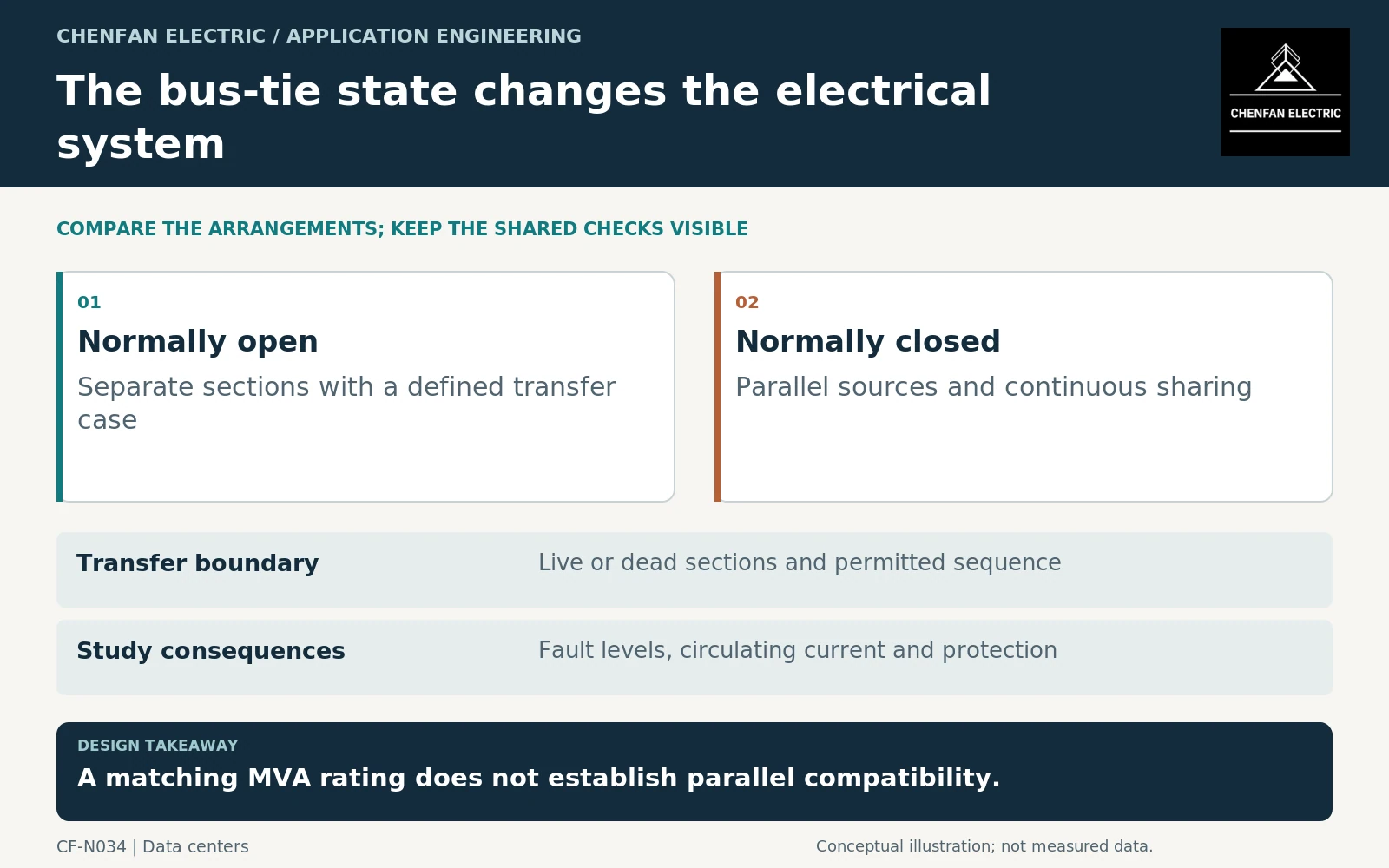
A normally open bus tie and a normally closed bus tie create different transformer duties and protection conditions. The former usually separates sections during normal operation and requires a defined transfer case. The latter can place transformers in continuous parallel operation. Choose the topology only after checking load sharing, fault levels, connection compatibility and the consequences of the permitted switching states.
Describe the normal state and the transfer state
Draw both normal and contingency configurations. Identify which sources are connected, which buses remain energized and whether a transfer can involve overlap. A single-line diagram showing only the normal state leaves important operating cases undefined.
Do not infer the switching procedure from this comparison. Live-bus transfers, synchronizing and isolation require an approved system design and operating procedure based on the actual equipment.
Transformer application guidance includes parallel-operation considerations and voltage behavior. It provides the equipment context, but the project’s topology and protection design determine which states are permitted. [1]
Check compatibility before continuous paralleling
Matching rated power is not sufficient. Review winding connections and phase relationships, ratios and tap positions, impedance values and their bases, and relevant tolerances. Unequal characteristics can affect load sharing and circulating current.
A transformer pair that shares adequately at one tap arrangement may need reassessment after a ratio change. The control philosophy should prevent incompatible regulating actions and identify how tap positions are coordinated where necessary.
| Normal-open emphasis | Normal-closed emphasis |
|---|---|
| Transfer capability after a source loss | Continuous current sharing |
| Remaining section capacity | Parallel-source fault contribution |
| Re-energization or load-pickup event | Ratio and impedance compatibility |
| Permitted temporary configuration | Coordinated voltage regulation |
These are priorities, not mutually exclusive requirements. A normally open system may still allow temporary paralleling, which creates a parallel-operation case that must be assessed.
Review fault and thermal consequences together
Connecting two sources can change available fault current and protection coordination. The transformer thermal rating does not establish the switchgear interrupting capability or the selectivity of the combined system.
After an outage in a normal-open arrangement, one transformer may carry transferred load for an extended period. The required duration, ambient conditions and cooling availability should be stated explicitly. Use the loading guide appropriate to the transformer construction rather than assuming a universal emergency allowance. [2] [3]
Include common auxiliary supplies and cooling systems in the contingency review. A transfer plan depending on equipment that is lost with the failed source does not provide the intended continuity.
Freeze the allowed topology in the equipment schedule
The procurement package should list all permitted connection states, corresponding transformer currents and the study assumptions for each. Identify prohibited states clearly. The implemented controls and interlocks should be reviewed against that approved topology by the responsible project team.
Require transformer offers to provide the ratio, connection and impedance information needed for the parallel assessment. General transformer requirements apply to the equipment, but they do not certify the complete bus-tie scheme. [4]
The final decision should explain why the chosen normal state suits the facility’s availability and operating requirements. “Normally closed is more reliable” and “normally open is safer” are both incomplete claims without the system studies and permitted operating boundaries that make them meaningful.
Core procurement checkpoint: Do not use identical cores as evidence of parallel compatibility
Two units built with the same electrical steel or core outline are not automatically suitable for parallel operation. The transformer manufacturer must establish the complete electrical compatibility and operating restrictions. Core procurement should preserve the approved design reference, matched dimensions where required and separate unit traceability, without converting a shared lamination schedule into approval of the bus-tie operating mode.
For the core enquiry: Approved transformer design IDs; core drawing revisions; matching requirements; unit and packet traceability; inspection scope.