

Two cores can start with the same steel grade and finish with different loss and exciting current.
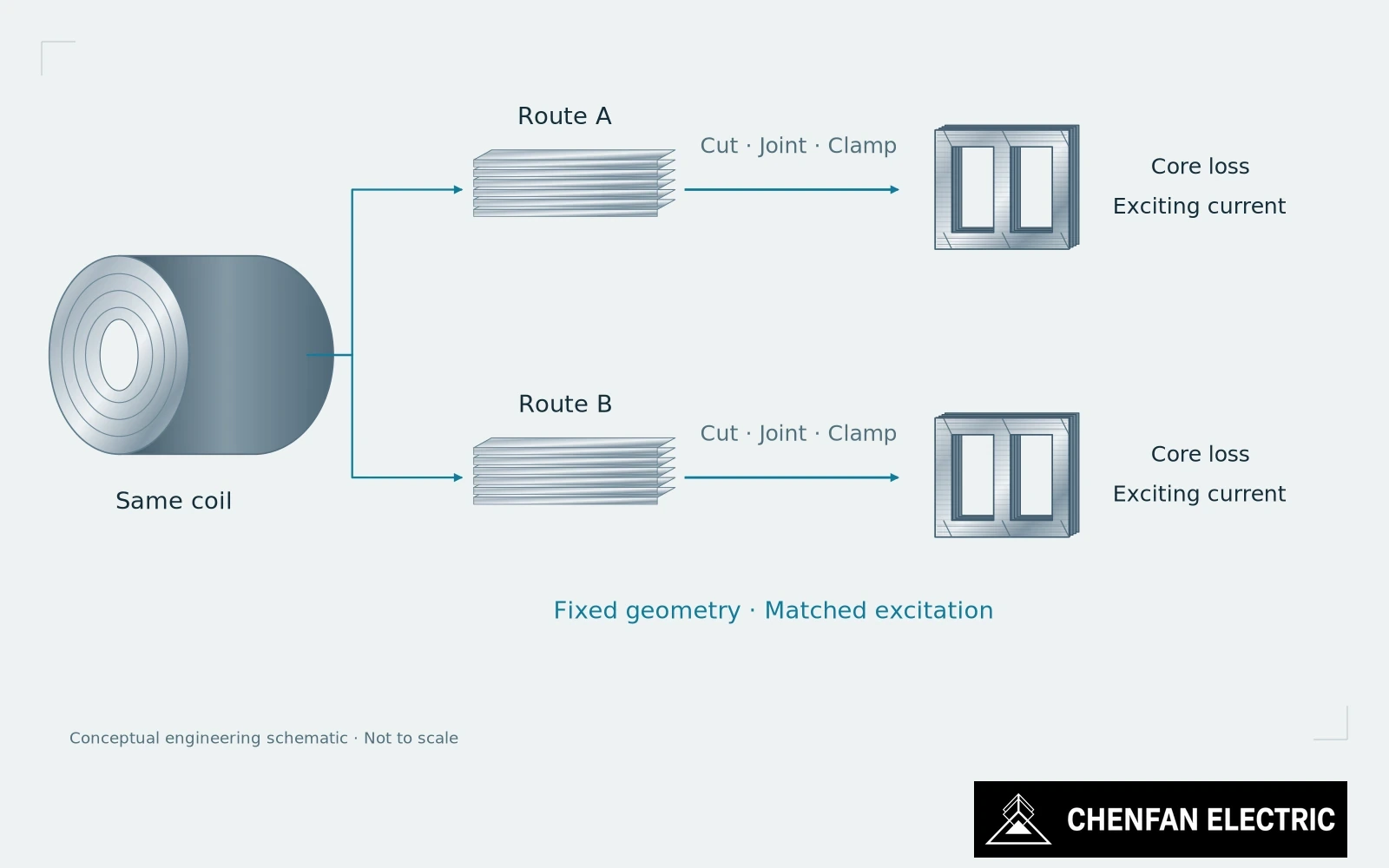
Before comparing suppliers, make that comparison harder: use material from the same coil.
Control the steel before comparing the process
A grade identifies a specification window. It does not mean two coils have identical measured properties. A split-coil trial removes much of that ambiguity and puts the manufacturing route under examination.
Keep the drawing, net iron area, lamination sequence and excitation conditions fixed. Then examine what each route does to the magnetic circuit.
Shearing introduces deformation near the cut edge. Joint assembly determines where flux must leave its preferred rolling direction or transfer between sheets. Clamping establishes a stress state that can change magnetization behaviour. Damaged insulation or conductive bridges can introduce additional current paths, but a visible edge mark alone does not prove that such a path exists.
Read loss and exciting current separately
These mechanisms leave different signatures. A reluctance problem can raise exciting current without a proportionate increase in measured watts. An interlaminar fault can produce localized heating that a dimensional inspection misses. Neither signature identifies the cause by itself.
That is why a useful comparison records both loss and current, rather than selecting whichever number supports the purchasing decision.
There is another control that often gets overlooked: the test boundary. A temporary winding and fixture do not automatically reproduce the completed transformer’s no-load test. Identify winding losses, instrument contributions, clamping state and the method used to establish flux density before interpreting a difference.
For a supplier qualification trial, I would retain matched material samples, photograph the joint sequence at defined stages, record the clamping arrangement and repeat the magnetic measurement without rebuilding the core. Only then would I investigate changes caused by an agreed handling or reassembly step.
Qualify a repeatable manufacturing route
That sequence separates three questions: was the starting material comparable, was the measurement repeatable, and did the manufacturing route preserve the intended magnetic circuit?
A small difference inside measurement uncertainty does not justify ranking two factories. A repeatable difference under controlled conditions does justify opening the process records.
The purchasing result should be a qualified manufacturing route for that core family, not a conclusion that one company somehow owns a better version of the same grade.
Practical takeaway
A split-coil comparison tests manufacturing influence more cleanly than matching grade names.
Chenfan Electric manufactures custom transformer cores according to customer drawings. Where applicable to the specified material and core design, agreed process controls include burr height below 0.02 mm and stacking factor above 97%. Measurement methods and acceptance conditions are defined for each order.