

A rolling-direction tensile test cannot determine how the same CRGO responds when transverse stress is also present. The second stress can alter the mechanical state while the nominal rolling-direction load remains unchanged. If the intended assembly creates that combination, uniaxial data leave a specific gap.
Label the rolling direction r and transverse direction t on the specimen. Use a consistent sign convention for tension and compression. The magnetic direction and both mechanical directions should remain visible in the trial record, even when the machine reports loads in its own axes.
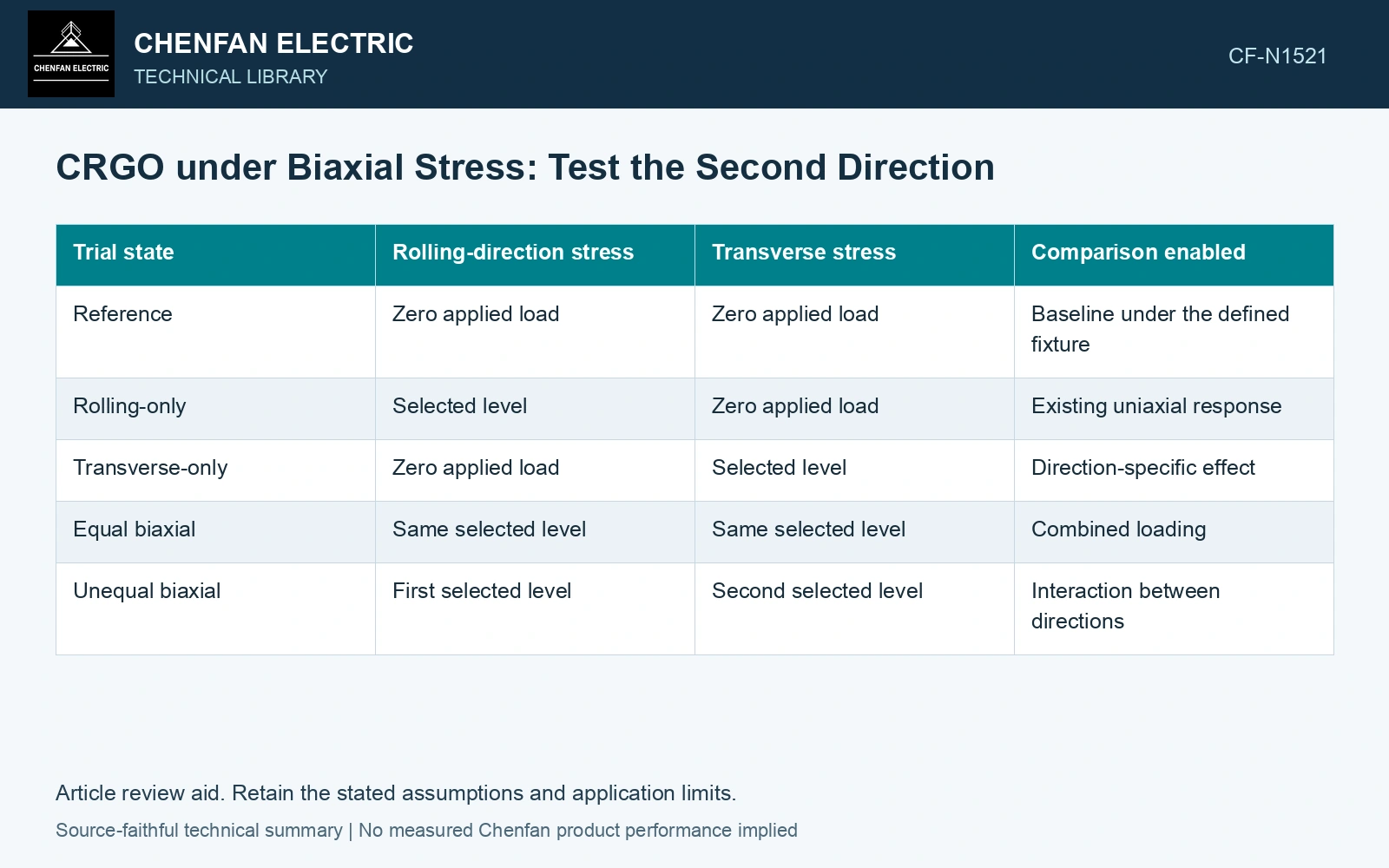
Cross the loads without changing the magnetic comparison
Choose stress levels that the fixture and specimen can sustain in a qualified test. Start with independent changes in each direction, then combine them. Keep specimen temperature, magnetic history and excitation controlled so that the result addresses stress rather than a changed test condition.
| Trial state | Rolling-direction stress | Transverse stress | Comparison enabled |
|---|---|---|---|
| Reference | Zero applied load | Zero applied load | Baseline under the defined fixture |
| Rolling-only | Selected level | Zero applied load | Existing uniaxial response |
| Transverse-only | Zero applied load | Selected level | Direction-specific effect |
| Equal biaxial | Same selected level | Same selected level | Combined loading |
| Unequal biaxial | First selected level | Second selected level | Interaction between directions |
Zero applied load does not mean zero residual stress. Record the received material state and prior handling. The reference provides an operational baseline, not a claim of a stress-free crystal.
Measure the stress where magnetization is evaluated
A biaxial fixture can create nonuniform stress, especially near grips or a specimen’s geometric transitions. Verify the useful central region through a suitable strain measurement and justified mechanical model. Report the magnetic sampling region relative to that region.
Compression introduces an additional challenge because a thin sheet may buckle. Preventing buckling with supports can add friction and transverse restraint. Those effects need qualification; the commanded force alone does not establish the desired sheet stress.
Equal principal values can still mean different material loading
In an anisotropic sheet, the orientation of principal stress relative to rolling direction matters. Compare states with the same principal values but different orientations where the fixture permits. This tests whether a material-direction-dependent response is being hidden by a summary such as maximum stress.
Retain magnetic loss, excitation response and any measured strain behavior as separate outcomes. A change in one is not proof that all improve together. Check reversibility by returning to the reference loading and repeating the magnetic preparation.
The decision is whether the uniaxial model reproduces the response in relevant combined states within its demonstrated uncertainty. If the combined result departs materially from that prediction, introduce the missing directional dependence or restrict the model’s use. Biaxial testing is valuable because it examines that specific transfer, rather than merely adding another stress number to the material sheet.
Technical references
- Materials / MDPI. Magnetostrictive Properties of the Grain-Oriented Silicon Steel Sheet under DC-Biased and Multisinusoidal Magnetizations.
- NIST. NCAL: Diffraction Stress Measurement Under Applied Load.