

A core insulation-resistance result is meaningful only when its electrical nodes, connected components and assembly state are stated. “Core insulation passed” is not enough to compare reports or establish the condition of a different configuration. The test record must describe the object actually evaluated without turning a generic article into a test procedure.
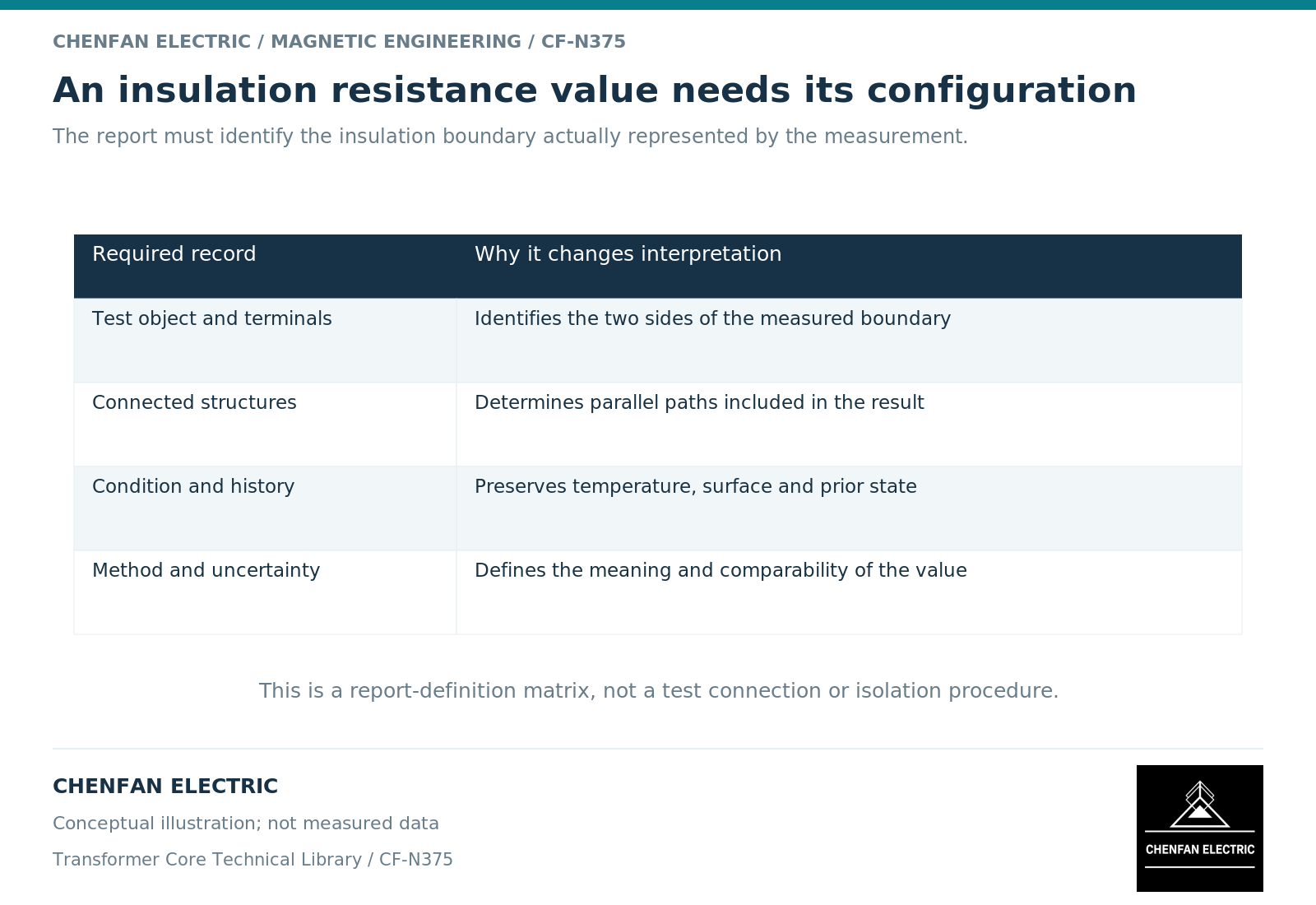
Name the measured interface
Distinguish core to clamp, core to tank, clamp to tank and other project-defined interfaces. Also identify the designated grounding and monitoring connections that form part of the tested state.
An electrical measurement follows the complete network between its terminals, including parallel paths. Core-grounding research illustrates why capacitive and conductive relationships between assembly parts cannot be ignored. [1] A reading attributed to one insulating interface may instead be dominated by another connected route.
The authorized procedure must establish the appropriate configuration. No connection should be opened, moved or restored on the basis of an inferred setup from a previous report.
Preserve the time and environmental definitions
Insulation-resistance measurements can depend on the applied test condition, elapsed reading time, temperature, surface condition and the surrounding insulation system. The record should retain these conditions rather than presenting an isolated resistance number.
State the instrument identity, calibration status where required, range or resolution limitations, and whether the result exceeded the instrument’s displayed range. An over-range indication is not an exact numerical resistance.
General measurement-uncertainty guidance distinguishes the result, its contributing uncertainties and the information needed to interpret the reported quantity. [2] It does not supply a transformer-specific test voltage or acceptance limit.
Compare like configurations
| Record field | Comparison purpose |
|---|---|
| Identified node pair | Confirms that the same interface was evaluated |
| Connected or excluded components | Reveals parallel-path differences |
| Assembly stage and revision | Distinguishes bare core from integrated active part |
| Approved test condition and reading time | Makes the reported value interpretable |
| Temperature and relevant environment | Supports a justified comparison |
| Criterion and decision rule | Explains the acceptance conclusion |
A factory result and a later integration result can both be valid while describing different systems. The first may precede installation of lead supports or clamps that affect the second. Preserve that distinction instead of treating every difference as deterioration or measurement error.
Likewise, an insulation-resistance test between assembly nodes is not a direct test of every interlaminar coating interface. A broad statement that the entire core is electrically defect-free would exceed the evidence.
Separate reporting from authorization
The useful output is a complete record tied to the approved procedure and the responsible review. This article intentionally supplies no test voltage, duration, disconnection sequence or discharge instruction. Those details require the actual equipment, its safety controls and qualified personnel.
If a report omits its configuration, request the missing definition before comparing the value with a previous test. If the configuration cannot be reconstructed, retain the result as limited evidence rather than relabeling it as a known interface test.
A clearly bounded result is more useful than an impressive resistance number with an unknown measurement path. It allows the transformer designer and core supplier to resolve the actual interface question without inventing criteria or drawing conclusions beyond the tested assembly.
References
[1] Xiu Zhou and coauthors / Frontiers in Energy Research. Analytical modeling and calculation of core grounding current in converter transformer (2023).
[2] Barry N. Taylor and Chris E. Kuyatt / NIST. NIST Technical Note 1297: Guidelines for Evaluating and Expressing the Uncertainty of NIST Measurement Results (1994).