

Core-loss ranking depends on the uncertainty of the difference between candidates. Carry shared material-measurement errors through both calculations to determine whether the predicted ordering survives the supported uncertainty. [1]
Work with ΔP = PA − PB. In a suitable local uncertainty model, u²(ΔP) = u²(PA) + u²(PB) − 2 Cov(PA,PB). The covariance must come from the measurement and calculation chain, not from a value chosen to make the ranking look secure.
Separate common movement from differential error
A common scale correction to a material loss curve can shift both core predictions in the same direction. A curve-shape uncertainty can affect designs differently when they use different inductions. Mass uncertainty, joint corrections and processing variation can add further design-specific contributions.
Preserve the curve-level perturbation through both calculations. Running unrelated random loss values for A and B discards shared errors; giving both designs exactly the same perturbation discards differential errors. Neither simplification is automatically conservative for every decision.
Calculate the uncertainty of the difference
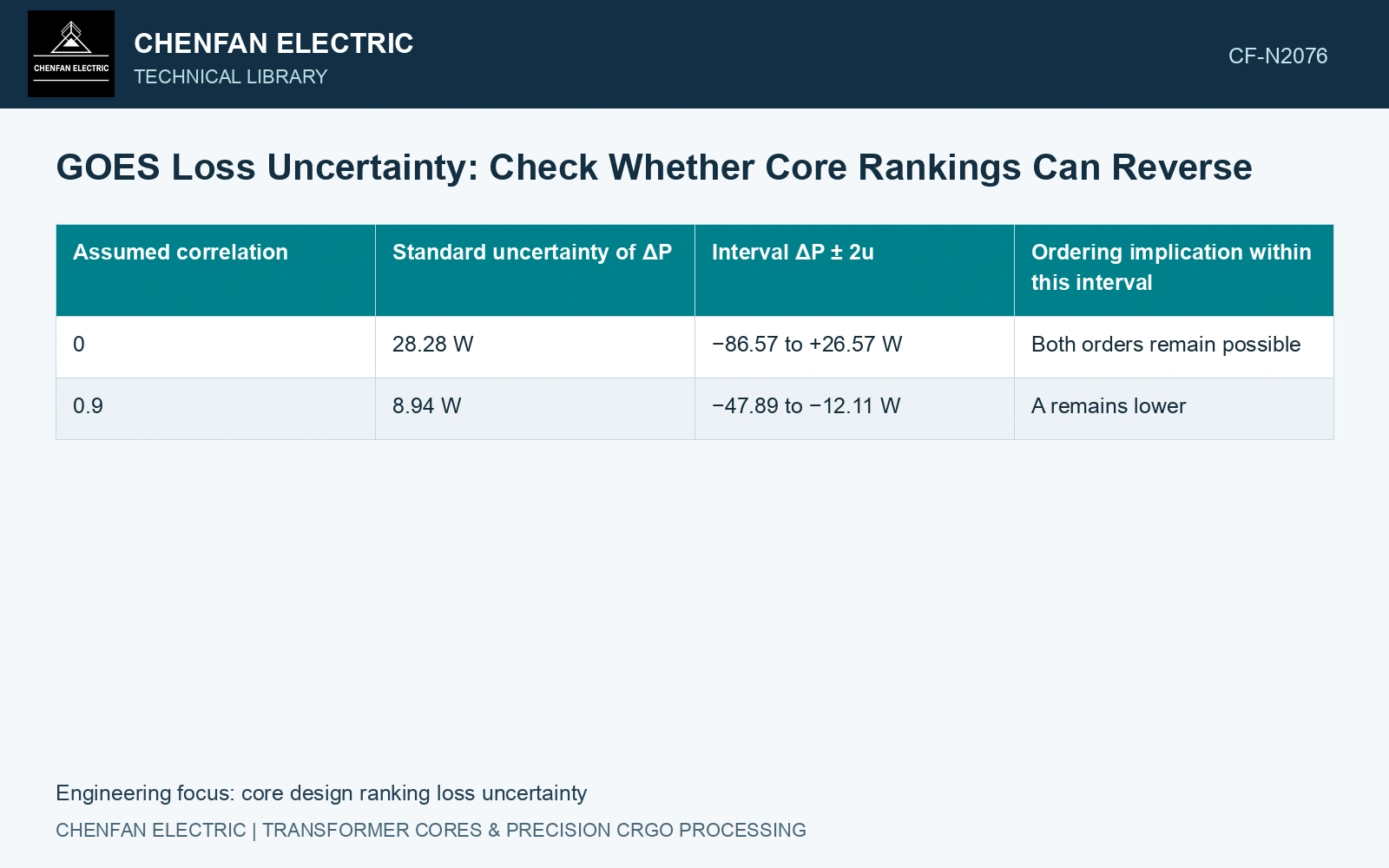
The following illustrative example assumes predicted losses of 1,000 W and 1,030 W, each with standard uncertainty 20 W. The correlation scenarios are hypothetical. Negative ΔP favours A.
| Assumed correlation | Standard uncertainty of ΔP | Interval ΔP ± 2u | Ordering implication within this interval |
|---|---|---|---|
| 0 | 28.28 W | −86.57 to +26.57 W | Both orders remain possible |
| 0.9 | 8.94 W | −47.89 to −12.11 W | A remains lower |
The factor two is an explicitly chosen interval multiplier here. It does not by itself establish a coverage probability. The example shows why correlation matters, not which scenario applies to a real steel test.
Find the measurement region that changes the decision
Evaluate ranking under coherent alternative curves, keeping measured-point uncertainty, interpolation assumptions and manufacturing spread distinguishable. Record the induction and frequency regions responsible for reversals.
If both candidates rely on an uncertain common scale, repeating a measurement designed only to improve that scale may reduce absolute uncertainty more than ranking uncertainty. If a missing high-induction segment affects only one design, targeted measurements there can be more valuable for selection.
At the same 0.23 mm gauge and 1.7 T, 50 Hz condition, Nippon Steel lists maximum specific losses of 0.90 W/kg for 23ZH90 and 0.85 W/kg for 23ZH85. [2] For an assumed equal 1,000 kg steel inventory, the catalogue ceiling budgets are 900 W and 850 W, a 50 W difference. They are ceilings, not two measured means, so their difference alone does not establish the delivered-core ranking. If an independent assumed paired prediction gives a 50 W advantage with 30 W standard uncertainty of the difference, its ±2u interval extends from −110 W to +10 W. Obtain better paired evidence before treating that ranking as resolved.
Cutting stress, overlap registration, burr formation and clamp pressure can add differential manufacturing effects between grades. Match these conditions in the paired trials rather than assigning all variation to catalogue specific loss.
Check excitation and temperature feasibility alongside the loss ordering. Target the measurement region that changes the choice, and base any loss premium on a difference resolved by the available evidence.
References
- B. N. Taylor and C. E. Kuyatt, NIST Technical Note 1297, Guidelines for Evaluating and Expressing the Uncertainty of NIST Measurement Results, 1994, sections 5 and 6.
- Nippon Steel Corporation, Grain-Oriented Electrical Steel Sheets, catalogue D004je, April 2020, specification and typical-property tables.