

An unexpected chemical result after introducing a core-bonding adhesive deserves two investigations: whether the material contributes to the sampled compounds, and whether an operating fault is present. Evidence for one does not automatically resolve the other.
The new material might release residual compounds during conditioning or subsequent heating. It might also react with the liquid. Neither possibility establishes which gases or extractables will appear in a particular transformer. That requires identified materials, representative conditioning and suitable chemical analysis.
Build a blank that contains the real material state
A raw adhesive blank can be misleading if production uses a fully cured joint. Prepare the material with the documented cure and post-conditioning history. Include the steel and original coating where they form part of the exposed construction. Surface area, liquid quantity and headspace should be known.
Run a liquid-only control through the same container and temperature history. Add a coated-steel control without added adhesive. If cleaning or release materials could remain on the packet, investigate them independently rather than attributing every new compound to the adhesive formulation.
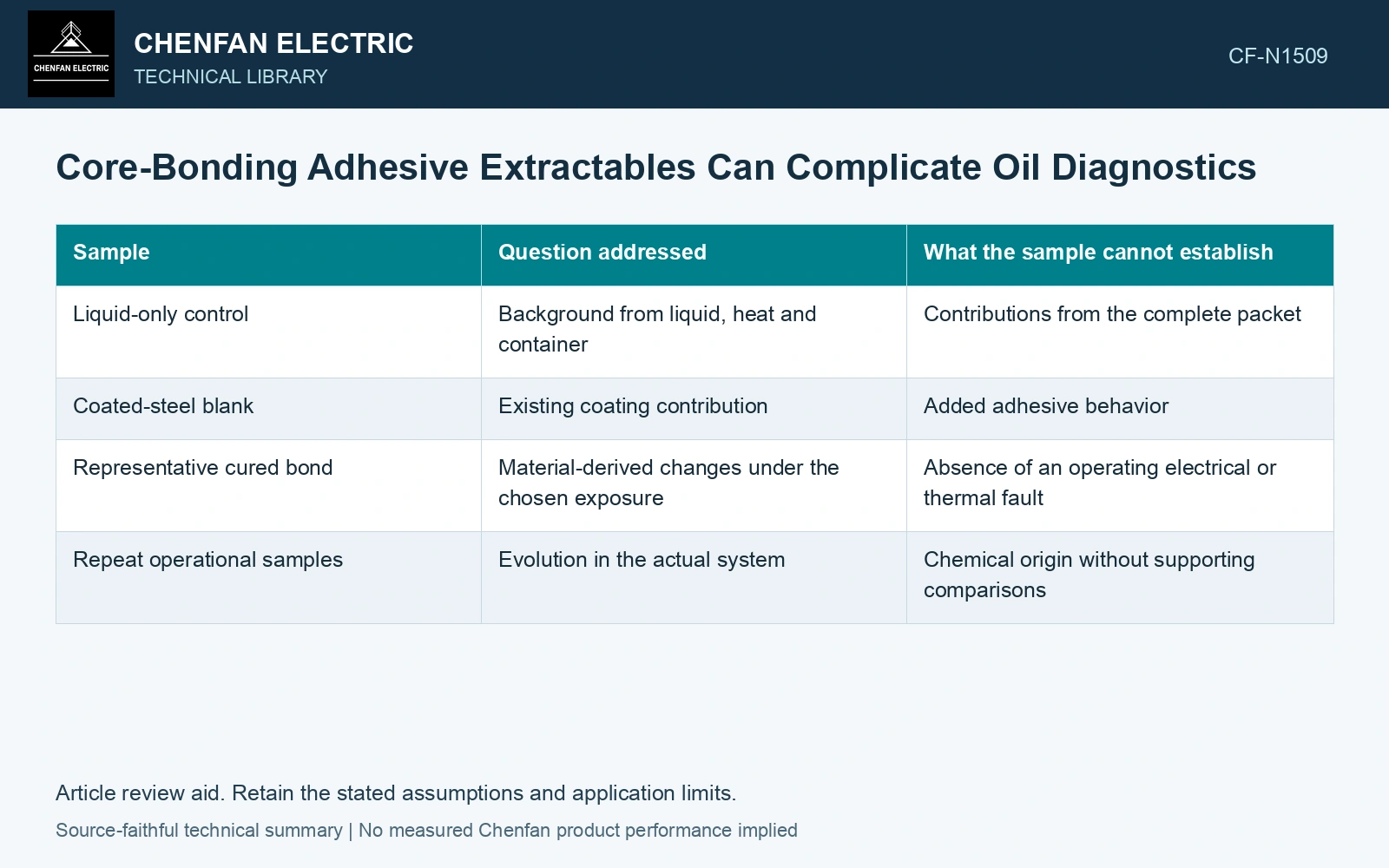
| Sample | Question addressed | What the sample cannot establish |
|---|---|---|
| Liquid-only control | Background from liquid, heat and container | Contributions from the complete packet |
| Coated-steel blank | Existing coating contribution | Added adhesive behavior |
| Representative cured bond | Material-derived changes under the chosen exposure | Absence of an operating electrical or thermal fault |
| Repeat operational samples | Evolution in the actual system | Chemical origin without supporting comparisons |
This matrix helps attribute observations. It should supplement the established diagnostic workflow and sampling practice.
Separate a chemical match from a causal explanation
Finding a compound in both an adhesive blank and operational oil supports a candidate material contribution. It does not prove that all of the operational concentration came from that source. Different temperature, oxygen exposure, liquid volume and sampling histories can change both production and partitioning of compounds.
Some volatile products may occupy the headspace as well as the liquid. Compare like sampling boundaries and record whether analysis concerns dissolved gas, headspace composition, or broader liquid chemistry. These measurements are related but do not report the same quantity.
Check the time pattern and material history
Follow repeated samples where the operating investigation permits. A concentration appearing after a material change and evolving with conditioning provides different information from an abrupt change coincident with an abnormal operating event. Keep the timing of installation, drying, filling, energization and sampling in the record.
Ask whether the blank reproduces the production cure state. An under-cured specimen can release compounds that the finished joint does not, while a laboratory specimen with an extra conditioning step can omit a contribution that remains in production. The comparison should identify this difference rather than hide it.
The appropriate outcome is an attributed or unresolved material contribution alongside the independent condition assessment. Until the evidence is sufficient, do not change alarm thresholds, disregard a gas trend, or label it harmless adhesive outgassing. A good blank narrows the investigation; it does not issue a transformer health verdict.
Technical references
- voestalpine. Backlack: Lamination bonding.
- voestalpine. Backlack: Testing methods and production of test specimens.