

In this illustrative example, three core-and-clamp package rows reconcile to 66,253 kg net and 67,050 kg gross. The difference is 797 kg. That result establishes only the difference between the entered gross and net weights; the available material does not itemize its components.
The method is to verify each row, total the consignment and then match every row to a physical package identifier. The shipment-specific primary records were not available for review, so the figures below are retained as an illustrative example rather than presented as an authenticated Chenfan shipment case.
Three package rows, reconciled individually
| Example row | Net weight (kg) | Gross weight (kg) | Gross − net (kg) |
|---|---|---|---|
| 1 | 22,071 | 22,350 | 279 |
| 2 | 22,096 | 22,350 | 254 |
| 3 | 22,086 | 22,350 | 264 |
| Total | 66,253 | 67,050 | 797 |
The weight arithmetic can be reproduced in two ways:
Net total: 22,071 + 22,096 + 22,086 = 66,253 kg.
Gross total: 22,350 + 22,350 + 22,350 = 67,050 kg.
Total difference: 67,050 − 66,253 = 797 kg.
Row cross-check: 279 + 254 + 264 = 797 kg.
For this example, net weight is defined as the core assembly with its clamps, gross weight as the packed item and container tare as separate. The causal chain is therefore straightforward: the stated assembly scope determines the net entry; items included only in the packed condition increase gross weight; and movement planning uses the applicable packed mass after the physical package has been matched to the correct record.
The example also shows why equal gross weights do not make the rows interchangeable. Although every row shows 22,350 kg gross, the net weights and gross–net differences vary. A package identifier is therefore necessary to connect the correct physical item to its row.
Supply scope represented in the example
The example describes a complete assembled core with core clamps. A receiving record using this scope would need to identify the same configuration consistently in the order, drawing, packing list and handling instructions.
The 40 MVA designation describes the associated transformer application in the supplied example; it is not a separate power rating assigned to a package.
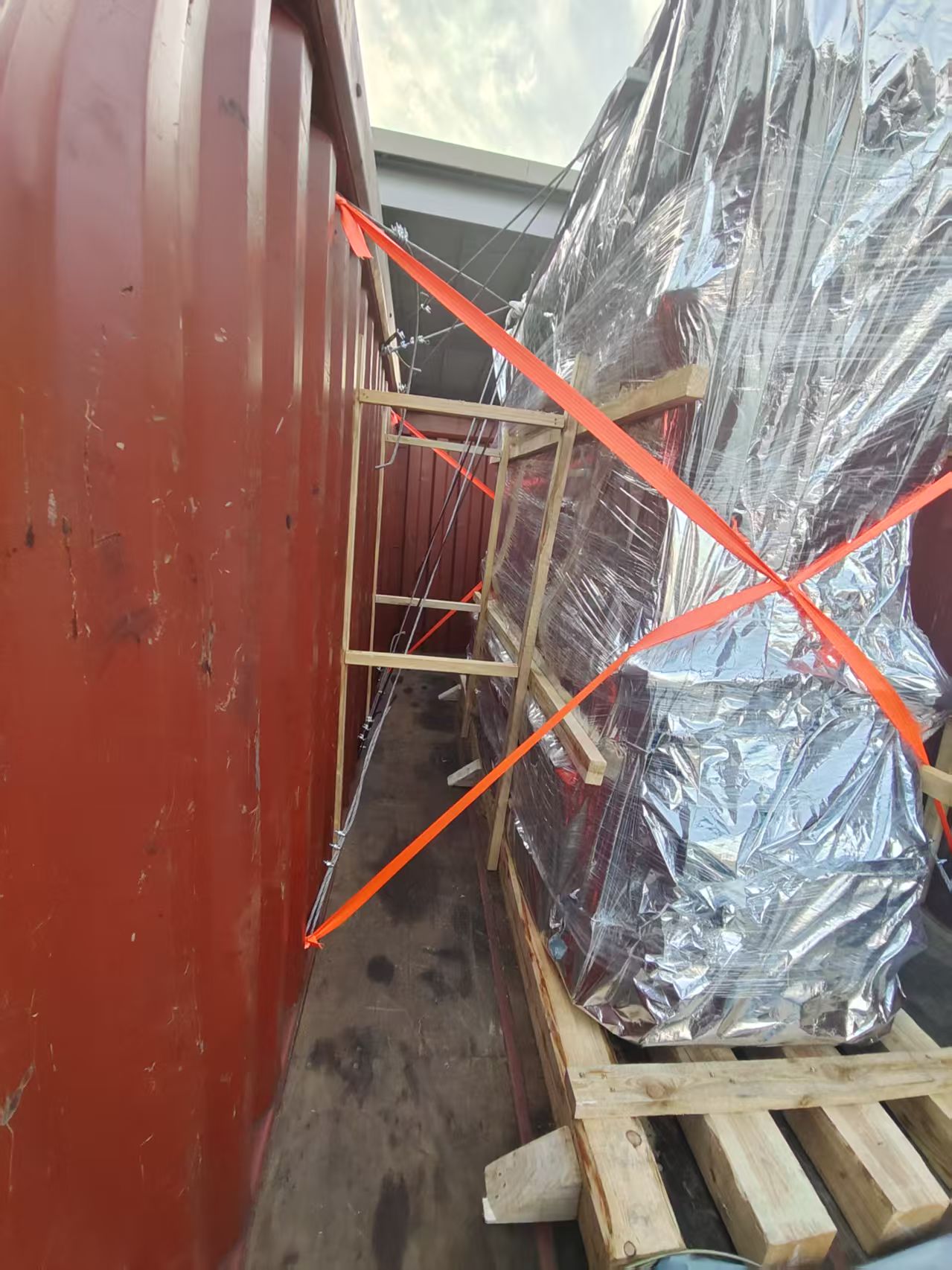
What the displayed photograph establishes
The photograph shows one wrapped assembly standing on a wooden base inside a container. Outer wrapping, clear film, timber members and crossed orange webbing are visible.
The image records visible condition and arrangement only. It does not establish the rated capacity or adequacy of lifting points, supports, webbing or the complete securing system. Equipment and handling decisions require the actual package dimensions, matched gross weight, designated load-bearing points and approved project handling plan. CCOHS gives a general load-dependent selection principle: a lift table should be selected according to the anticipated load’s weight and size [2]. This does not establish that a lift table is suitable for the 22,350 kg packages in this illustrative example.
How to complete the reconciliation at receipt
A manufacturer’s manual instructs recipients to inspect equipment immediately upon receipt [1]. The project documents must then provide the package-specific identity chain needed for these separately shipped assemblies.
- Match the identifier: connect the physical package mark to its packing-list row, assembly or drawing reference and package-linked condition photograph.
- Apply the matched mass: only after that match, use the row’s gross weight—22,350 kg in this example—for movement planning under the approved project handling plan.
- Reproduce both calculations: check each gross–net difference, then confirm 66,253 kg net, 67,050 kg gross and 797 kg difference for the complete example.
- Record visible condition: compare the received package with its corresponding dated photograph and record damage, displacement, missing items or identity conflicts.
- Control revisions: identify the applicable packing list, drawing and handling-instruction revisions before unloading.
The calculation changes the conclusion: “three packages at 22,350 kg gross each” is not a complete reconciliation. The rows form one consignment only after each physical package is tied to its own net weight, gross weight, technical scope and condition record.
References
- [1] Rex Power Magnetics, Dry-Type Power Transformers: Installation, Operation and Maintenance Manual, Doc. IOMM-POW-EN, March 2026, §3.1 “Receiving,” p. 6.
- [2] Canadian Centre for Occupational Health and Safety, MMH—Hoisting and Moving Heavy Objects, fact sheet revised 11 August 2025, section “What equipment can I use to help with moving or lifting heavy objects?”, subsection “Lift tables.”