

Battery energy storage system (BESS) standby should be divided into electrically distinct states before transformer designs are compared. A disconnected unit, an energized unit ready for dispatch and a unit providing reactive support do not impose the same duty. Counting all nondispatch hours as no-load hours—or as zero-consumption hours—can distort the comparison of losses, auxiliaries and operating availability.
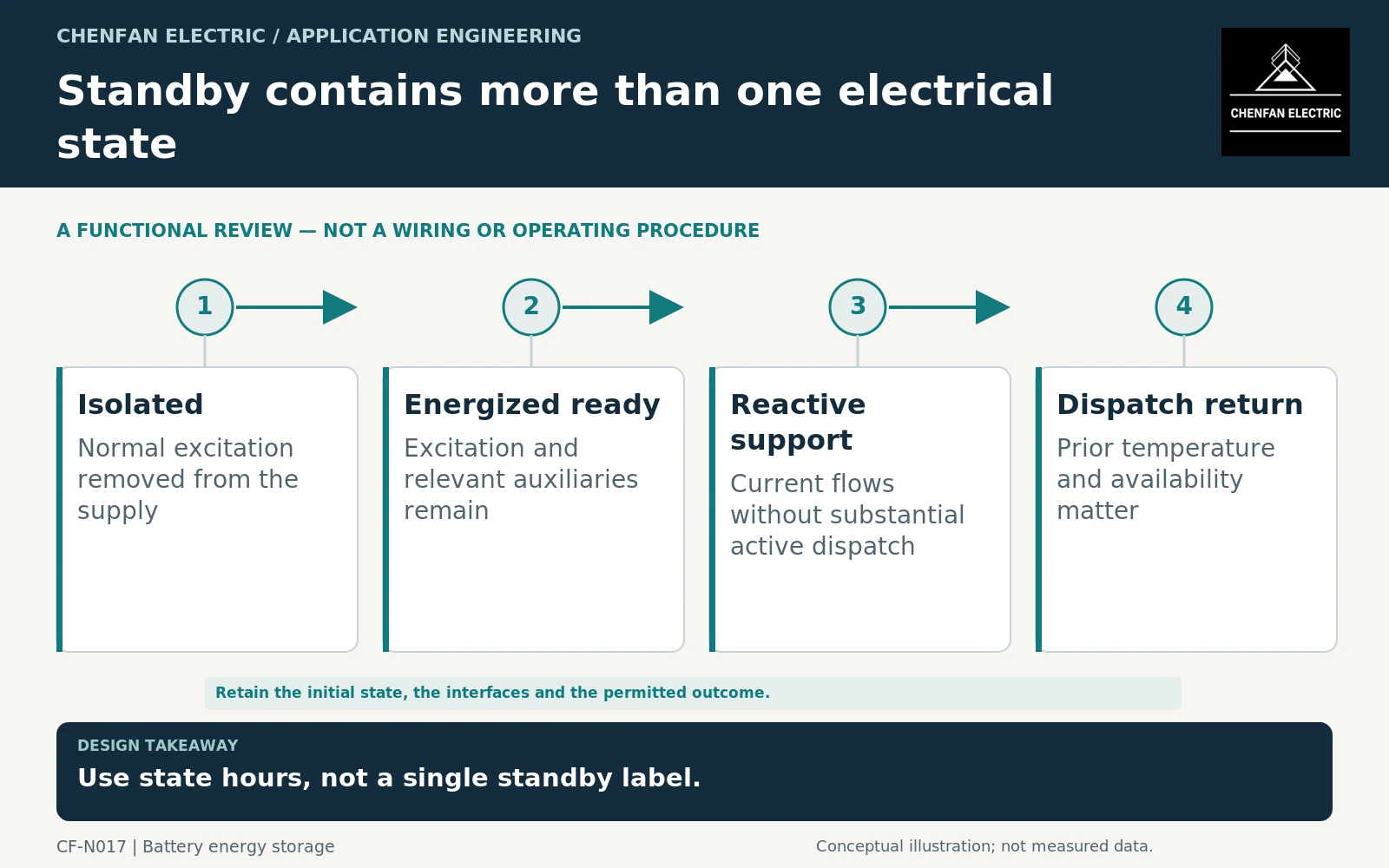
Define what “ready” requires
Record whether the transformer remains connected, which cooling and control systems operate, and whether the power conversion system (PCS) provides voltage support during standby. Include any requirement for rapid dispatch that prevents routine disconnection.
The plant’s availability strategy may favor an energized ready state even when active power is near zero. That is an operating decision with electrical consequences, not evidence that the transformer has no relevant load or auxiliary consumption.
General transformer application guidance supports matching equipment to its operating conditions. It does not define the commercial meaning of standby for a storage project. [1] The operating contract and converter controls must supply that definition.
Keep consumption categories separate
Core excitation, current-related transformer losses, cooling power and other station auxiliaries belong to different categories. Their values may come from different documents and measurement boundaries. Do not add a PCS auxiliary figure to a station figure that already includes it.
For an illustrative accounting example, a constant assumed 4 kW loss over 6,000 energized hours represents 24,000 kWh. The arithmetic is only an energy-accounting illustration; 4 kW is not a measured loss or a claim about a particular transformer. It also excludes any separately varying current-related and auxiliary consumption.
Where standby includes reactive current, the case is not transformer no-load operation. Current magnitude and duration need to be represented separately from the active-energy dispatch schedule.
Compare designs using the same state schedule
| State | Hours to record | Quantities to evaluate |
|---|---|---|
| Disconnected | Time actually isolated | Any independently supplied auxiliaries |
| Energized ready | Connected time without material load current | Excitation and applicable auxiliaries |
| Reactive support | Time at stated P-Q conditions | Winding current and associated consumption |
| Dispatch | Charging and discharging sequence | Current, duration and thermal history |
Use mutually exclusive states so annual hours are not counted twice. A transition period can be assigned its own state when it materially changes consumption or temperature; otherwise explain how it is included.
Do not compare one offer using idealized full-load efficiency with another using an annual loss estimate from a different schedule. Retain the common load profile, voltage assumptions and auxiliary boundary as part of the comparison record.
Review the return from standby
The state preceding dispatch affects initial temperature and auxiliary availability. A transformer that has remained energized with reactive current starts from a different condition than one isolated for a long period. Loading guides address thermal duty using equipment-specific assumptions; a standby label is not a thermal model. [2] [3]
Operational restrictions also matter. If a lower-consumption strategy requires disconnection, identify the associated restoration requirements and whether they fit the dispatch obligation. This does not mean one strategy is universally better; it means the benefit should be compared with the service constraint it creates.
The procurement deliverable should be an annual state schedule, a consumption-boundary diagram and a transparent calculation using supplier-supported inputs. It should identify assumptions separately from guaranteed loss values. That gives a defensible comparison without turning an uncertain standby definition into a precise-looking annual saving.
Core procurement checkpoint: Compare losses at the same supply boundary
When energized hours drive a purchasing comparison, label every loss figure as material, bare core or completed transformer data. Keep frequency, flux density, waveform and assembly state consistent with the stated test method. A CRGO certificate is valuable traceability evidence, but it should not be presented as a guaranteed annual saving for a BESS transformer whose winding, joints and operating schedule differ.
For the core enquiry: Loss-value boundary; common excitation conditions; core assembly state; acceptance method; energized-hour assumptions supplied by the owner.