

Schedule furnace release together with downstream completion. Giving the longest downstream lot an earlier release can finish the order set sooner, even when both plans consume the same furnace hours and available batch slots.
Calculation basis. Unless a value is explicitly attributed to a cited source, numerical inputs in the demonstrations are assumptions for the stated model. Normalized variables are dimensionless. The examples define their own geometry, excitation and measurement boundary.
Begin with the supplied material’s approved thermal route. Domain-refinement treatment and coating identity can constrain whether a core may be annealed; retain the actual supplier procedure before scheduling the resource.
Convert the route into release and resource constraints
For each lot, identify the prerequisites for entering the qualified furnace process and the downstream operation that receives it. That operation may be stacking, controlled reassembly or another route-specific completion activity. Use its actual qualified resource definition rather than assuming every core follows the same sequence.
Define precedence, exclusive-machine occupancy and completion of a started indivisible operation. Furnace batching additionally requires an explicit decision about which compatible lots share a batch.
For a proposed batch, its start must be no earlier than the latest readiness time of its members. Members need compatible approved processing requirements, permissible loading and sufficient capacity. A common grade name alone does not establish that compatibility. Once started, the complete qualified cycle occupies the required resource until its defined release point.
Include cooling, unloading, inspection and transfer where they prevent the next activity from starting. These may occupy different resources from the hot furnace itself. Combining them into one interval is acceptable only when that is the chosen model definition; otherwise separate them and retain their dependencies. Do not make a waiting lot available to stacking halfway through an indivisible thermal cycle.
A deliberately small scheduling comparison
Consider three hypothetical compatible lots A, B and C. Their furnace-ready times are 0, 2 and 4 hours. One furnace holds at most two lots per batch. Every batch takes 4 hours, whether it contains one or two lots. In this teaching model, that interval includes all processing and release work needed before downstream use.
One exclusive downstream completion station requires 4 hours for A and 1 hour each for B and C. The station represents the approved stacking/completion resource for this example. All durations are assumed; they are not factory capacity, thermal-process recommendations or delivery commitments. No breakdown, changeover or extra transfer delay is modeled.
Policy 1 waits for a full first batch. It processes A and B from hour 2 to 6, then C from 6 to 10. Downstream A runs from 6 to 10, B from 10 to 11 and C from 11 to 12. All three lots are complete at hour 12.
Policy 2 releases the long downstream lot earlier. It processes A alone from 0 to 4, then B and C together from 4 to 8. Downstream A runs from 4 to 8, B from 8 to 9 and C from 9 to 10. All lots are complete at hour 10.
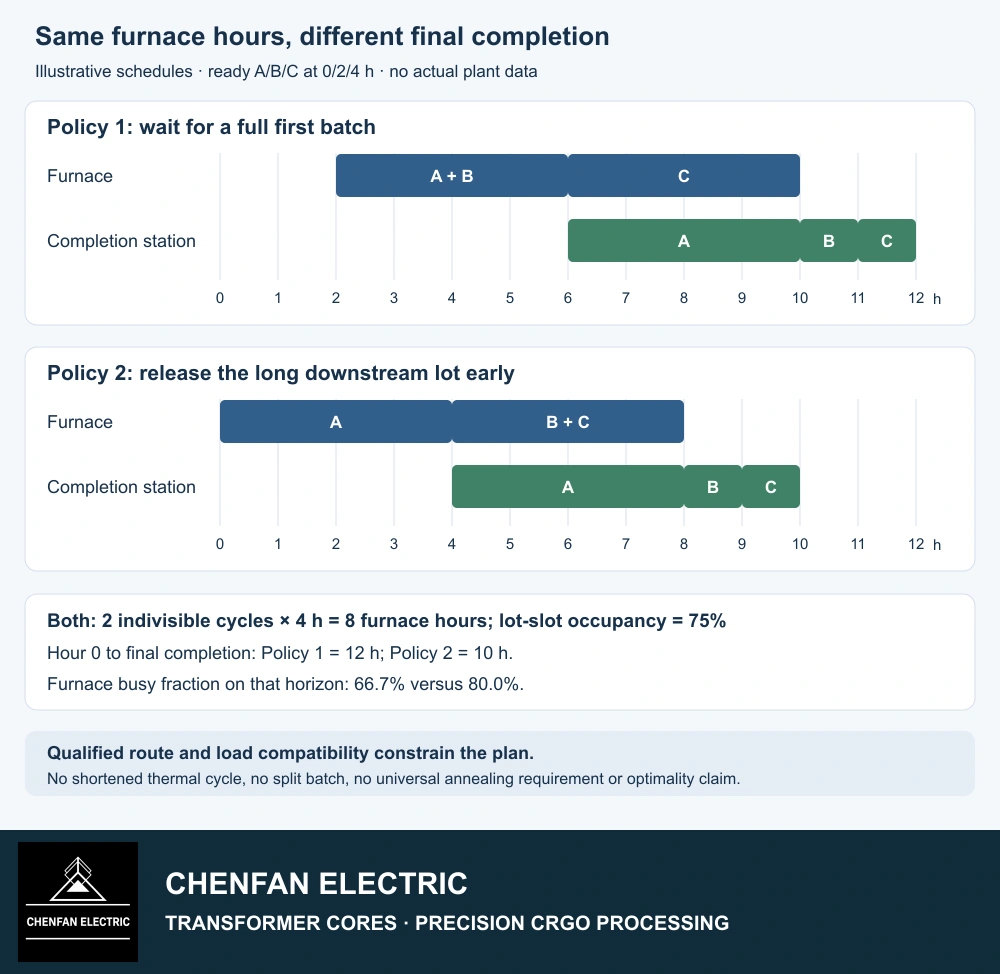
Both schedules respect readiness, the two-lot limit, exclusive furnace and completion-station use, and the rule that downstream work begins after its batch is released. Both consume two complete furnace cycles, totaling 8 hours. Neither splits a batch or shortens its process.
The improvement in this comparison comes from advancing A’s downstream release while B and C wait for their already defined batch. It is not a reduction in thermal processing time. These are two feasible schedules, not a solver-certified global optimum or a general rule that single-lot batches are preferable.
Use one time boundary for utilization
Average capacity occupancy is the same in both schedules: three lots across two batches with capacity two, or 3/4 = 75% of the available lot slots. The first batch is fuller under Policy 1, but that local statistic does not predict the final completion time.
Using the shared interval from hour 0 to the last downstream completion, furnace busy-time fractions are 8/12 = 66.7% and 8/10 = 80.0%. The downstream station is busy for 6 hours, giving 50.0% and 60.0% on those respective order-set horizons. These percentages describe the hypothetical schedules under an explicit denominator; they are not general plant efficiency measures.
If utilization instead is measured only between the first and last furnace operation, both schedules report 100% furnace busy time: Policy 1 from 2 to 10 and Policy 2 from 0 to 8. That reporting convention excludes Policy 1’s initial wait. Therefore utilization values should always state their time boundary before they are used to compare policies.
Review the conditions that could reverse the result
The comparison depends on equal batch duration, permissible single-lot processing and the stated downstream times. A loading restriction, minimum qualified load, different cooling requirement or sequence-dependent changeover could invalidate Policy 2 or change its advantage. Model those conditions rather than treating unused furnace space as automatically wasteful or automatically acceptable.
Choose the objective that matches the order decision. Finishing all lots, meeting different due dates, limiting work in progress and minimizing changeovers can favor different schedules. Keep late-lot readiness and scarce downstream fixtures visible; accelerating cutting alone can simply move inventory into a queue.
Release a constraint-backed schedule with batch membership, resource intervals and downstream availability. Update it as readiness or qualified resource conditions change, and identify the specific wait removed by each scheduling choice. Use that record to forecast completion on the stated assumptions.
Distinguish a material soak recommendation from occupied furnace time
The catalog recommends a 790–820°C soak for at least 15 minutes for the listed LITE CARLITE and Mill-Anneal products, with process time and atmosphere chosen for the core and furnace load. [1] In the assumed schedule, two batches occupy 2 × 4 = 8 h. Two minimum 15-minute soak segments total 0.50 h, leaving 7.50 h assigned to the rest of the assumed cycle. That arithmetic does not identify removable time: heat-up, load equalization, cooling and release must satisfy the qualified material route. Keep the actual thermal cycle intact while comparing batch release and downstream sequencing.
Control approved material/treatment identity, furnace loading, core temperature history, atmosphere and handling before stacking or reassembly. Validate each batch’s physical compatibility before combining lots; a nominal grade label alone cannot establish a common thermal route. IEC 60404-8-7 provides the delivery-specification framework for fully processed grain-oriented steel. [2]
NIST’s manufacturing digital-twin framework separates a model’s intended purpose from its verification and physical validation. Test a schedule against actual readiness, resource and qualified-process records. [3]
References
[1] Cleveland-Cliffs, Grain-Oriented Electrical Steels — LITE CARLITE and Mill-Anneal, October 2023, Tables 1 and 5; Stress-Relief Annealing.
[2] IEC, IEC 60404-8-7:2020, Magnetic materials — Part 8-7: Specifications for individual materials — Cold-rolled grain-oriented electrical steel strip and sheet delivered in the fully-processed state.
[3] G. Shao, J. Hightower and W. Schindel, Credibility Consideration for Digital Twins in Manufacturing, NIST manuscript, 2022.