

Reconcile production mass on one electrical-steel basis. Remove packaging from incoming coil weight and added hardware from finished-core weight before investigating the residual; errors on opposite sides can cancel and hide the real correction required.
Calculation basis. Unless a value is explicitly attributed to a cited source, numerical inputs in the demonstrations are assumptions for the stated model. Normalized variables are dimensionless. The examples define their own geometry, excitation and measurement boundary.
Define the material basis, physical area and reporting interval before calculating yield. Track that same basis through incoming transfers, finished output, scrap and all inventory states within the boundary.
Define what crosses the boundary
A useful balance for a reporting interval is:
Δ = opening inventory + steel entering − finished steel leaving − scrap leaving − closing inventory.
All quantities are masses on the same material basis. Positive Δ means recorded available material exceeds recorded destinations; negative Δ means recorded destinations exceed recorded availability. Neither sign identifies a cause by itself.
Opening and closing inventory include every relevant physical state inside the chosen boundary: unprocessed issued material, cut laminations, incomplete packets, identified usable remnants and completed cores awaiting transfer. These are inventory states, not additional outputs. Material moved from cutting to stacking remains inside the boundary and must not be counted again as a new input.
Choose the transfer point carefully. If finished cores remain inside at the closing cutoff, include their steel mass in closing inventory rather than also booking them as material leaving. If a scrap bin remains inside, its mass belongs to closing inventory until the defined outward transfer occurs. A balance based on generation instead of transfer is possible, but it requires a different, explicitly consistent boundary.
Exclude packaging, pallets and lifting equipment from incoming steel mass. Exclude clamps, fasteners and other non-steel additions from the finished electrical-steel mass. Declare how supplied coatings are treated: one workable operational basis is the mass of the supplied coated sheet, with any added or removed material accounted for separately where significant. Mixing bare-metal theory with coated-sheet weighings creates another mismatch.
Retain gross, tare and net evidence
Keep gross weight, excluded container/packaging mass and net steel mass as separate ledger quantities. Apply the actual tare to each weighing and preserve the instrument record.
For each weighing event, preserve the object identity, scale identity, time, gross reading, tare method, net result and included material states. A displayed net number is useful only when the tare corresponds to the actual container or excluded load. Changes to pallets, restraints or scrap-bin contents need controlled evidence rather than an inherited value copied from an earlier job.
Do not silently substitute calculated drawing mass for a missing physical weighing. A calculation may be an inventory estimate, but mark its method and uncertainty so that a theoretical quantity cannot masquerade as an independently measured destination. Use one unit throughout the ledger and retain the original records behind conversions.
A balance that closes only after both corrections
Consider a hypothetical interval with 100 kg of opening steel inventory. An incoming package weighs 1,030 kg gross, including 30 kg of packaging. Finished assemblies leaving weigh 870 kg, including 20 kg of clamps and other excluded hardware. Scrap leaving is 180 kg and closing steel inventory is 70 kg. All values are assumed for this example.
| Ledger item | Uncorrected quantity, kg | Common steel-basis quantity, kg |
|---|---|---|
| Opening inventory | 100 | 100 |
| Incoming material | 1,030 | 1,000 |
| Finished material leaving | 870 | 850 |
| Scrap leaving | 180 | 180 |
| Closing inventory | 70 | 70 |
| Signed residual Δ | +10 | 0 |
The uncorrected calculation is 100 + 1,030 − 870 − 180 − 70 = +10 kg. After applying the two separately supported exclusions, it becomes 100 + 1,000 − 850 − 180 − 70 = 0 kg. The original residual is the net effect of a +30 kg input error and a −20 kg output error. It understates the amount of boundary correction required.
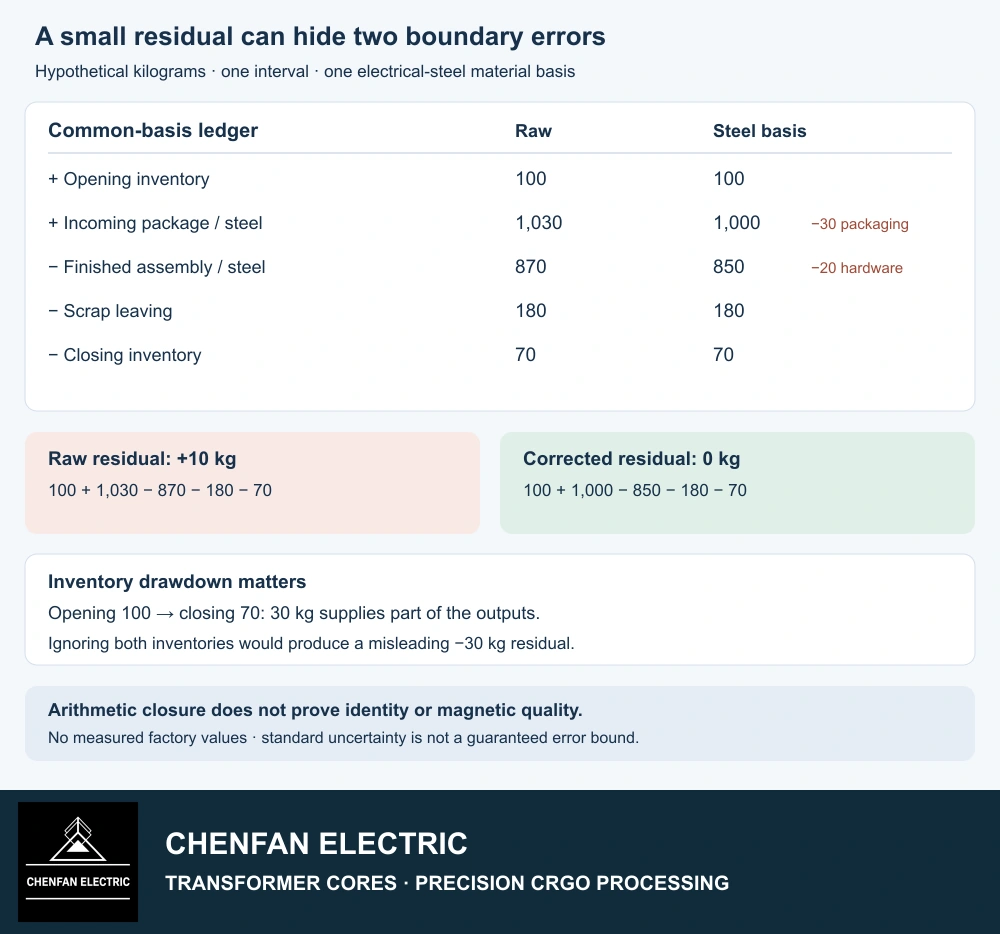
Omitting opening and closing inventory would give 1,000 − 850 − 180 = −30 kg. That apparent excess of outputs is explained here by drawing down inventory from 100 to 70 kg. It is not evidence of creating steel or automatically evidence of a false scrap record.
A zero residual still cannot prove correct grade identity, correct lamination count or complete recording. An unrecorded input and equally unrecorded output can cancel. Reconcile identities and counts separately, and avoid moving unexplained quantities into a balancing category simply to make Δ zero.
Evaluate the measurement model separately
For illustration, suppose the five corrected ledger quantities have standard uncertainties of 0.5, 1.0, 0.6, 0.4 and 0.5 kg, respectively, and their estimation errors are uncorrelated. With coefficients +1, +1, −1, −1 and −1, the combined standard uncertainty of Δ is √(0.5² + 1.0² + 0.6² + 0.4² + 0.5²) = 1.42 kg.
These assumed uncertainties concern the final net quantities; determine scale and process contributions from the actual weighing system. A standard uncertainty is not a guaranteed error bound or, by itself, an acceptance threshold.
Include covariance when the ledger inputs share significant measurement errors. Repeated use of one scale does not establish independence; the balance coefficients determine each covariance term’s sign.
Investigate residuals through physical evidence
If a residual remains after boundary correction, check the interval cutoff, incomplete transfers, omitted inventory states, incorrect tares, duplicate transactions and material assigned to the wrong job. Record findings against the original event rather than hiding them in a general adjustment.
For mixed jobs, start with individual identified lots or compatible material groups. An overall plant balance can conceal one lot’s shortage behind another lot’s excess. A usable remnant needs an identity, measured or explicitly estimated mass and a controlled inventory state; relabeling scrap as a remnant does not recover material physically.
Release the reconciliation with its boundary definition, supporting weighing records and unresolved items. Use the accounted material destinations for the mass decision, and carry the same identified records into the separate drawing, magnetic-quality, scrap-classification and billing checks.
Test a gauge mismatch before assigning an unexplained loss
The catalog provides nominal gauges 0.23 and 0.27 mm and density 7,650 kg/m³. [1] Assume 10.00 m² of accepted sheet area. Calculated steel masses are 10 × 0.00023 × 7,650 = 17.595 kg and 10 × 0.00027 × 7,650 = 20.655 kg, a 3.060 kg difference. That discrepancy can exceed the earlier assumed 1.42 kg combined standard uncertainty without representing scrap. Confirm gauge, coating basis, area and inventory identity before interpreting the residual; preserve theoretical and weighed quantities as separate evidence.
Control net incoming mass, measured gauge, accepted cut area, remnant identity, scrap cutoff and non-steel hardware tare. These manufacturing records must use one material basis and reporting boundary before yield is compared across jobs. IEC 60404-8-7 provides the delivery-specification framework for fully processed grain-oriented steel. [2]
References
[1] Cleveland-Cliffs, Grain-Oriented Electrical Steels — LITE CARLITE and Mill-Anneal, October 2023, Tables 1 and 5; Stress-Relief Annealing.
[2] IEC, IEC 60404-8-7:2020, Magnetic materials — Part 8-7: Specifications for individual materials — Cold-rolled grain-oriented electrical steel strip and sheet delivered in the fully-processed state.