

Qualify a second-source transformer core from the steel coil through the manufactured assembly and its condition at handover. Matching the electrical steel grade establishes the material designation; cutting, joint registration, stacking and final-state performance need their own linked evidence.
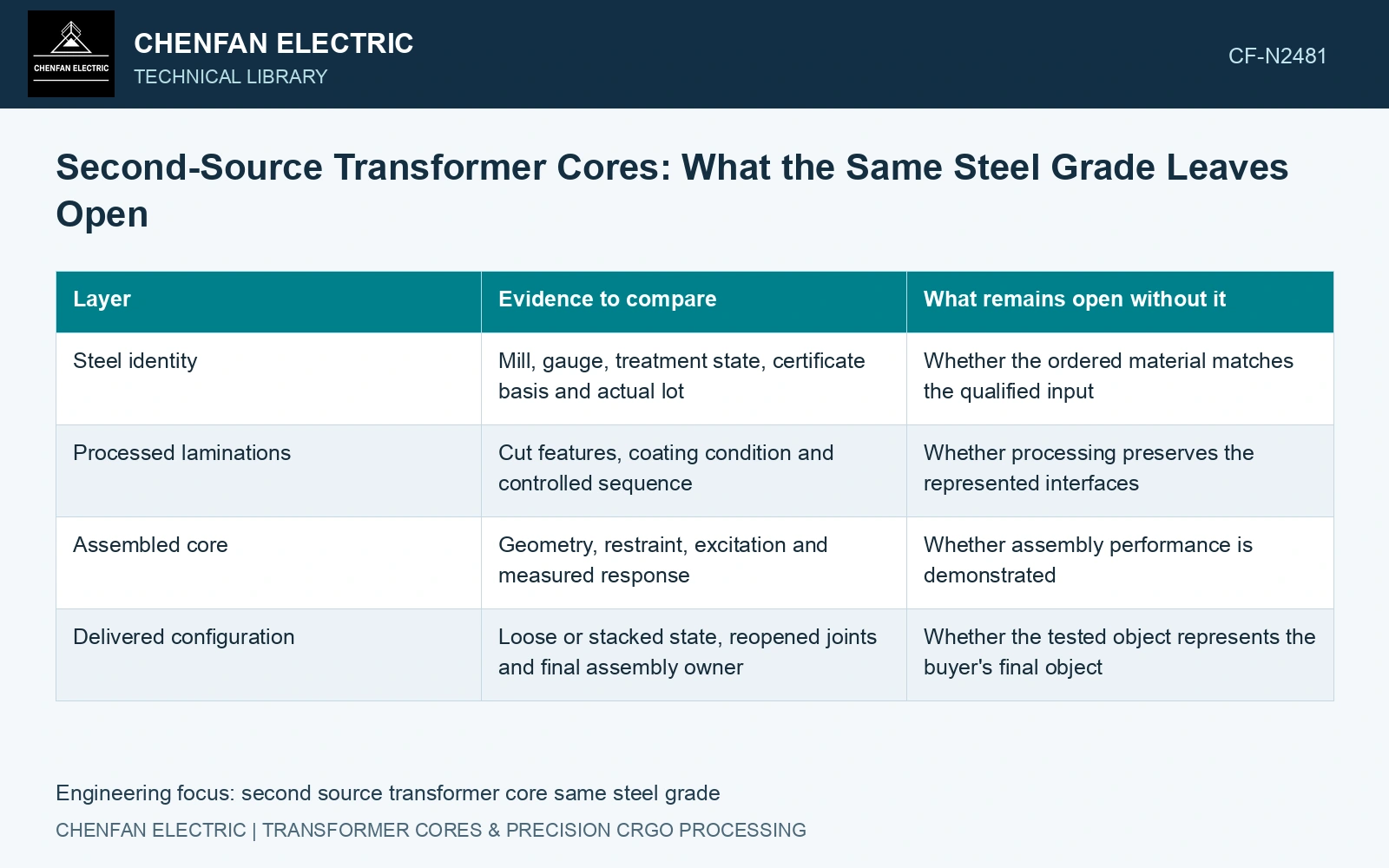
Keep the qualification file in four layers. A favourable result at one layer should not silently approve the others.
| Layer | Evidence to compare | What remains open without it |
|---|---|---|
| Steel identity | Mill, gauge, treatment state, certificate basis and actual lot | Whether the ordered material matches the qualified input |
| Processed laminations | Cut features, coating condition and controlled sequence | Whether processing preserves the represented interfaces |
| Assembled core | Geometry, restraint, excitation and measured response | Whether assembly performance is demonstrated |
| Delivered configuration | Loose or stacked state, reopened joints and final assembly owner | Whether the tested object represents the buyer’s final object |
Start with the material’s reporting basis
Check the complete purchase designation and test conditions, including whether specimen preparation represents the supplied treatment. A typical catalogue value and a certified limit are different evidence. Nippon Steel’s product information distinguishes preparation and refinement routes; the grade name does not eliminate those distinctions.
Track the steel through the actual cutting work order. A sample certificate for the offered grade does not identify the coils used for the qualification core. Retain that connection before discussing whether material performance transferred successfully. [1]
Close the handover gaps
Identify changes after the supplier’s test: dismantling a yoke, temporary restraint removal, transport and the buyer’s final stacking or clamping. For each consequential change, decide what evidence represents the final state. A photograph of the test arrangement is useful only when it is linked to the tested unit and configuration.
Compare assembled acceptance at the same steel designation
Assume two 1,000 kg cores both use catalogue 23ZH90, whose sheet maximum is 0.90 W/kg at 1.7 T and 50 Hz [2]. Further assumptions: a 1,000 W assembled-core contractual ceiling, and matched final-state results of 980 W and 1,060 W at those nominal excitation conditions. Margins are +20 W and −60 W, or +2% and −6% of the ceiling. One result meets the assumed ceiling and the other does not, before the agreed uncertainty decision rule. The 900 W material-limit product cannot identify which manufacturing feature caused the difference.
Cutting stress, burr, joint gaps, stack registration and clamp load govern the manufactured core. Retain matched assembly evidence through shipment and reconstruction rather than qualifying by grade name alone.
Release the second source against the actual core configuration entering the transformer factory. Close each material, manufacturing and handover requirement with traceable evidence, or assign the remaining item to a defined trial and engineering disposition before procurement treats the qualification as complete.
References
- NASA, NASA Systems Engineering Handbook, section 6.5, Configuration Management, official online text.
- Nippon Steel Corporation, Grain-Oriented Electrical Steel Sheets, catalogue D004je, April 2020, specification tables, size tolerances and Annealing by Customers.