

Separate the effects of coupled design changes with comparisons that isolate each revision. A build containing both a core change and an assembly change establishes their combined result; the individual contributions and interaction need the corresponding configurations.
Preserve the missing comparisons
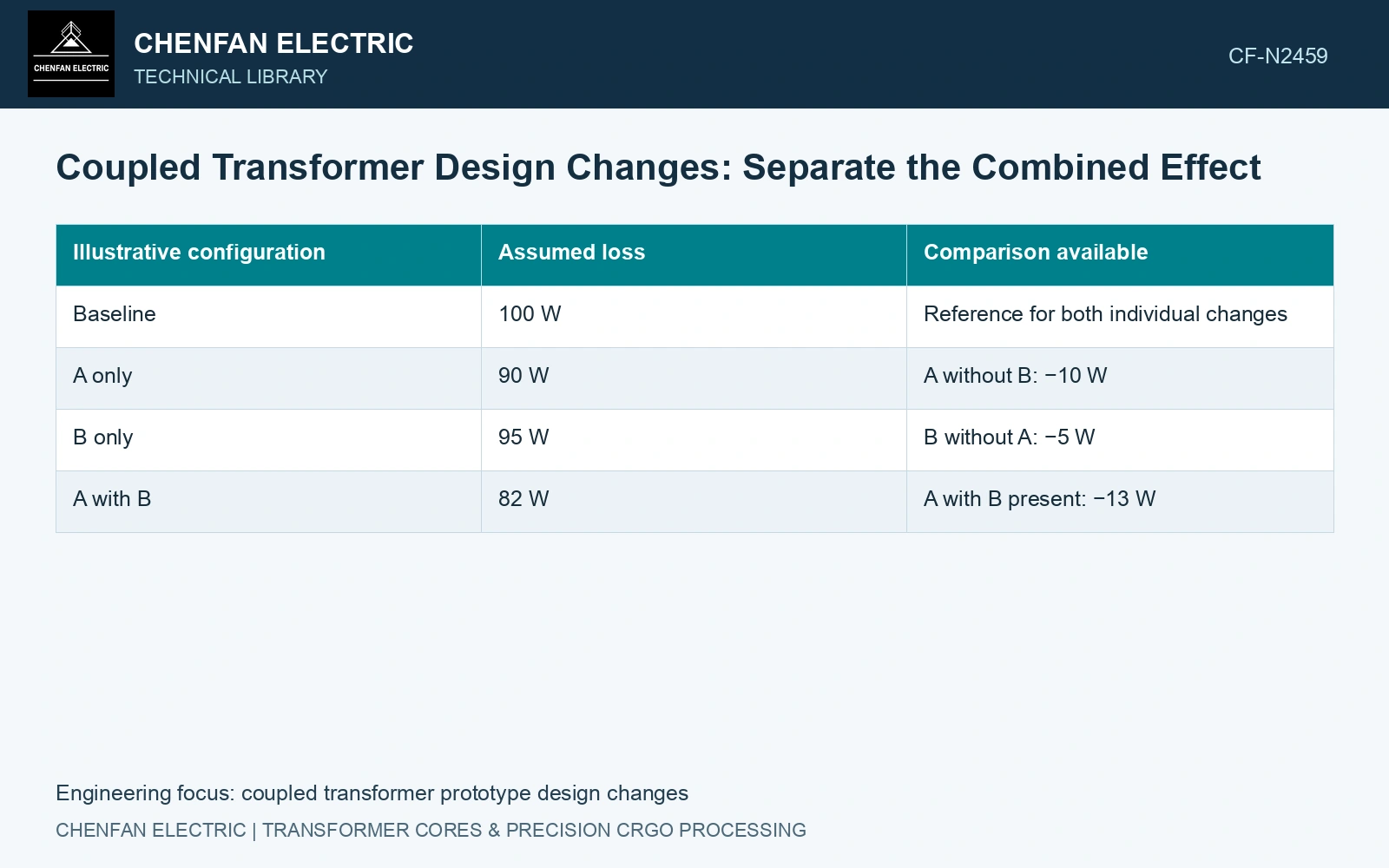
For two changes A and B, compare the unchanged baseline, A only, B only and A with B where technically valid. Define each configuration before building it. Material lot, assembly state, excitation and measurement method belong to the comparison, not to incidental notebook details. [1]
If a combination is infeasible, record that constraint and the narrower inference it permits. A sequential development history is useful evidence, but it is not automatically a factorial experiment: learning, elapsed time and other concurrent adjustments may move with the revision sequence.
| Illustrative configuration | Assumed loss | Comparison available |
|---|---|---|
| Baseline | 100 W | Reference for both individual changes |
| A only | 90 W | A without B: −10 W |
| B only | 95 W | B without A: −5 W |
| A with B | 82 W | A with B present: −13 W |
Make interaction arithmetic explicit
Without interaction, adding the two isolated reductions predicts 100 − 10 − 5 = 85 W. The assumed combined result is 82 W. The difference of differences is 82 − 90 − 95 + 100 = −3 W: A changes loss by 3 W more when B is present. [1]
These assumed values demonstrate the comparison only. The −3 W is the stated contrast, not an unspecified regression coefficient or evidence of statistical significance. A model using coded factors needs its coding and coefficient convention identified separately.
Separate build variation from repeated readings
Repeated instrument readings of one build characterize a narrower source of variation than independently produced assemblies. Plan replication for the variation relevant to the decision, and retain individual build results. Control or account for order, drift and material allocation so they are not silently assigned to A or B. [1]
Compare uncertainty and observed variability with the effect being interpreted. A small difference of differences may remain unresolved by the available evidence. NIST’s experiment-design guidance discusses interaction; it does not supply a transformer-specific sample count or a universal significance rule for these assumed numbers. [1] [2]
Retain the valid configuration map, individual build results and unresolved influences with the decision. Assess the combined revision on its demonstrated behavior, and attribute a separate material or process benefit only to the comparison that isolates that change.
References
- NIST/SEMATECH, e-Handbook of Statistical Methods, section 5.3.3.3.1, Two-level full factorial designs, official online text.
- B. N. Taylor and C. E. Kuyatt, NIST Technical Note 1297, Guidelines for Evaluating and Expressing the Uncertainty of NIST Measurement Results, 1994, sections 5 and 6.