

Update the core design model with the replacement steel’s supported operating curves and process state. A matched loss point leaves excitation, stress sensitivity and the rest of the duty range to compare against the inputs used in the original model.
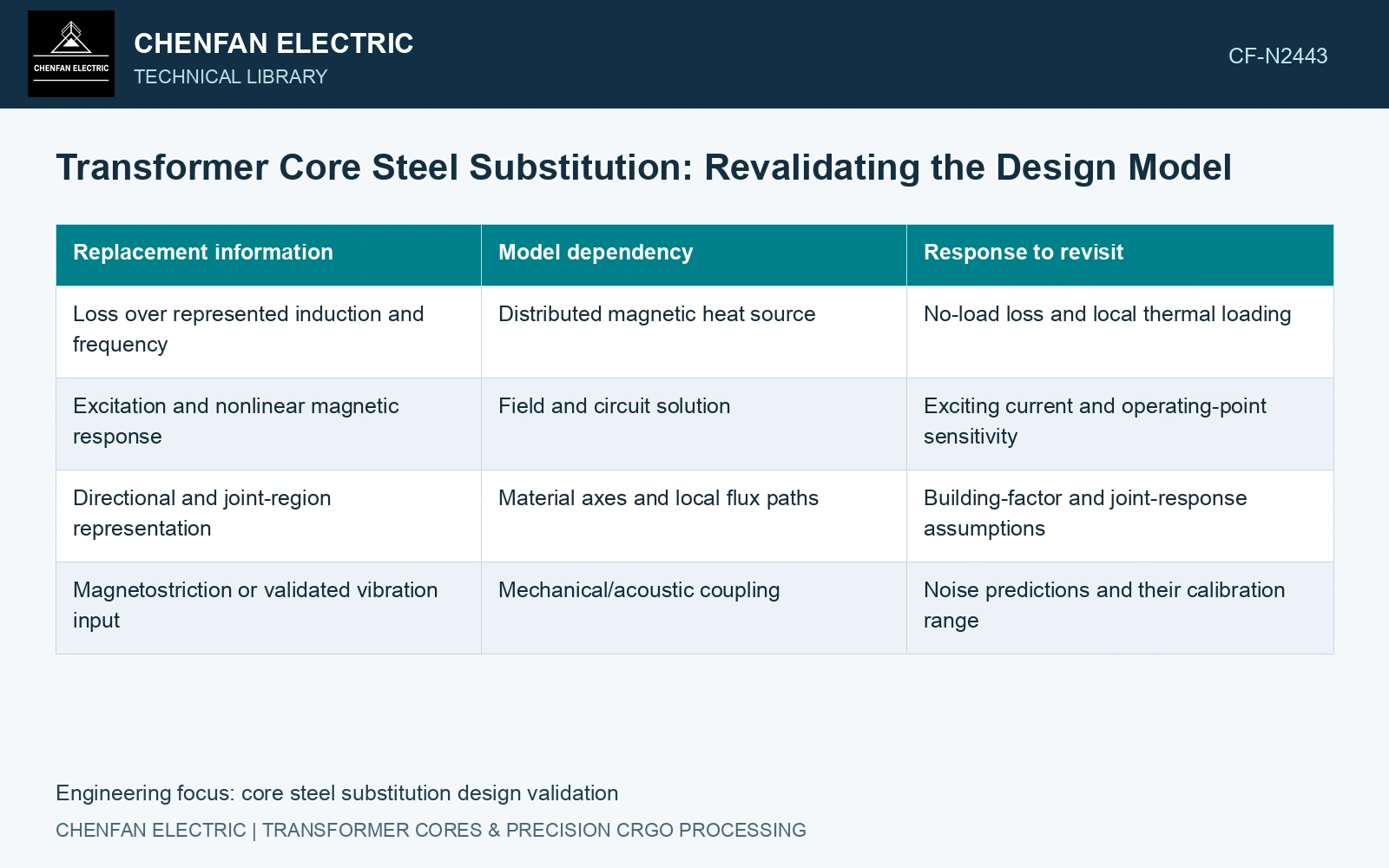
Inventory the magnetic inputs before replacing them
Identify where the old design uses measured loss data, a magnetization relation, directional assumptions and any stress-dependent correction. Separate supplier specification limits from the curves actually fitted to the model. A guaranteed maximum at one point is not a complete material law. [1]
The steelmaker’s published product information distinguishes rolling-direction properties and different specimen preparation for refinement routes. Those distinctions matter when comparing datasets. A measurement after stress relief cannot silently replace an as-sheared result for a treatment whose benefit changes during that processing.
| Replacement information | Model dependency | Response to revisit |
|---|---|---|
| Loss over represented induction and frequency | Distributed magnetic heat source | No-load loss and local thermal loading |
| Excitation and nonlinear magnetic response | Field and circuit solution | Exciting current and operating-point sensitivity |
| Directional and joint-region representation | Material axes and local flux paths | Building-factor and joint-response assumptions |
| Magnetostriction or validated vibration input | Mechanical/acoustic coupling | Noise predictions and their calibration range |
Distinguish recalculation from revalidation
Rerunning the old mesh with a new loss constant updates a calculation. Revalidation asks whether the model predicts observations relevant to its intended decision. That requires independent test evidence, not merely a converged solution.
Choose measured conditions that represent the proposed operating range and the model’s consequential assumptions. Include excitation as well as loss where both support a design decision. If noise is important, collect evidence suited to the mechanical construction; it cannot be derived from the loss change alone.
Keep geometry and processing fixed for the material comparison where possible. If the substitution also changes gauge, stacking factor, cutting or clamping, identify those as separate inputs. Otherwise an apparent steel effect includes changes to effective section and assembly stress.
Bound the evidence that transfers
Some geometric calculations can remain valid if dimensions and boundary conditions are preserved. A calibrated magnetic or acoustic response needs its own inheritance argument. Record the represented inputs rather than marking the entire model either unchanged or invalid.
Compare predicted and measured changes, including their uncertainty, against the decision the model is intended to support. A small error at one calibration point does not establish performance outside the tested range. Retain unexplained residuals rather than adjusting several parameters until every displayed curve looks similar.
Compare a material-limit change before rerunning the model
For 0.23 mm 23ZH90 and 23ZH85, catalogue maxima at 1.7 T and 50 Hz are 0.90 and 0.85 W/kg on the specified stress-relieved rolling-direction specimens [1]. Assume 2,000 kg of steel: their products are 1,800 and 1,700 W, a 100 W or 5.56% difference between maxima. This does not predict an assembled-core reduction. Wang et al. measure temperature-dependent magnetic properties and iterate the coupled magnetic/thermal solution [2]. Obtain the replacement’s corresponding curves and compare updated predictions with matched core observations.
Control gauge, rolling orientation, steel count, cut-edge stress, annealing state, joint registration and retained clamp load. Preserve those manufacturing inputs during the material comparison; a duct or packet revision would introduce a separate geometric change.
Submit the replacement dataset, updated model and confirming measurements on the same processing and duty basis. Compare predicted changes and residual errors against the design decisions being supported, and retain the old evidence only for conditions the replacement still represents.
References
- Nippon Steel Corporation, Grain-Oriented Electrical Steel Sheets, catalogue D004je, April 2020, specification tables, size tolerances and Annealing by Customers.
- Z. Wang, K. Xu and Y. Du, Temperature Rise Calculation of Magnetic Core Considering the Temperature Effect of Magnetic Properties in an Electrical Steel Sheet, Symmetry, 2022. DOI: 10.3390/sym14112315.