

Qualify a conductor-temper change through forming and the final winding state. Yield response, springback and retained restraint can change even when alloy, dimensions and nominal conductivity remain the same.
Follow the material state through the factory
Draw the process as supplied conductor → bending and winding → joining or local heating → drying or curing → final assembly. DOE describes work hardening as plastic deformation beyond yield, increasing strength while reducing ductility [1]. Record the conductor’s actual state after these transitions, including locally altered regions.
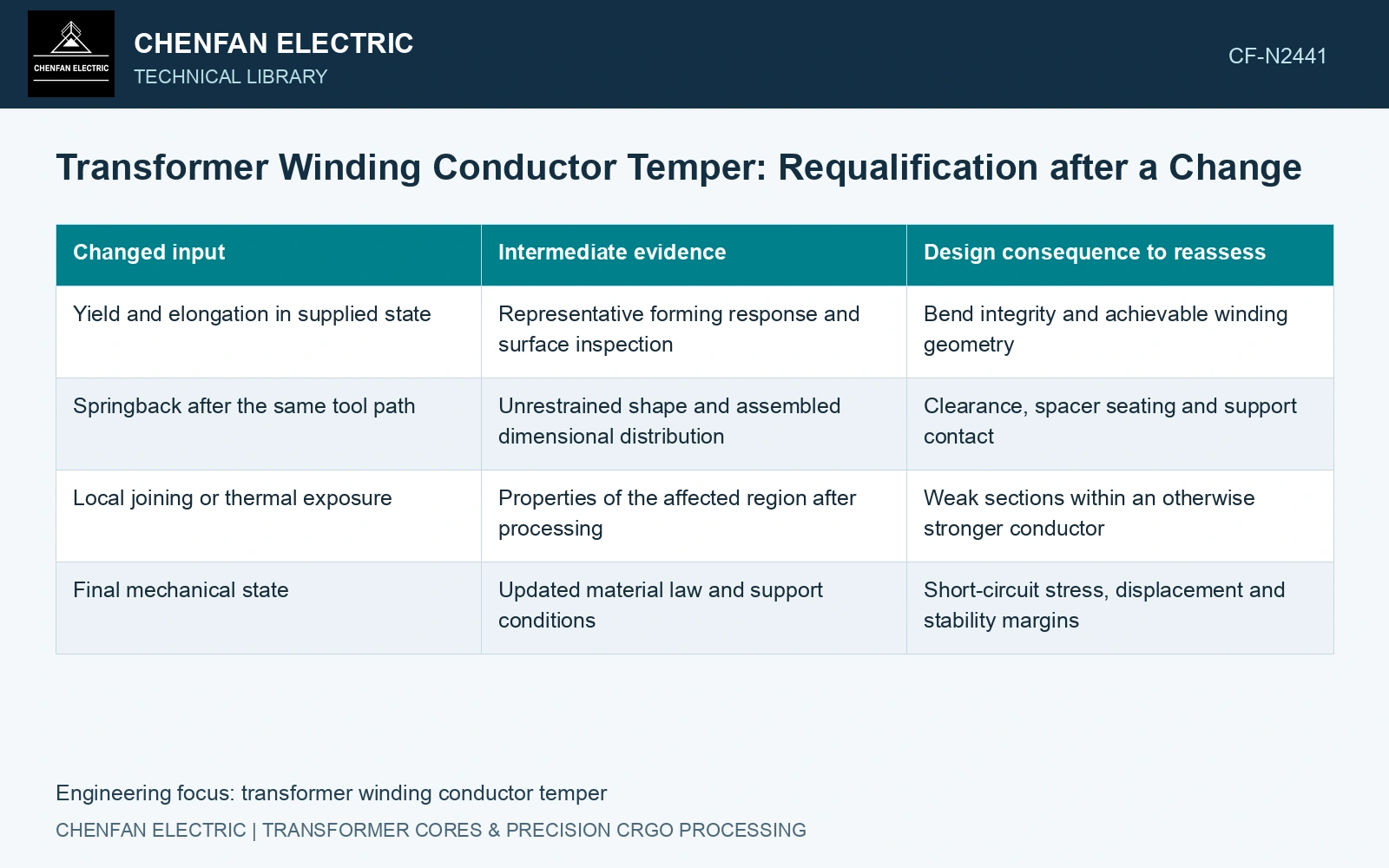
| Changed input | Intermediate evidence | Design consequence to reassess |
|---|---|---|
| Yield and elongation in supplied state | Representative forming response and surface inspection | Bend integrity and achievable winding geometry |
| Springback after the same tool path | Unrestrained shape and assembled dimensional distribution | Clearance, spacer seating and support contact |
| Local joining or thermal exposure | Properties of the affected region after processing | Weak sections within an otherwise stronger conductor |
| Final mechanical state | Updated material law and support conditions | Short-circuit stress, displacement and stability margins |
Compare temper with forming geometry and restraint
A harder temper may increase forming force or springback; a softer state may change retained mechanical margin. Neither direction is a general improvement. Compare representative bends, orientation and restraint. DOE’s general work-hardening discussion [1] does not provide a bend radius or allowable for the proposed winding conductor.
Inspect whether the process compensates by changing tool settings, tension or support. If those settings change, include them in the qualification configuration. Otherwise the apparent material comparison combines an undocumented process revision with the temper revision.
Reconnect the mechanical proof
Review earlier short-circuit evidence against its material assumptions, final dimensions, preload and support. An unchanged force-producing circuit may retain its calculation while the stress or displacement model needs revision. NASA’s configuration guidance supports tracing those changed inputs and verification boundaries [2]; it does not qualify this temper.
Preserve electrical checks where their governing inputs remain represented, and explain that inheritance separately. Equal measured resistance supports an electrical property under its test conditions; it does not demonstrate equal buckling resistance, local strain capacity or retained clamping.
Quantify how a temper change affects the forming screen
Assumptions: a 2.0 mm rectangular conductor is bent from an initially flat state to a 20 mm inside radius, with equal tension/compression behaviour. The outer-fibre strain screen is t/(2r + t) = 4.76%. Assume candidate yield strengths of 70 MPa and 200 MPa with E = 110,000 MPa; corresponding elastic yield strains are 0.0636% and 0.1818%. Both cases require plastic forming in this simplified screen. The higher supplied yield strength therefore does not prove acceptable springback or final winding strength. Verify the formed material, restraints and local joining regions before inheriting the mechanical qualification [1] [2].
Release the conductor revision against the established final material state, recorded forming settings and supported mechanical conclusions. Verify locally altered regions after processing, and retain separately the electrical results whose test conditions still transfer.
References
- U.S. Department of Energy, DOE-HDBK-1017/2-93, Material Science, Volume 2, 1993, Plant Material Problems.
- NASA, NASA Systems Engineering Handbook, section 6.5, Configuration Management, official online text.