

Design a reproduction test to distinguish the suspected failure mechanism from competing explanations. Recreated damage demonstrates behavior under the laboratory conditions; its causal value comes from matching the controlling boundaries and testing a prediction that could fail. [1]
Write the prediction before the test
Define the suspected mechanism and at least one competing explanation. State which observable outcome would distinguish them. If both produce the same final burn pattern, visual similarity alone is a weak discriminator.
Include an outcome that could weaken the favored hypothesis. A test designed only to produce a photograph matching the accident is a demonstration, not a strong causal test.
Specify the similarity boundary
Identify the variables governing the mechanism: contact geometry for a joint problem, electric-field configuration for insulation breakdown, or constraints and material state for deformation. A smaller specimen can change heat transfer, fields and mechanical stiffness in different ways.
Do not assume one scale factor preserves all relevant behavior. Use a supported model to decide which ratios or states must match and which differences the interpretation can tolerate.
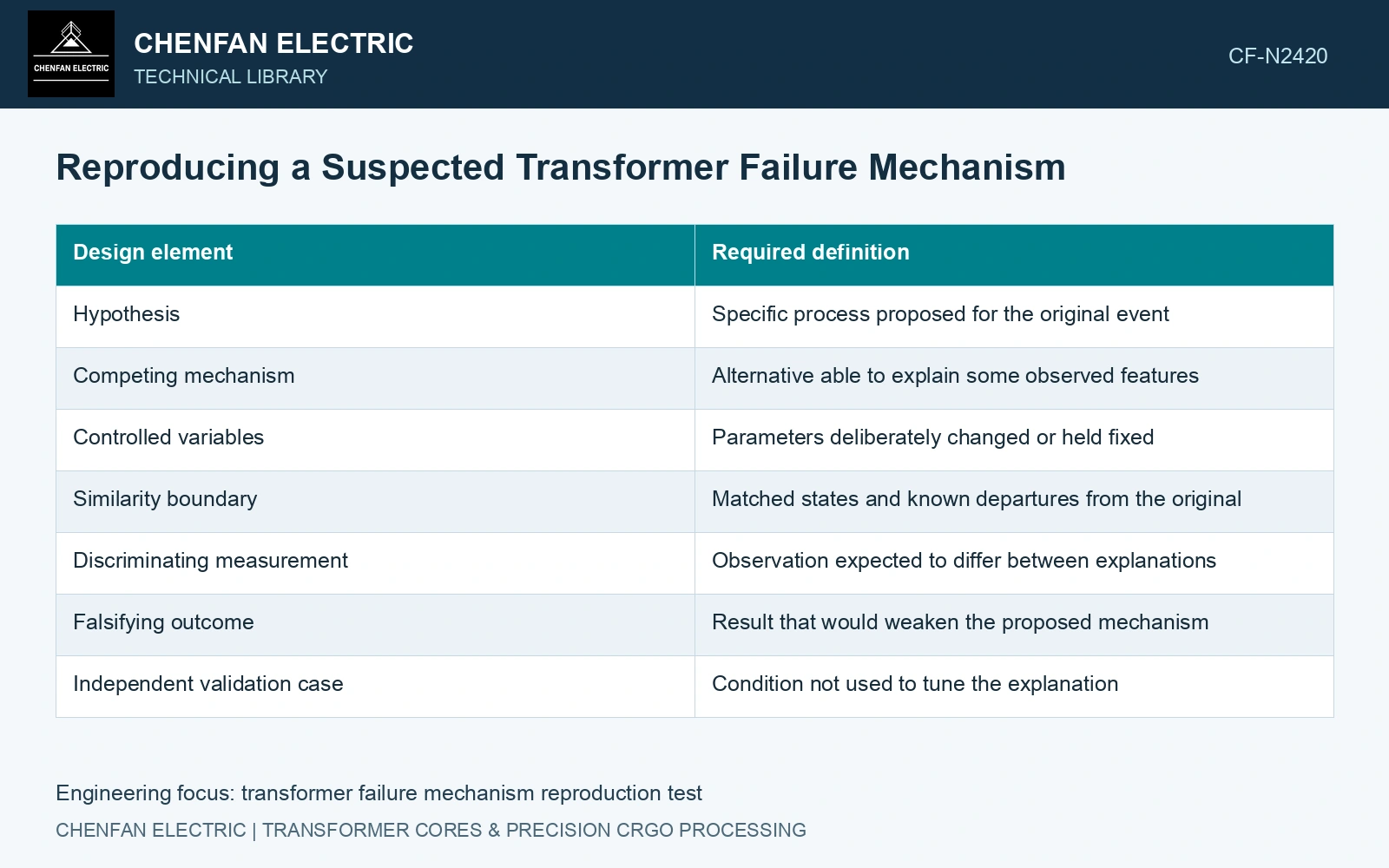
| Design element | Required definition |
|---|---|
| Hypothesis | Specific process proposed for the original event |
| Competing mechanism | Alternative able to explain some observed features |
| Controlled variables | Parameters deliberately changed or held fixed |
| Similarity boundary | Matched states and known departures from the original |
| Discriminating measurement | Observation expected to differ between explanations |
| Falsifying outcome | Result that would weaken the proposed mechanism |
| Independent validation case | Condition not used to tune the explanation |
Control preparation and sequence
Specimen manufacturing, conditioning, assembly and measurement can introduce differences that resemble the effect being studied. Record them and use suitable comparisons. Repeating one condition measures repeatability; it does not by itself establish transfer to the transformer.
Measure intermediate behavior where possible rather than only the final damaged state. A sequence of contact resistance, temperature or deformation can discriminate mechanisms that leave similar remnants. The choice depends on the hypothesis and approved laboratory arrangement.
USBR’s transformer diagnostics guide discusses winding-resistance evidence for connections and gas-analysis evidence for electrical or thermal faults [2]. Choose measurements suited to the proposed mechanisms; a diagnostic signature alone does not establish the original event’s causal order.
Use an intermediate prediction to distinguish mechanisms
Assume hypothesis A predicts rising contact resistance before visible heating, while B predicts insulation discharge before contact alteration. The planned test records both intermediate signals and specimen state. If only the final crater matches, neither predicted order has been tested. Add the discriminating observation before transferring laboratory damage to the original event.
Evaluate results against the represented state
Failure to reproduce damage may weaken the hypothesis only if the required state was actually represented. Missing a relevant boundary cannot refute the original mechanism. Successful reproduction is also limited when the test used stresses or states unsupported by the accident record.
References
- L. Ochs, NASA Goddard Space Flight Center, Basics of Failure Analysis, NASA Parts 101, December 4, 2024.
- U.S. Bureau of Reclamation, FIST Volume 3-31, Transformer Diagnostics, June 2003.