

Align fault records using supported clock-offset and channel-latency bounds before inferring causal order. NIST notes that client time accuracy depends on the network connection, not only the server timestamp [1]. Retain each device’s clock and physical-event basis.
Keep each device’s original timeline
Preserve original files and their configuration/identity links [2]. Record clock basis, synchronization and event definitions. A breaker command, auxiliary-contact change and current interruption are related events, not interchangeable timing markers.
Retain sampling interval, filter behavior and any known reporting delay separately from clock offset. SCADA receipt time may describe arrival at the server rather than occurrence in the primary circuit.
Align a genuinely common event
Choose an event visible in both records whose physical meaning and channel response are understood. More than one shared event helps check drift and mistaken alignment. A broad voltage change may align different thresholds in different instruments, so document that ambiguity.
Define clock offset as d = local time − reference time. Convert a local event by t = local time − d. If d is bounded rather than known exactly, the converted event is an interval.
For an illustrative calculation, device B is 120–140 ms ahead of device A after accounting for the shared-event identification. B records an event at 250 ms. On A’s time basis it lies at 110–130 ms. If A records a different event at 118–122 ms, the intervals overlap. The data do not establish which event occurred first.
Build an interval timeline
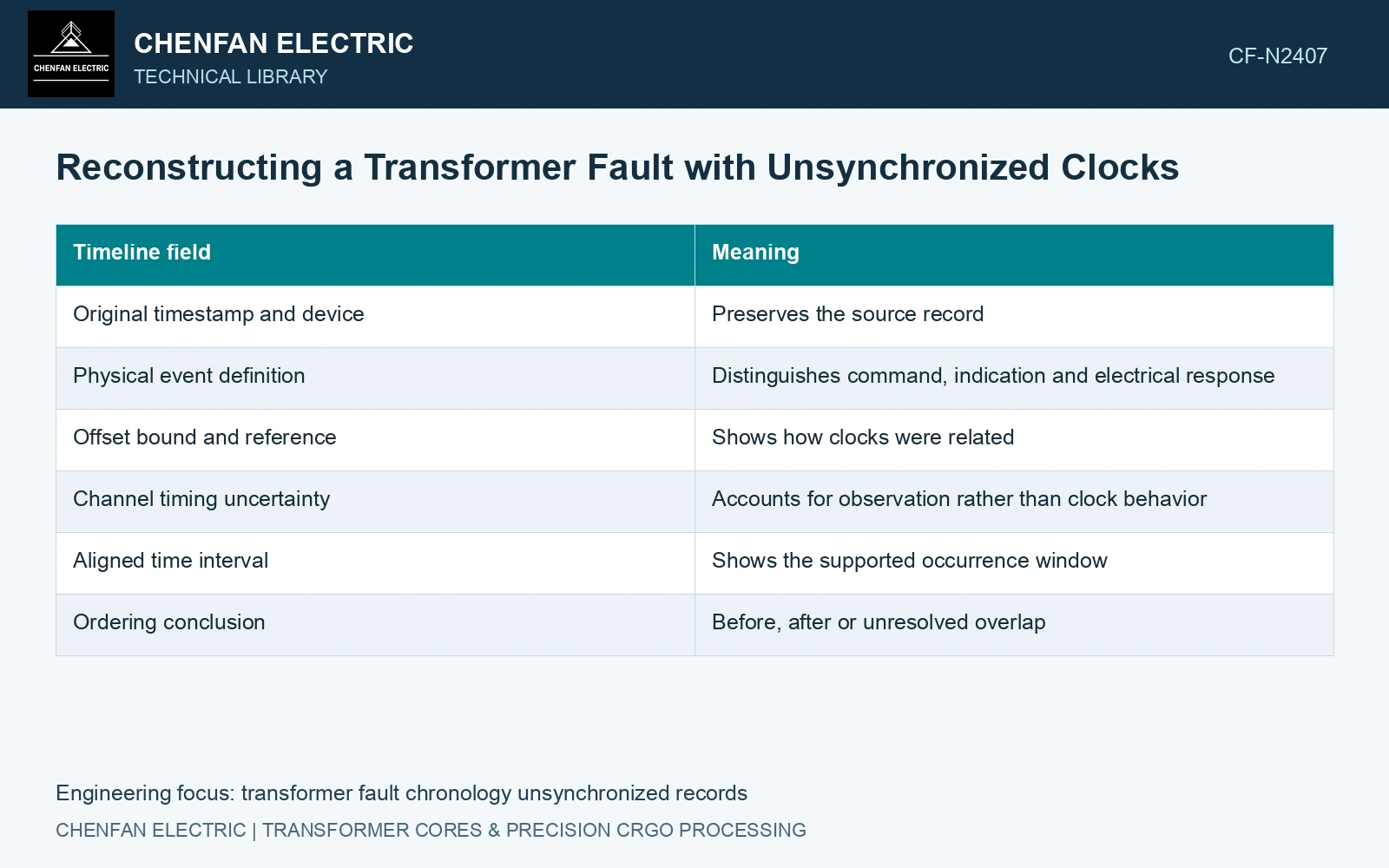
| Timeline field | Meaning |
|---|---|
| Original timestamp and device | Preserves the source record |
| Physical event definition | Distinguishes command, indication and electrical response |
| Offset bound and reference | Shows how clocks were related |
| Channel timing uncertainty | Accounts for observation rather than clock behavior |
| Aligned time interval | Shows the supported occurrence window |
| Ordering conclusion | Before, after or unresolved overlap |
Add deterministic latency corrections only when supported. Unknown delays should remain bounds or limitations, not convenient zeroes. Where uncertainties are dependent, do not blindly combine them as independent statistical quantities.
NIST distinguishes server timestamps from accuracy at the client [1]. Similarly, a finely displayed relay or SCADA timestamp does not quantify this channel’s acquisition or reporting delay. Establish the actual event and timing bounds rather than inferring accuracy from decimal places.
Retain the unresolved overlap in the event order
For the stated assumed offset bounds, B’s 250 ms event maps to 110–130 ms on A’s clock. A’s event spans 118–122 ms, fully inside that interval. The records do not establish which occurred first. Seek a shared physical event or tighter latency bounds before using either order as a necessary step in the causal argument.
References
- National Institute of Standards and Technology, NIST Internet Time Service (ITS), updated June 9, 2026, Protocols and Authentication.
- NASA, NASA Systems Engineering Handbook, section 6.5, Configuration Management, official online text.