

Build the switching-study data request around the required events and outputs. Breaker timing and recovery, cable topology and propagation, and transformer magnetic or wideband response must meet at compatible electrical boundaries. [1]
The data request should define the event family, required outputs and frequency/time boundaries first. That makes each equipment owner’s input specific enough to evaluate.
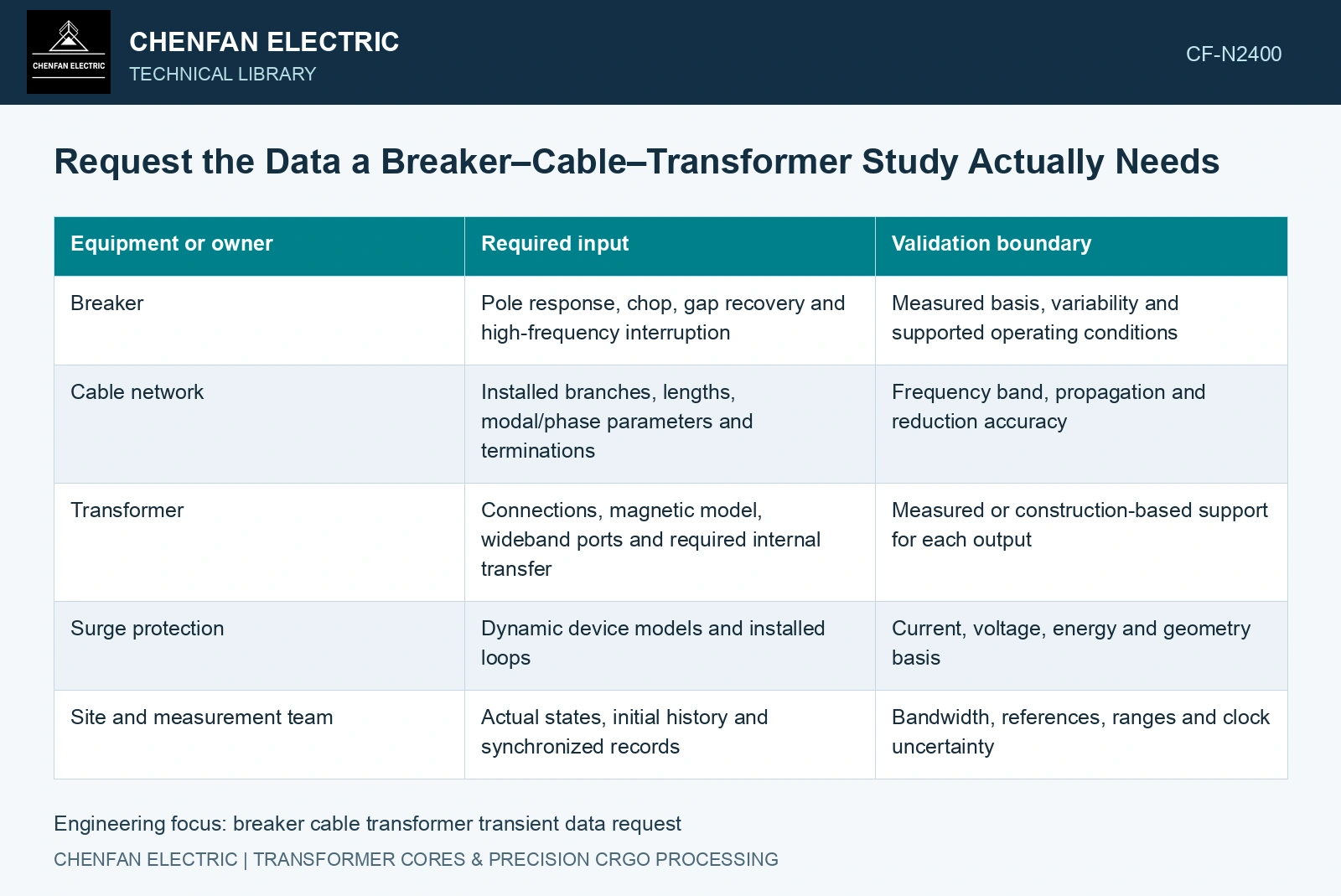
Allocate the model inputs and evidence
| Equipment or owner | Required input | Validation boundary |
|---|---|---|
| Breaker | Pole response, chop, gap recovery and high-frequency interruption | Measured basis, variability and supported operating conditions |
| Cable network | Installed branches, lengths, modal/phase parameters and terminations | Frequency band, propagation and reduction accuracy |
| Transformer | Connections, magnetic model, wideband ports and required internal transfer | Measured or construction-based support for each output |
| Surge protection | Dynamic device models and installed loops | Current, voltage, energy and geometry basis |
| Site and measurement team | Actual states, initial history and synchronized records | Bandwidth, references, ranges and clock uncertainty |
Define the interfaces in compatible terms
Specify voltage and current orientation, ground references, winding connections and unit conventions. A model using phase-ground quantities cannot be joined blindly to one whose ports represent phase differences.
Retain the model frequency range, time-domain realization and any excluded phenomena. A model suitable for slow magnetic excitation may not support fast cable waves, while a linear wideband terminal model may omit remanence and saturation.
Request the basis of statistical inputs. Typical published chopping or recovery values are sensitivity assumptions unless supported for the actual device. They do not establish occurrence probabilities.
Classify inputs and bound missing parameters
Classify each input as measured, supplied, inferred, assumed or unavailable. Missing capacitance, mutual coupling or internal loss is not zero by default. Assess its possible effect with supported bounds, or retain the resulting output as unresolved.
Where proprietary internal geometry is unavailable, request a suitable validated equivalent and the outputs it supports. A terminal equivalent may be adequate for terminal voltage but insufficient for turn-to-turn stress.
Define how models and measured records will be checked together. Independent switching events are stronger validation than reproducing the same event used to fit parameters.
Keep each equipment model version, physical circuit state and documented change linked in the configuration record [2]. A cable or transformer revision can change the applicable interface, so a model filename alone does not establish that the switching event used the represented hardware.
Match model time resolution to the requested output
Assume a study must resolve a 1 μs terminal-front feature but its retained waveform samples are 10 μs apart. The record has no within-front sample pair and cannot establish that edge shape. Obtain appropriately validated bandwidth and propagation data before interpreting turn stress; reducing solver step alone cannot recover missing equipment-model content.
Close gaps according to their decision impact
Prioritize the missing input that changes the required protection or insulation conclusion. A detailed cable fit cannot resolve an unsupported breaker sequence, and a precise terminal peak cannot resolve an unidentified internal transfer.
References
- M. Popov, R. P. P. Smeets, L. van der Sluis, H. de Herdt and J. Declercq, Experimental and Theoretical Analysis of Vacuum Circuit Breaker Prestrike Effect on a Transformer, IEEE Transactions on Power Delivery 24, 2009. DOI: 10.1109/TPWRD.2009.2013383.
- NASA, NASA Systems Engineering Handbook, section 6.5, Configuration Management, official online text.