

Separate the initiating defect from later arc damage. NASA notes that severe damage can erase original failure evidence [1]. Begin with competing sequences and identify the surviving feature that could distinguish them; extensive melting alone does not locate the origin.
Build at least two sequences before labeling an origin. One may begin with a deteriorated connection, followed by heating, insulation damage and arcing. Another may begin with an insulation failure elsewhere, followed by current transfer and damage at that same connection. Both can end with a melted joint.
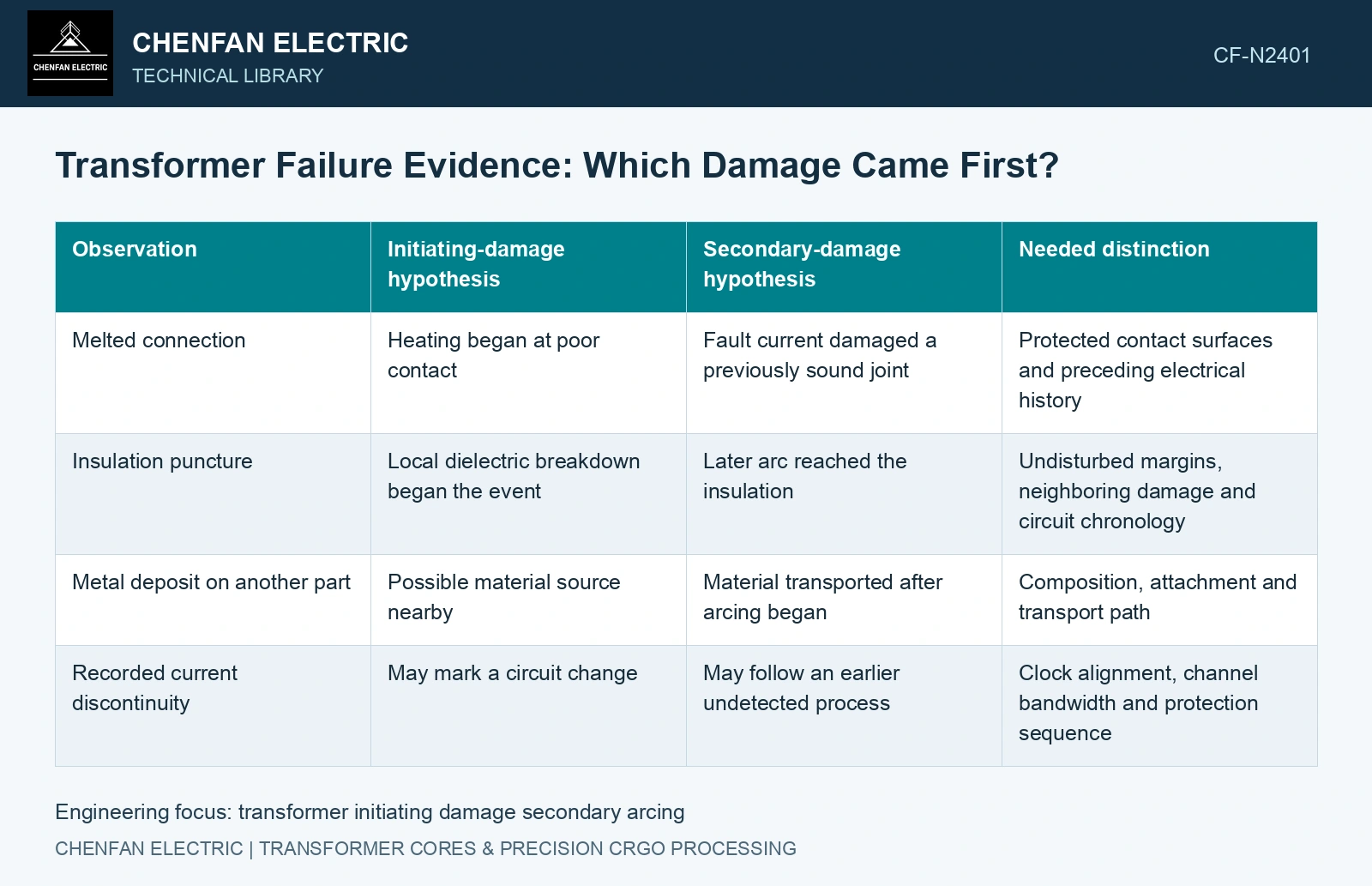
Ask which evidence distinguishes the sequences
A useful observation changes the relative plausibility of the explanations. General burning supports an energetic event but may fit both. An intact interface showing an older deterioration process beneath later deposits can be more discriminating, provided its interpretation is supported by material examination and the documented location.
| Observation | Initiating-damage hypothesis | Secondary-damage hypothesis | Needed distinction |
|---|---|---|---|
| Melted connection | Heating began at poor contact | Fault current damaged a previously sound joint | Protected contact surfaces and preceding electrical history |
| Insulation puncture | Local dielectric breakdown began the event | Later arc reached the insulation | Undisturbed margins, neighboring damage and circuit chronology |
| Metal deposit on another part | Possible material source nearby | Material transported after arcing began | Composition, attachment and transport path |
| Recorded current discontinuity | May mark a circuit change | May follow an earlier undetected process | Clock alignment, channel bandwidth and protection sequence |
Check whether the proposed sequence had an energy path
Draw the electrical connections at each stage, including the condition after each protective operation. A proposed sustained arc needs a source and a return path during the relevant interval. An open breaker indication does not establish when every pole stopped conducting, and a local damaged region does not identify which winding supplied the energy.
Check mechanical and thermal consequences against this sequence without manufacturing precision. Damage volume alone cannot reconstruct arc duration because heat transfer, material expulsion and changing arc attachment are unknown.
USBR’s diagnostic comparisons require consistent connection and test conditions [2]. Keep the as-found record separate from measurements after repair or movement; a normal later configuration cannot supply the missing pre-arc current path or timing.
Check the assumed arc energy path against switching time
Assume a proposed 5 kW average arc is electrically supplied for 20 ms before current interruption in the aligned record. Its input scale is 100 J. A hypothesis requiring 200 ms at that same power needs a documented additional source or interval. Test the physical return path and timing instead of reconstructing duration from damage volume.
References
- L. Ochs, NASA Goddard Space Flight Center, Basics of Failure Analysis, NASA Parts 101, December 4, 2024.
- U.S. Bureau of Reclamation, FIST Volume 3-31, Transformer Diagnostics, June 2003.