

Validate a reignition model against the event sequence that creates transformer stress. Compare gap voltage, current zeros, interruption timing and terminal response through the actual measurement chain. [1] [2]
Rao and Gajjar use random typical parameters rather than measured breaker parameters [2]. Treat that model as a sensitivity framework until independent records validate the actual breaker.
Separate equipment parameters from event inputs
Freeze the recovery, chopping and quenching representation selected for validation. Retain its characterization basis and uncertainty. Source phase, actual topology and pre-event load can legitimately vary between events; unmeasured recovery parameters should not be silently retuned to each waveform. [2]
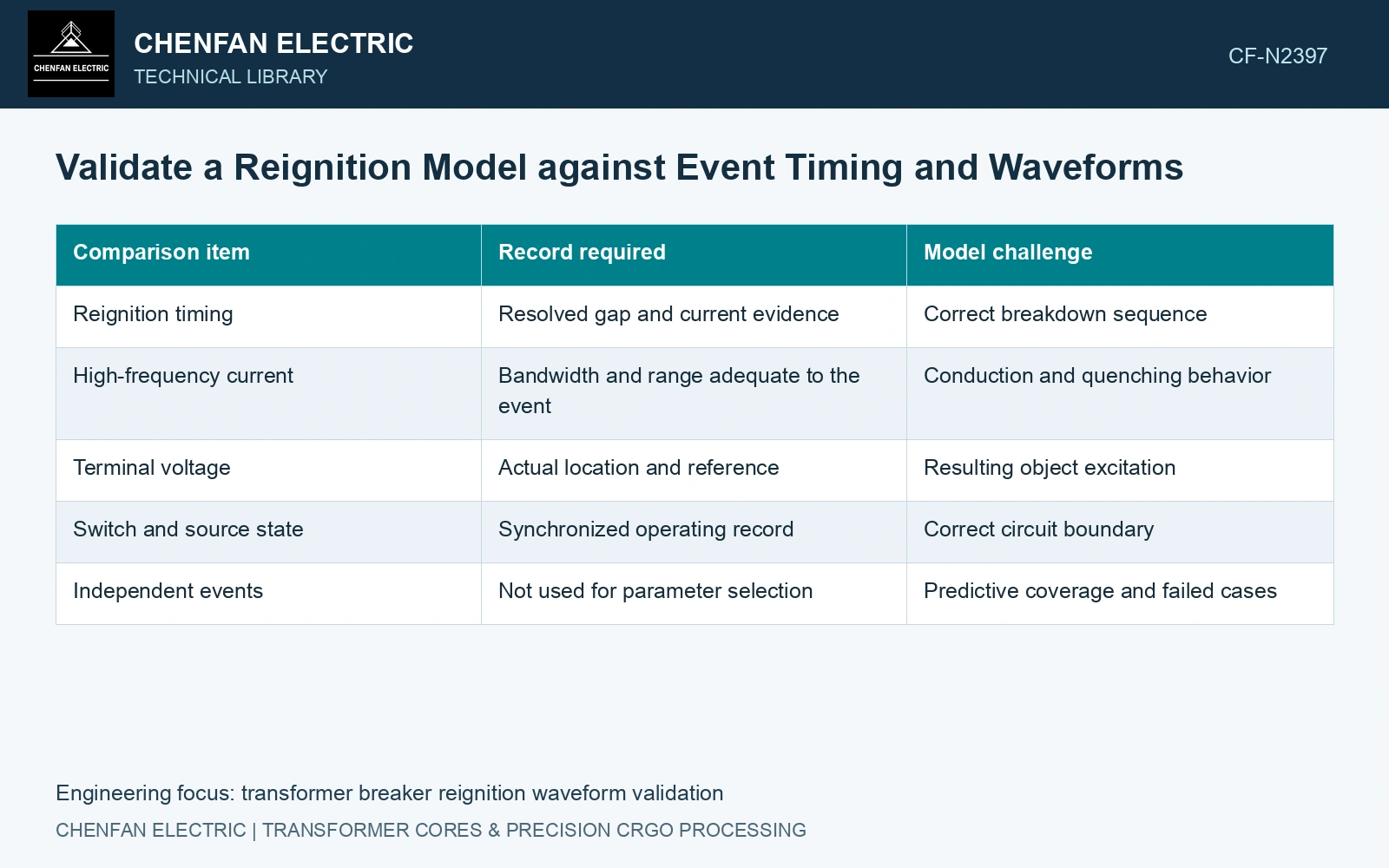
| Comparison item | Record required | Model challenge |
|---|---|---|
| Reignition timing | Resolved gap and current evidence | Correct breakdown sequence |
| High-frequency current | Bandwidth and range adequate to the event | Conduction and quenching behavior |
| Terminal voltage | Actual location and reference | Resulting object excitation |
| Switch and source state | Synchronized operating record | Correct circuit boundary |
| Independent events | Not used for parameter selection | Predictive coverage and failed cases |
Compare through the measurement transfer
A fast simulation contains features that a slower recorder cannot resolve. Apply the supported sensor and acquisition response to the modeled signal before comparing displayed event count or peak shape. Preserve the unprocessed modeled signal separately.
Do not interpret a missing measured pulse as proof that the model produced an extra physical event when the measurement bandwidth could have merged it. Conversely, a model that omits a clearly resolved current event needs explanation.
Check channel timing and polarity. An apparent gap-voltage/current inconsistency can result from clock or reference error, and it should not be repaired by shifting one trace until agreement looks favorable.
Retain sequence and uncertainty mismatches
Compare event intervals, current slopes, subsequent interruption and oscillation bands alongside peak voltage. Identify which quantities are independently observed and which are inferred from the model.
If initial charge or magnetic state is uncertain, evaluate a supported range. Selecting one hidden state solely because it fits the event converts validation into fitting.
Challenge the frozen model with additional events, including operations without repeated reignition. Retain false predictions and missed events; a model that predicts escalation everywhere lacks useful discrimination.
Accept the frozen model over the event conditions and acquisition band tested. Investigate sequence mismatches in breaker recovery or quenching before using the model to select protection, even when the terminal peak agrees. Preserve the corrected model and its independent validation events.
References
- M. Popov, R. P. P. Smeets, L. van der Sluis, H. de Herdt and J. Declercq, Experimental and Theoretical Analysis of Vacuum Circuit Breaker Prestrike Effect on a Transformer, IEEE Transactions on Power Delivery 24, 2009. DOI: 10.1109/TPWRD.2009.2013383.
- B. Kondala Rao and G. Gajjar, Development and Application of Vacuum Circuit Breaker Model in Electromagnetic Transient Simulation, IEEE, 2006. DOI: 10.1109/POWERI.2006.1632503.