

Time step and integration method can affect the state selected in a ferroresonance simulation. Jacobson’s event discussion notes this numerical sensitivity in reproducing initial transitions. Compare solver settings to establish a converged response for the stated physical model. [1]
Hold physical inputs fixed during the numerical check
Keep topology, switching-event definitions, capacitor voltages, magnetic initial state and component parameters unchanged. If switch timing shifts when the time grid changes, record how the event is represented and whether its physical timestamp is preserved. [2]
A comparison that changes the initial state along with the time step cannot isolate numerical effects.
| Numerical variation | Comparison output | Question |
|---|---|---|
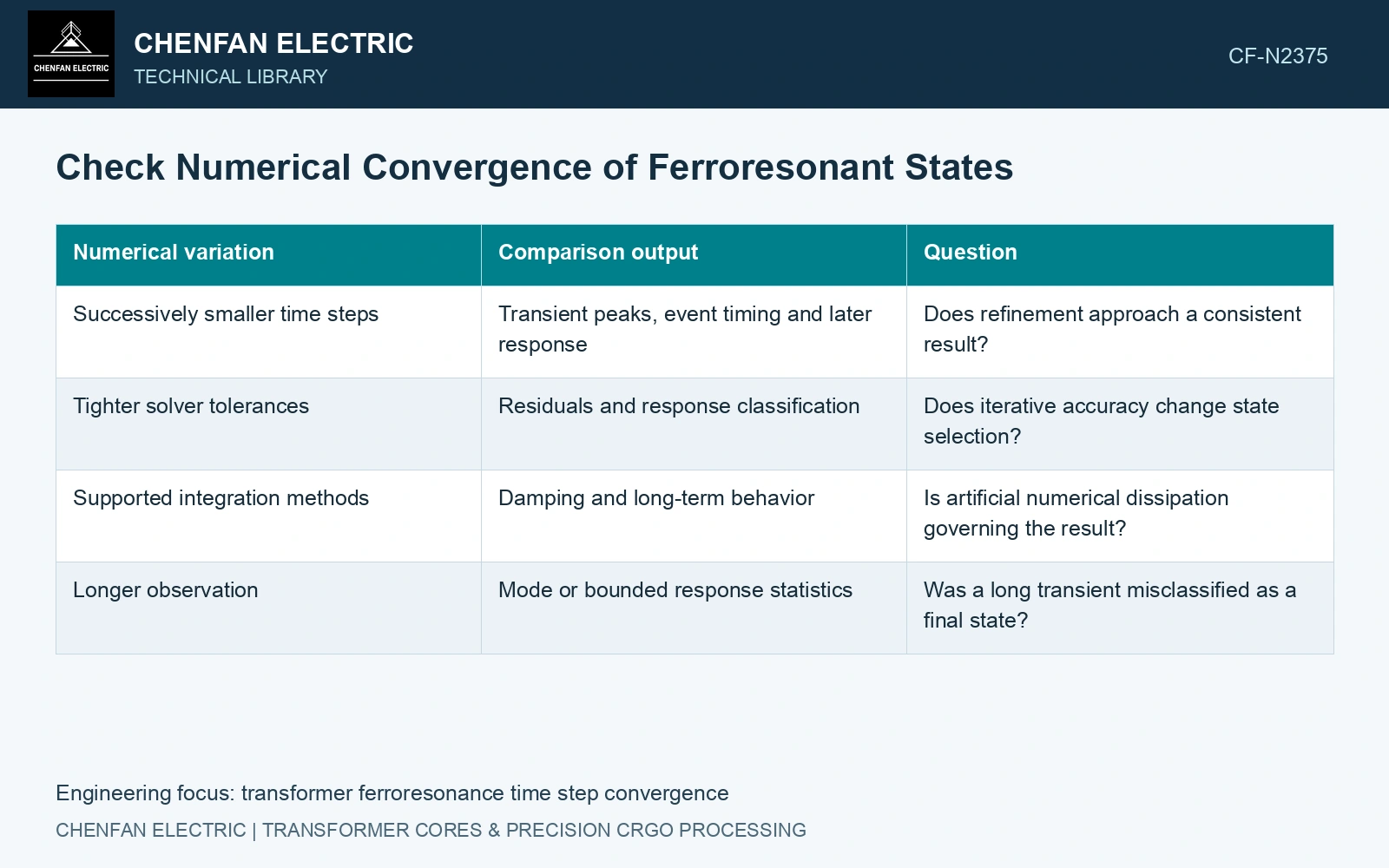
| Successively smaller time steps | Transient peaks, event timing and later response | Does refinement approach a consistent result? |
| Tighter solver tolerances | Residuals and response classification | Does iterative accuracy change state selection? |
| Supported integration methods | Damping and long-term behavior | Is artificial numerical dissipation governing the result? |
| Longer observation | Mode or bounded response statistics | Was a long transient misclassified as a final state? |
Compare more than the largest voltage
Retain phase waveforms, current, flux where modeled and dissipated energy. Two runs can share a maximum voltage while settling into different modes or accumulating different thermal exposure. [2]
Check energy behavior where the formulation supports it. An unexplained energy gain, or damping that changes materially with time step, can indicate a numerical artifact. Keep physical loss mechanisms separate from numerical damping.
Resolve rapid saturation transitions and relevant circuit timescales adequately. An arbitrary fixed step copied from another model is not evidence that this one is resolved.
Treat transition-sensitive cases honestly
Near a boundary between accessible states, small perturbations can select different responses. If numerical refinement changes the selected state, report a sensitive or unresolved case rather than averaging the modes into a fictitious stable waveform. [2]
For a candidate irregular response, long trajectories may diverge point by point even when the underlying behavior is consistent. Compare appropriate bounded statistics, phase-synchronous structure and classification in addition to short-term trajectory accuracy. Do not use divergence alone to claim chaos.
Repeat nearby supported physical cases after the numerical check. This distinguishes a broad response region from a result balanced precariously on one initialized boundary.
Retain the settings matrix and non-converged cases. Use the converged result alongside validated topology, material and loss inputs to interpret the physical response.
References
- D. A. N. Jacobson, Examples of Ferroresonance in a High Voltage Power System, IEEE PES General Meeting, 2003. DOI: 10.1109/PES.2003.1270499.
- P. Ferracci, Schneider Electric, Ferroresonance, Cahier Technique No. 190, March 1998.