

Pole-to-pole timing changes the temporary circuit, capacitor charge and magnetic state during switching. Carry those evolving states into the final circuit to establish which response each event sequence selects. [1]
Ferracci identifies switching instant among the initial-condition inputs. [2] Jacobson’s case discussion also notes the difficulty of reproducing early transients when exact breaker timing and pre-switch conditions are unknown. [1]
Define the event time being varied
Keep the command, mechanical contact event and effective electrical interruption distinct where they differ. Opening current can continue until interruption, while closing can involve other device-specific behavior. A model’s switch timestamp must correspond to the physical event it is intended to represent. [2]
Declare the source-phase reference and phase sequence. A timestamp without that reference cannot specify where on the voltage waveform the circuit changed.
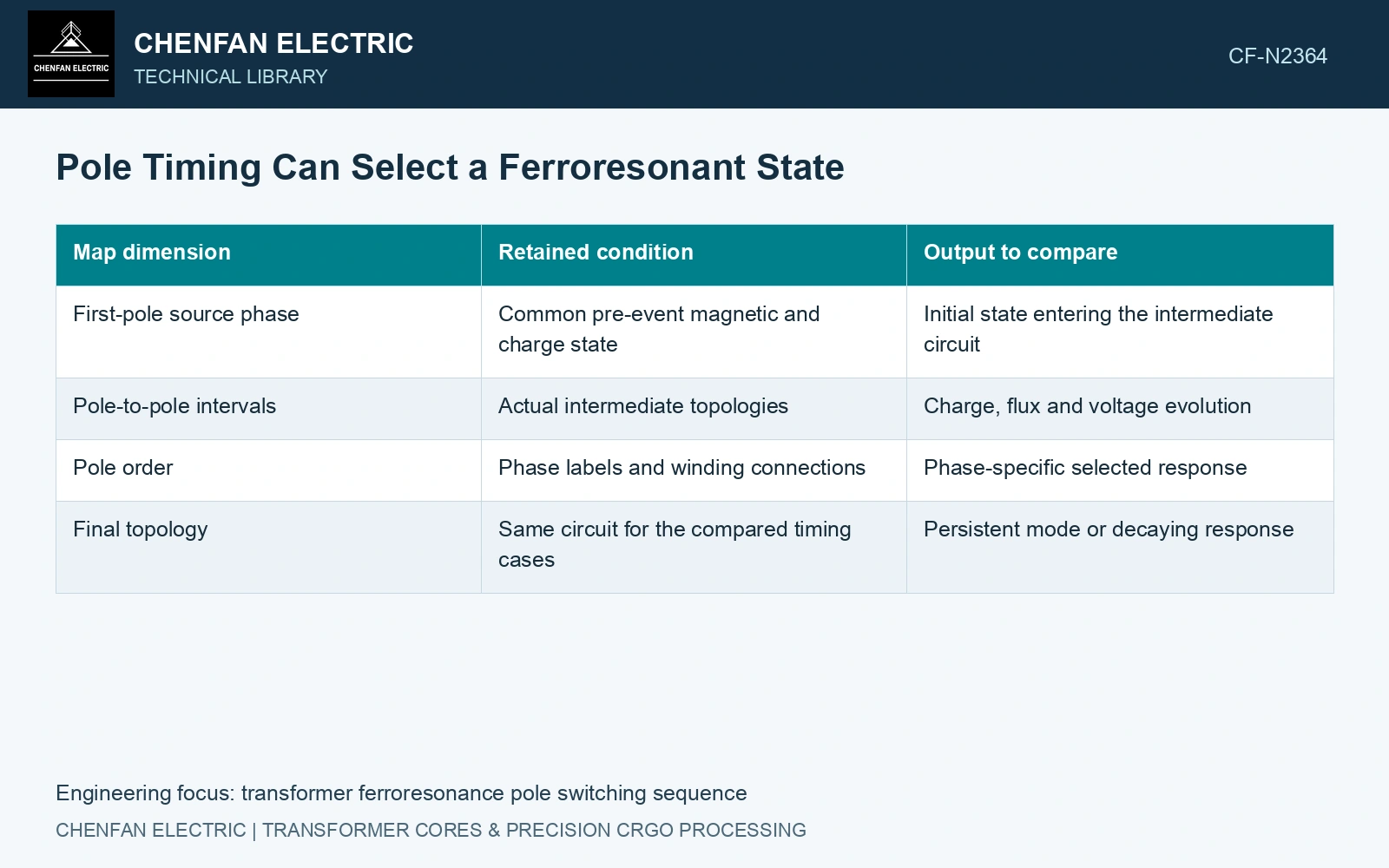
Build the pole-time state map
| Map dimension | Retained condition | Output to compare |
|---|---|---|
| First-pole source phase | Common pre-event magnetic and charge state | Initial state entering the intermediate circuit |
| Pole-to-pole intervals | Actual intermediate topologies | Charge, flux and voltage evolution |
| Pole order | Phase labels and winding connections | Phase-specific selected response |
| Final topology | Same circuit for the compared timing cases | Persistent mode or decaying response |
Use timing ranges supported by the device and event evidence. Arbitrary extreme intervals may be useful for sensitivity exploration but should be labeled as such, not presented as measured switching behavior. [2]
For each run, carry states continuously through the intermediate configurations. Resetting flux or capacitor voltage when the last pole moves would erase the timing mechanism being studied.
Compare eventual states as well as the first peak
A timing case can generate a large initial excursion and later settle normally, while another reaches a sustained abnormal state. Retain both transient stresses and long-term classification. Do not use one peak-voltage ranking as a substitute for state selection. [2]
Refine the timing grid near transitions and verify the numerical settings. If a small timing change switches the result, report the boundary sensitivity and the uncertainty of the actual event time.
Include credible pre-event magnetic histories in separate layers of the map. A favorable timing region for one remanent state may not remain favorable for another.
Record event phase, pole intervals and initial state beside each selected response. Use the resulting case matrix in the design and protection assessment under the approved operating basis.
References
- D. A. N. Jacobson, Examples of Ferroresonance in a High Voltage Power System, IEEE PES General Meeting, 2003. DOI: 10.1109/PES.2003.1270499.
- P. Ferracci, Schneider Electric, Ferroresonance, Cahier Technique No. 190, March 1998.