

GIC screening identifies the transformers that need detailed assessment. Advance the units whose current exposure, construction or starting thermal state warrants a closer calculation of local loss and heat removal. [1]
The NERC thermal white paper separates preliminary screening from design-specific thermal assessment. Its historical screening values should not be repackaged as a universal pass/fail current for every transformer.
State the screen’s decision before selecting its metric
A useful screen answers a limited question: which units or scenarios should receive further engineering effort under the chosen project basis? Record the metric, calculation assumptions and intended consequence. A result below a study trigger supports the consequence defined for that screen; it does not independently establish immunity to every possible event.
Resolve the current basis first. Total neutral current, winding current and autotransformer effective current are not interchangeable. If the screen uses the wrong quantity, additional numerical precision will not repair the underlying comparison.
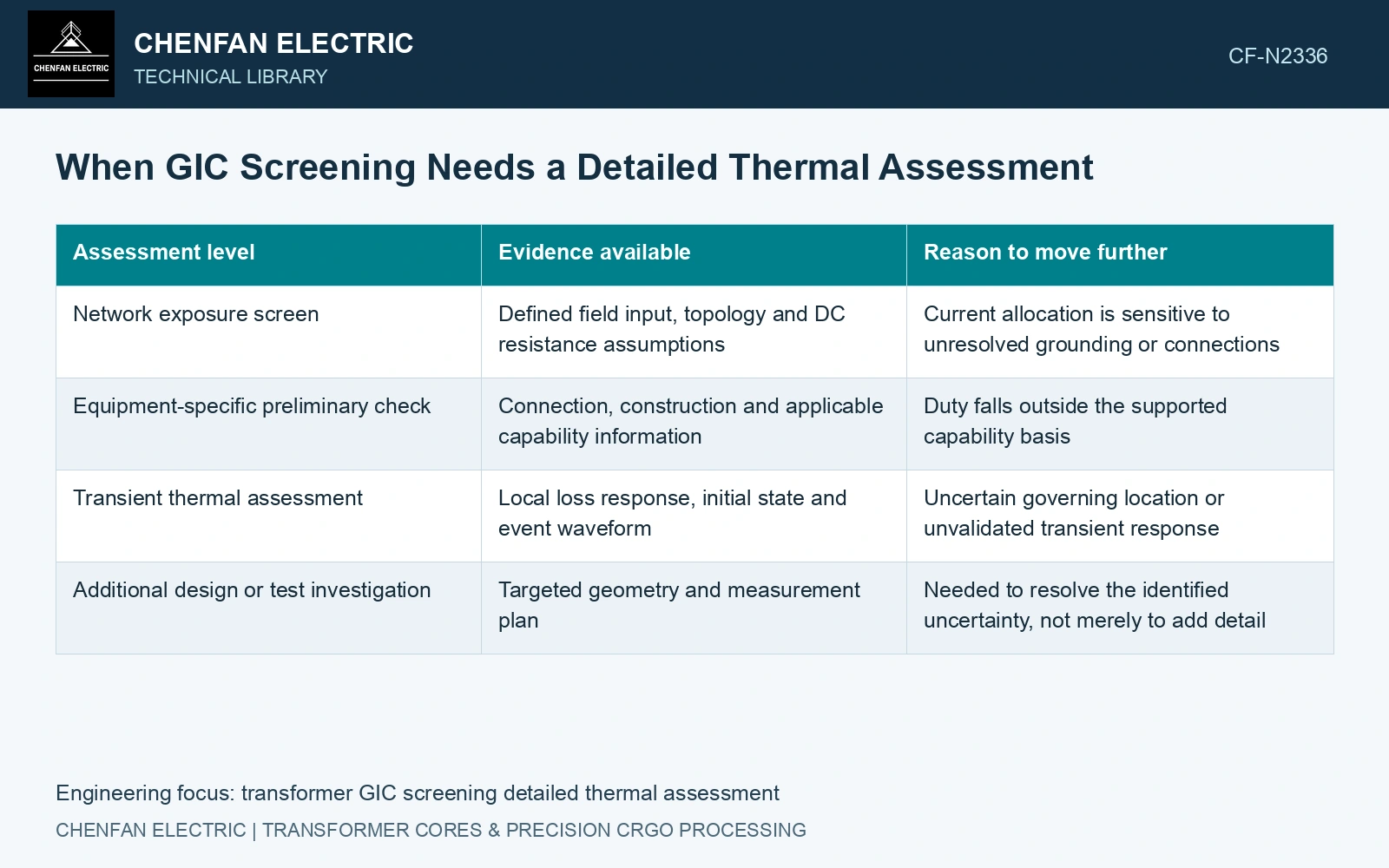
Escalate at the missing boundary
| Assessment level | Evidence available | Reason to move further |
|---|---|---|
| Network exposure screen | Defined field input, topology and DC resistance assumptions | Current allocation is sensitive to unresolved grounding or connections |
| Equipment-specific preliminary check | Connection, construction and applicable capability information | Duty falls outside the supported capability basis |
| Transient thermal assessment | Local loss response, initial state and event waveform | Uncertain governing location or unvalidated transient response |
| Additional design or test investigation | Targeted geometry and measurement plan | Needed to resolve the identified uncertainty, not merely to add detail |
Unknown structure can be an escalation reason even when the estimated current seems modest. A model that omits a conductive tie plate cannot demonstrate its temperature. Similarly, a steady-state capability point does not establish the response to a repeated pulse sequence unless that use is supported.
Retain the operating and event conditions
Carry initial load, oil temperature, cooling state, AC voltage and the GIC time history into the thermal stage. A capability comparison detached from its initial condition can understate absolute temperature.
Investigate credible network and resistance variations before selecting a single exposure case. The station with the largest total neutral current is not necessarily the transformer with the governing structural hot spot. Current allocation and internal response belong to different parts of the assessment. [2]
Use uncertainty to guide the next investigation. If grounding resistance dominates the exposure range, obtain better network evidence. If local structural geometry dominates the predicted temperature, refine that part of the transformer model rather than repeating the field-input calculation.
Keep a screening temperature on its published event basis
The 2017 NERC paper’s Table 1 gives a conservative 170 °C peak metallic hot spot for its benchmark event at 70 A/phase effective GIC and 80 °C bulk oil [1]. Assumptions: retain that event response and add a 10 K higher initial oil temperature; use an illustrative project review boundary of 180 °C. The shifted screen reaches 180 °C, consuming the original 10 K margin. This is a conditional screening comparison, not an asset prediction or a current regulatory requirement. Advance the unit to construction-specific assessment rather than calling the 70 A input a safe-current rating.
Close the screen with the units advanced, assumptions retained and specific questions assigned to detailed assessment. Establish thermal capability through local-loss, cooling and duty evidence for those units.
References
- NERC, Transformer Thermal Impact Assessment White Paper, Project 2013-03 Geomagnetic Disturbance Mitigation, October 2017.
- R. L. Bailey and coauthors, Modelling geomagnetically induced currents in midlatitude Central Europe using a thin-sheet approach, Annales Geophysicae 35, 2017. DOI: 10.5194/angeo-35-751-2017.