

Core recovery after a sustained DC-bias test depends on remanence, residual injection current and the condition of the test circuit. Compare the post-test electrical response with a controlled pre-test baseline to establish the recovered state.
Use the following matched-baseline screen to separate residual DC input from a persistent electrical change. Its result covers the declared checks, not unmeasured insulation or structural condition.
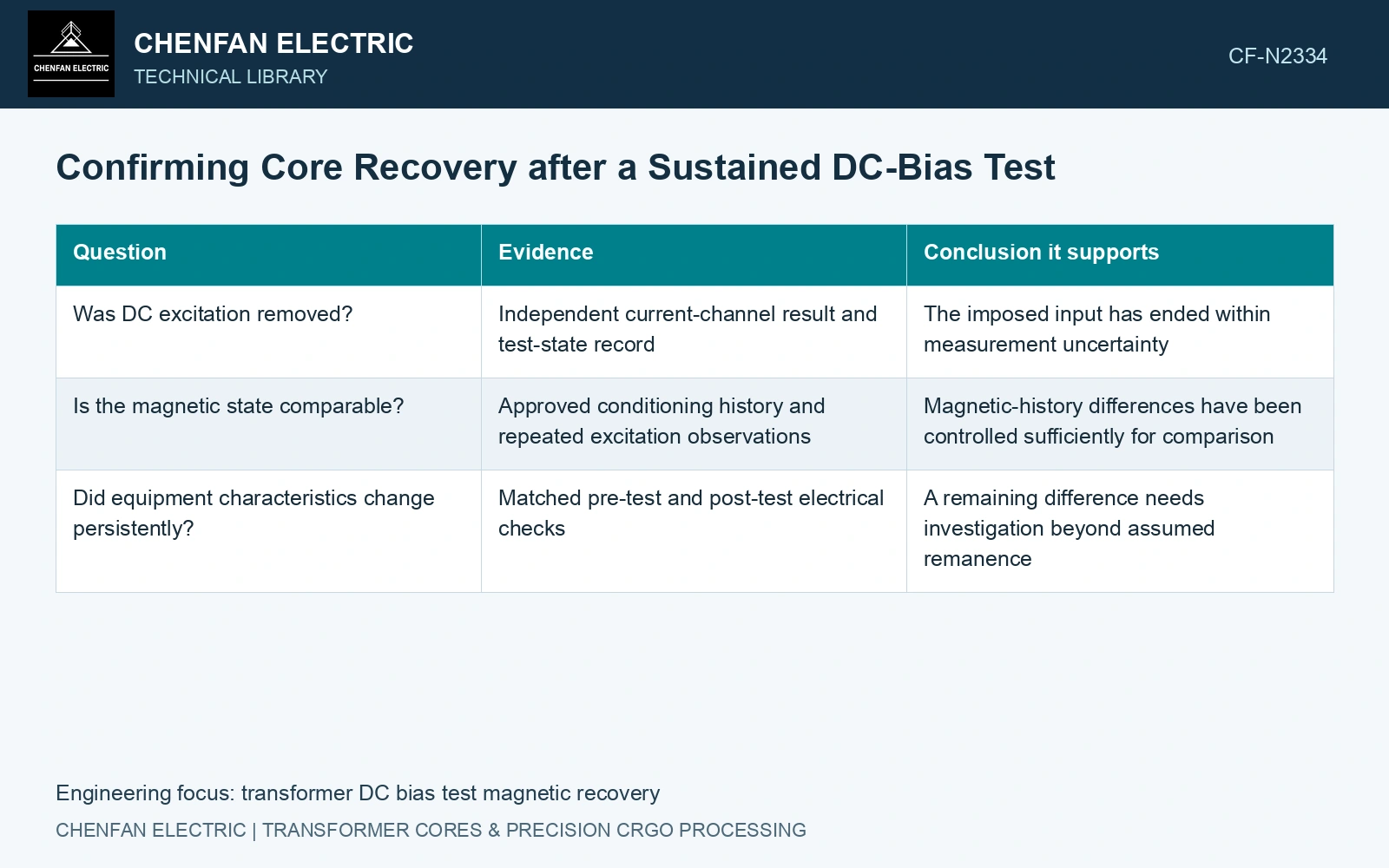
Distinguish three questions in the recovery record
| Question | Evidence | Conclusion it supports |
|---|---|---|
| Was DC excitation removed? | Independent current-channel result and test-state record | The imposed input has ended within measurement uncertainty |
| Is the magnetic state comparable? | Approved conditioning history and repeated excitation observations | Magnetic-history differences have been controlled sufficiently for comparison |
| Did equipment characteristics change persistently? | Matched pre-test and post-test electrical checks | A remaining difference needs investigation beyond assumed remanence |
Do not use an AC-current transformer’s return to a normal-looking waveform as proof of zero DC. Check the channel capable of measuring the continuing DC component and the circuit state that could sustain it.
Reproduce the baseline conditions
Compare at the same connection, tap, voltage, frequency and stated thermal condition. Preserve the voltage waveform as well as its RMS value because distortion can alter excitation current and measured loss. Use the same instruments and processing where possible, or quantify the changes.
Record how the original baseline was established. If it followed a defined magnetic-state conditioning procedure, a post-test comparison without comparable conditioning may be testing a different initial state. That does not justify an improvised demagnetization sequence; use only the equipment’s approved test procedure.
Retain excitation-current waveforms by phase, power measurements and any other checks required by the agreed test plan. Compare differences against repeatability and measurement uncertainty before treating a small change as an equipment effect.
Follow the evolution instead of choosing one favorable reading
Keep the first post-test energization transient separate from stable observations. Track whether asymmetry evolves, follows residual DC or persists after comparable conditioning.
Temperature recovery is a separate observation. Cooling to the initial oil temperature does not, by itself, confirm magnetic-state equivalence or rule out a local structural change. Conversely, a temperature difference can explain some electrical measurement differences without proving magnetic damage.
Check the AC baseline before judging magnetic recovery
Use catalogue nominal gauge 0.23 mm [1]. Assumptions: 1,000 active sheets, width 100 mm, 100 turns, sinusoidal induced voltage and 50 Hz. Steel-only section is 0.0230 m². A pre-test 868.02 V gives 1.700 T; a post-test 876.70 V gives 1.717 T, a 1.00% higher peak. A measured loss increase under those unequal conditions would not isolate incomplete recovery. Restore the same induced waveform and thermal state before comparing watts [2] [3]. Control cut-edge stress, joint registration, yoke reconstruction and clamp load as part of that baseline; catalogue sheet identity does not establish an unchanged assembled core.
After matching those conditions, assume measured DC is 0 A with expanded uncertainty 0.02 A, against a declared |IDC| + U ≤0.05 A rule. Assume pre/post losses are 1,000/1,004 W with 8 W expanded uncertainty in their difference and an agreed ±15 W equivalence band. Both screens meet their assumed criteria: 0.02 ≤0.05 A and |4| + 8 = 12 ≤15 W [3]. Investigate any remaining physical discrepancy separately.
References
- Nippon Steel Corporation, Grain-Oriented Electrical Steel Sheets, catalogue D004je, April 2020, specification tables, size tolerances and Annealing by Customers.
- U.S. Department of Energy, DOE-HDBK-1011/4-92, Electrical Science, Volume 4, 1992.
- B. N. Taylor and C. E. Kuyatt, NIST Technical Note 1297, Guidelines for Evaluating and Expressing the Uncertainty of NIST Measurement Results, 1994, sections 5 and 6.