

Compare transport mass and transformer rating on their actual configurations. Separately transported coolers change the vehicle load; active-part changes can affect losses, impedance, thermal limits and mechanical margin. The buyer needs both the shipping inventory and the complete deployed mode rating. [1]
Calculation basis. Project-specific values and gates in the illustrative screens below are assumptions; cited catalogue values retain their source test conditions.
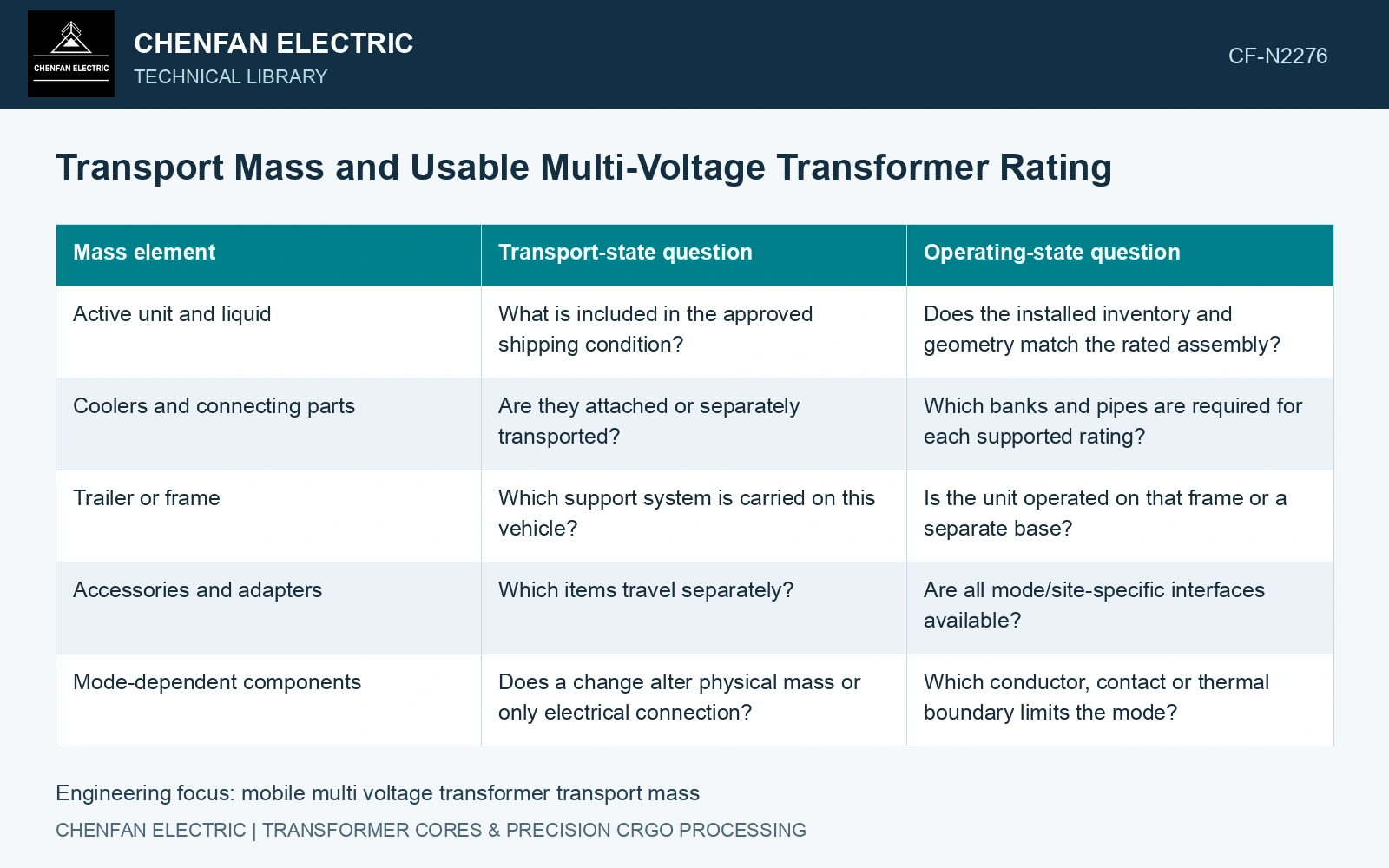
Define the mass boundary before comparing designs
Separate the active unit, liquid inventory, transport frame, cooling equipment, accessories and separately shipped items. Preserve whether a quoted mass refers to shipment, deployed operation or one vehicle leg. A lighter main vehicle does not mean the complete installed system has lost that mass.
| Mass element | Transport-state question | Operating-state question |
|---|---|---|
| Active unit and liquid | What is included in the approved shipping condition? | Does the installed inventory and geometry match the rated assembly? |
| Coolers and connecting parts | Are they attached or separately transported? | Which banks and pipes are required for each supported rating? |
| Trailer or frame | Which support system is carried on this vehicle? | Is the unit operated on that frame or a separate base? |
| Accessories and adapters | Which items travel separately? | Are all mode/site-specific interfaces available? |
| Mode-dependent components | Does a change alter physical mass or only electrical connection? | Which conductor, contact or thermal boundary limits the mode? |
Separate the shipping and service inventories
In an illustrative inventory, assume 21 tonnes for the active unit, 2 tonnes of liquid, 4 tonnes of trailer/frame and 3 tonnes of cooler equipment. The complete assembly totals 30 tonnes. Shipping the coolers separately reduces that vehicle’s assumed mass to 27 tonnes, but the operating system still needs the specified cooler package. These values are arithmetic examples, not a proposed shipping arrangement or transport-permit assessment.
Compare rating by mode and deployment
For each electrical mode, map winding currents, reconnection-link currents, losses and the applicable cooling state. A lower-voltage mode may expose a different current bottleneck even when the main assembly mass is unchanged. Conversely, a mass-reduced redesign can require new evidence for leakage impedance, heating and transport response.
Do not merge a best-case mode rating with a minimum-mass shipping state unless that deployed combination is actually supported. Include the time and hardware required to assemble separately transported equipment in the practical deployment comparison.
Show the mass carried on each route leg beside the equipment required for each operating mode. Include assembly time and hardware so the buyer can compare a logistics change with an active-part redesign.
Keep the cooler mass attached to the operating rating
Keep the installed cooler and liquid configuration with its maintenance evidence [2].
The assumed 21 t active unit, 2 t liquid, 4 t trailer/frame and 3 t cooler package total 30 t. Separate cooler transport reduces the first vehicle to 27 t, a 10% reduction, while total equipment mass remains 30 t. Require the completed cooler configuration for the stated operating duty and include the separate shipment in dispatch planning.
References
- U.S. Department of Energy, Benefits of Using Mobile Transformers and Mobile Substations for Rapidly Restoring Electrical Service, August 2006, sections 2.1.4 and 2.2.1–2.2.2.
- U.S. Bureau of Reclamation, FIST Volume 3-30, Transformer Maintenance, 2000.