

Commissioning after a mobile transformer move should target the interfaces that changed. Compare mode, cooler arrangement, supports, cables, neutral connection and auxiliaries with the previous verified assembly, then select the checks that establish the new site configuration. [1]
Calculation basis. Project-specific values and gates in the illustrative screens below are assumptions; cited catalogue values retain their source test conditions.
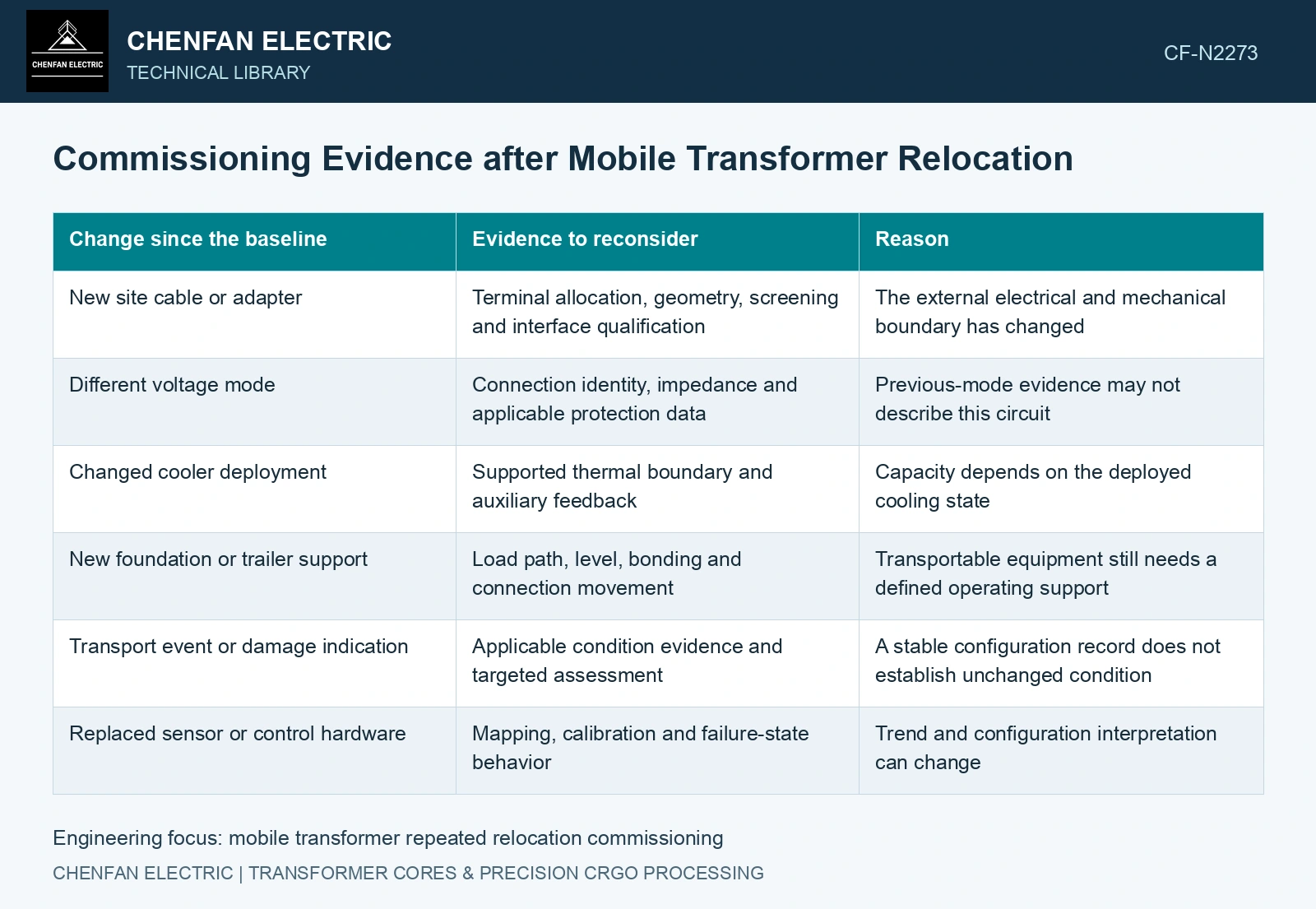
Classify changes by their engineering consequence
Compare the previous verified assembly with the present one. Retain serial identities, mode, cooler arrangement, support geometry, cables, neutral connection and auxiliary system. An item described as unchanged needs supporting traceability; the statement should not conceal a replacement or an unrecorded field modification.
| Change since the baseline | Evidence to reconsider | Reason |
|---|---|---|
| New site cable or adapter | Terminal allocation, geometry, screening and interface qualification | The external electrical and mechanical boundary has changed |
| Different voltage mode | Connection identity, impedance and applicable protection data | Previous-mode evidence may not describe this circuit |
| Changed cooler deployment | Supported thermal boundary and auxiliary feedback | Capacity depends on the deployed cooling state |
| New foundation or trailer support | Load path, level, bonding and connection movement | Transportable equipment still needs a defined operating support |
| Transport event or damage indication | Applicable condition evidence and targeted assessment | A stable configuration record does not establish unchanged condition |
| Replaced sensor or control hardware | Mapping, calibration and failure-state behavior | Trend and configuration interpretation can change |
Keep the baseline interpretable
Record the conditions under which a previous measurement was taken. Winding resistance, excitation behavior and thermal readings can differ because temperature, tap or test arrangement changed. A comparison requires matching references or justified normalization rather than treating every numerical difference as deterioration.
Separate a configuration change from a condition change. A new cable path can alter a measured transient even when the transformer is unchanged. A damaged support can alter condition without changing the nominal electrical mode. The chosen assessment should address the plausible mechanism.
Define targeted retests with a clear purpose
For each changed boundary, state the question and the evidence that answers it. This may be drawing verification, interface inspection, a specific electrical check or additional engineering analysis. The applicable manufacturer and project requirements determine the actual test methods and acceptance criteria.
Retain the factory results that still apply and close the changed site interfaces with targeted tests. Use traceable equipment identities, assembly records and configuration-sensitive diagnostics to support that assessment.
Record the change, the check that addresses it and the earlier result that remains valid. This keeps commissioning focused on the actual move and gives the next deployment a usable baseline.
Normalize comparison measurements before diagnosing transport damage
USBR gives the copper temperature-correction constant as 234.5 °C [2].
Assume the same copper winding measures 0.100 Ω at 20 °C before the move and 0.112 Ω at 50 °C afterward. The 20 °C equivalent is 0.112 × (234.5+20)/(234.5+50) = 0.10019 Ω, only 0.192% above baseline. Confirm the material relation and measurement uncertainty before attributing the raw 12% increase to damage.
References
- U.S. Department of Energy, DOE-HDBK-1011/4-92, Electrical Science, Volume 4, 1992.
- U.S. Bureau of Reclamation, FIST Volume 3-31, Transformer Diagnostics, June 2003, section 15.1.