

A phase-shifter digital model needs traceable assembly identity and demonstrated calculation scope. Deliver the port conventions, parameter evidence and model class that the receiving engineer needs for the intended study. [1]
Calculation basis. Project-specific values and gates in the illustrative screens below are assumptions; cited catalogue values retain their source test conditions.
State the model class before listing parameters
Define the intended quantities and time scale. A positive-sequence load-flow model may represent terminal ratio, angle and impedance without identifying every internal winding. An internal-fault or fast-transient study needs information that such an equivalent deliberately omits. A parameter fitted to terminal measurements is not automatically a uniquely identified physical winding parameter.
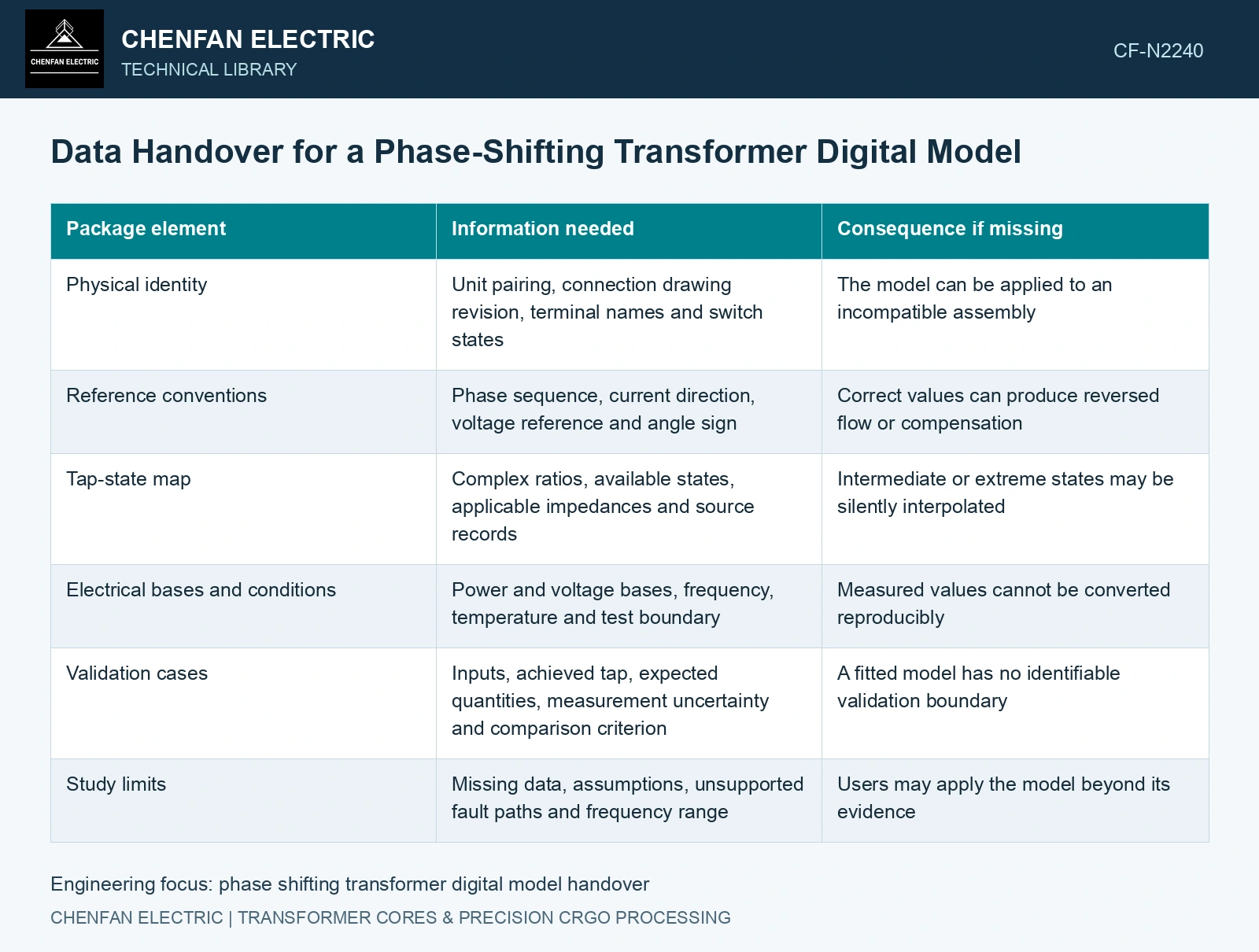
| Package element | Information needed | Consequence if missing |
|---|---|---|
| Physical identity | Unit pairing, connection drawing revision, terminal names and switch states | The model can be applied to an incompatible assembly |
| Reference conventions | Phase sequence, current direction, voltage reference and angle sign | Correct values can produce reversed flow or compensation |
| Tap-state map | Complex ratios, available states, applicable impedances and source records | Intermediate or extreme states may be silently interpolated |
| Electrical bases and conditions | Power and voltage bases, frequency, temperature and test boundary | Measured values cannot be converted reproducibly |
| Validation cases | Inputs, achieved tap, expected quantities, measurement uncertainty and comparison criterion | A fitted model has no identifiable validation boundary |
| Study limits | Missing data, assumptions, unsupported fault paths and frequency range | Users may apply the model beyond its evidence |
Make one test case reproducible
Package a complete case rather than a screenshot of a matching curve. Specify the terminal source conditions, connections, grounding, tap and quantities being compared. Preserve the measured reference and units alongside the converted model input. A reviewer should be able to reproduce the same case without guessing the angle sign or replacing the impedance base.
Label each parameter as measured, derived, assumed or unavailable. For a derived value, retain the derivation and originating record. Where alternative internal models fit the same terminal data, disclose that non-uniqueness and restrict the resulting model to the validated purpose.
Control revisions at the data boundary
Associate the model file, parameter table and validation cases with a common revision and stable identifiers. A changed tap schedule or replacement unit should trigger review of the affected parameters and cases. A checksum can detect a changed file; it cannot establish that the changed model remains physically correct.
Deliver a terminal model with identified limits where detailed design data are unavailable. State the studies it supports and the measurement or model-class changes needed to resolve remaining gaps.
Make the handed-over angle unit testable
Tie the model and acceptance evidence to the specific PST application and tested configuration [2].
Assume the factory model specifies a +10° phase shift, while a receiving tool expects radians. The correct input is 10π/180 = 0.17453 rad. Entering 10 as radians would represent 572.96°, equivalent to 212.96° after full rotations. Include a signed phasor test in the handover so unit conversion and terminal direction are checked together.
References
- B. Cook, M. J. Thompson, K. Garg and M. Malichkar, Phase-Shifting Transformer Control and Protection Settings Verification, 2018. DOI: 10.1109/CPRE.2018.8349815.
- IEC, IEC 62032:2012, Guide for the Application, Specification and Testing of Phase-Shifting Transformers.