

AC furnace factory acceptance needs a duty-to-evidence map. Connect each electrical, mechanical and thermal stress to the agreed test or system qualification that demonstrates the relevant performance. IEEE C57.17-2012 is listed as Inactive-Reserved; use its furnace-transformer scope as a historical reference while specifying the contract acceptance basis. [1]
Calculation basis. Project-specific values and gates in the illustrative screens below are assumptions; cited catalogue values retain their source test conditions.
Start with the stated current waveforms, tap sequence, repeated events and cooling conditions. Then identify what the agreed factory measurements actually apply and observe. Test names alone do not establish the waveform, duration or boundary represented.
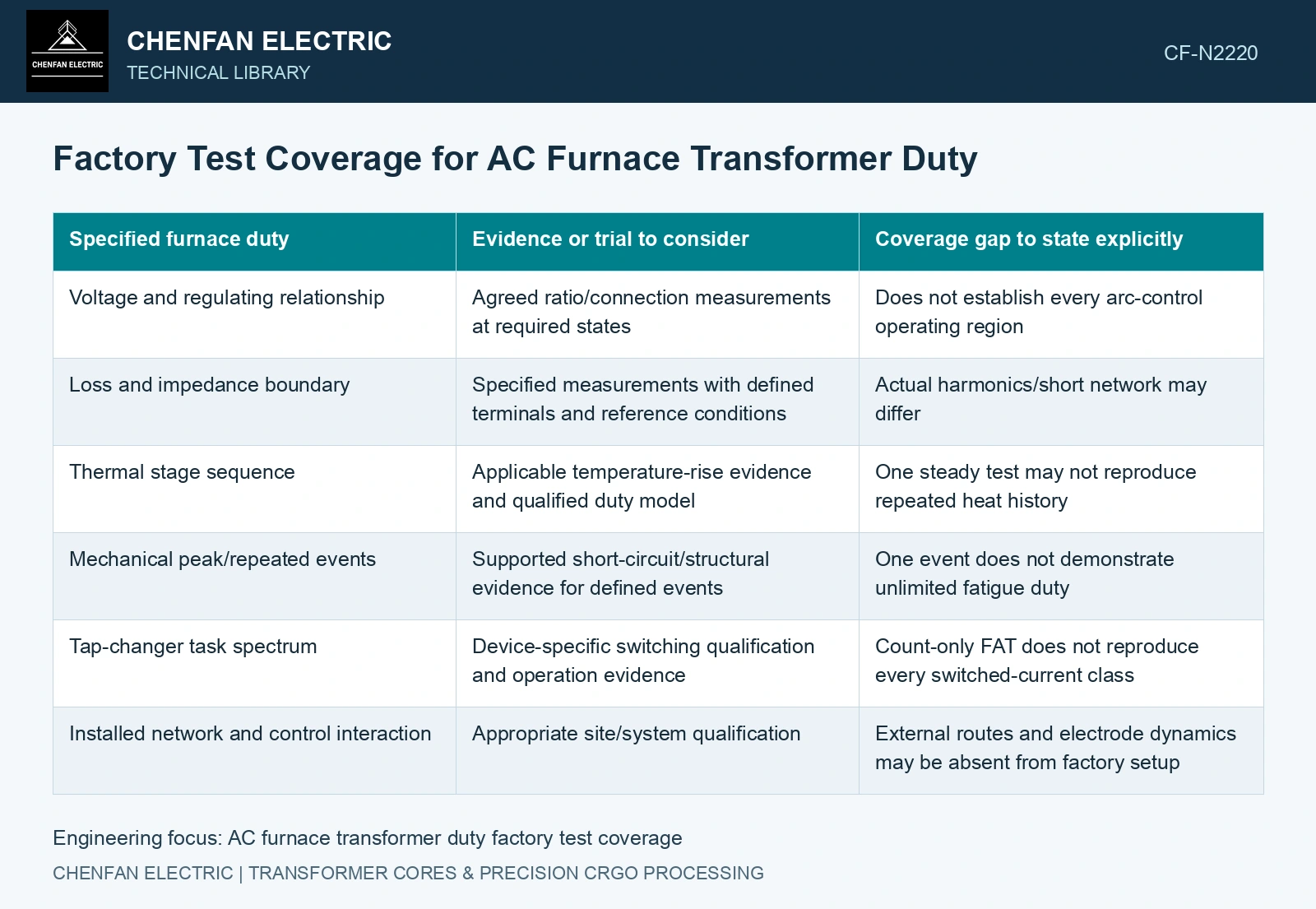
Map duty requirements to test coverage
| Specified furnace duty | Evidence or trial to consider | Coverage gap to state explicitly |
|---|---|---|
| Voltage and regulating relationship | Agreed ratio/connection measurements at required states | Does not establish every arc-control operating region |
| Loss and impedance boundary | Specified measurements with defined terminals and reference conditions | Actual harmonics/short network may differ |
| Thermal stage sequence | Applicable temperature-rise evidence and qualified duty model | One steady test may not reproduce repeated heat history |
| Mechanical peak/repeated events | Supported short-circuit/structural evidence for defined events | One event does not demonstrate unlimited fatigue duty |
| Tap-changer task spectrum | Device-specific switching qualification and operation evidence | Count-only FAT does not reproduce every switched-current class |
| Installed network and control interaction | Appropriate site/system qualification | External routes and electrode dynamics may be absent from factory setup |
Read the actual waveform and state
A measurement performed under a particular sinusoidal or other stated input supports that condition. It should not be described as a complete harmonic-duty demonstration unless the method or validated model supplies that transfer. The same applies to temperature, tap and cooling states.
Where modelling bridges a test to service duty, identify the validated parameters and uncertainty. A calculation is another form of evidence with its own scope; it is not a missing test silently treated as completed.
Assign system questions to representative qualification
Some installed short-network geometry, electrode-control behavior or site-source condition cannot be represented economically or faithfully in the factory arrangement. Define the appropriate later system evidence and preserve responsibility for the gap.
For a representative special test, state the imposed waveform, duration, initial state and observed quantities. A demonstration of one operating point may leave adjacent taps, degraded cooling or recurring events unresolved.
Make the acceptance conclusion traceable
Record whether each requirement is supported directly, through a qualified transfer model, by applicable prior evidence or remains open. The classification should refer to an actual report and scope, not an unsupported assurance that the design has been tested before.
Reconcile changes after FAT. A different external reactor, cooling accessory or short-network layout can alter the service duty even when the tested transformer is unchanged.
Close factory acceptance on the agreed demonstrated properties. Carry each remaining system question to its named qualification step in the duty-to-evidence record.
Map a furnace pulse into the factory-duty envelope
Electrical loss and impedance calculations require one declared current and terminal reference [2].
Assume an operating pulse of 20 kA RMS for 2 s and a factory thermal-equivalent pulse of 16 kA for 3 s in the same conductor. Their current-squared-time integrals are 800 and 768 (kA)²·s, leaving the operating event 4.17% higher. Matching peak current, winding temperature and repetition remains necessary before declaring the factory evidence sufficient.
References
- IEEE, IEEE C57.17-2012, IEEE Standard Requirements for Arc Furnace Transformers (Inactive-Reserved).
- U.S. Department of Energy, DOE-HDBK-1011/4-92, Electrical Science, Volume 4, 1992.