

Fix terminal reference before translating phase-shifter advance and retard. Match drawing connections, measured voltage angles and software signs in one table to make each tap state’s physical meaning clear. [1]
Calculation basis. Project-specific values and gates in the illustrative screens below are assumptions; cited catalogue values retain their source test conditions.
Choose terminal S as the sending reference and define positive power from S to R. Then declare the voltage transformation and angle sign mathematically. Do not infer the sign from a tap label or from the word advance alone.
Declare one study convention
For the illustrative convention used here, the effective sending voltage is Veff = VSexp(−jα). Positive α therefore retards that voltage relative to VS. A lossless fixed-bus branch screen is P = |VS||VR|sin(θS − θR − α)/X, with X positive and power referenced S to R.
Other equipment or software conventions can be valid, but they must be translated to this declaration before comparison. Some programs place a complex ratio at the from terminal; reversing from/to order can change the interpretation.
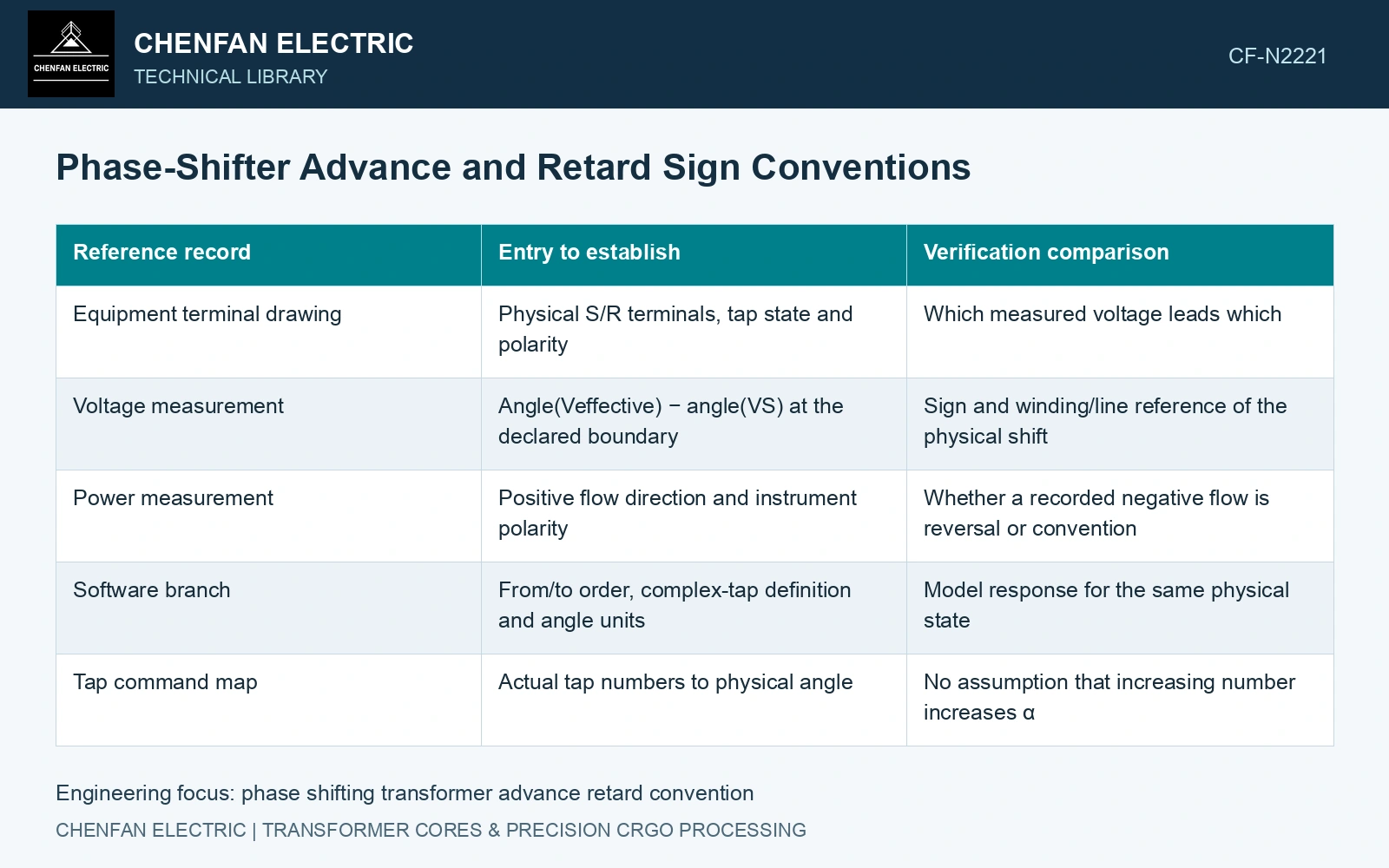
| Reference record | Entry to establish | Verification comparison |
|---|---|---|
| Equipment terminal drawing | Physical S/R terminals, tap state and polarity | Which measured voltage leads which |
| Voltage measurement | Angle(Veffective) − angle(VS) at the declared boundary | Sign and winding/line reference of the physical shift |
| Power measurement | Positive flow direction and instrument polarity | Whether a recorded negative flow is reversal or convention |
| Software branch | From/to order, complex-tap definition and angle units | Model response for the same physical state |
| Tap command map | Actual tap numbers to physical angle | No assumption that increasing number increases α |
Run a small sign test
Assume, illustratively, fixed terminal-angle difference 10° and otherwise unchanged lossless branch inputs. Changing α from 0° to +2° changes the sine term from sin10° to sin8°. The model power becomes about 80.1% of its previous value.
That direction check belongs only to the stated fixed-bus model. In a full meshed network, bus angles and other flows can also respond. Recompute the full-network response before using the local sign sensitivity in a control study.
Check units and reversed references
Most analytical derivatives require radians even when drawings and software display electrical degrees. Record the conversion. A sign that looks correct at one point can still be paired with a degree/radian error in a sensitivity matrix.
Retain the equipment terminal and tap references in the PST test record [2].
References
- B. Cook, M. J. Thompson, K. Garg and M. Malichkar, Phase-Shifting Transformer Control and Protection Settings Verification, 2018. DOI: 10.1109/CPRE.2018.8349815.
- IEC, IEC 62032:2012, Guide for the Application, Specification and Testing of Phase-Shifting Transformers.