

A post-conversion sampling plan should follow retained liquid, circulation and stagnant volumes. Map representative composition by location before supporting fire-point, viscosity or monitor-calibration claims. [1]
Calculation basis. Project-specific values and gates in the illustrative screens below are assumptions; cited catalogue values retain their source test conditions.
Start with the installed oil-route drawing. Mark upper and lower tank ports, cooler connections, return paths and any isolated or poorly swept volume. A port’s height alone does not establish the material that passes it during the chosen pump state.
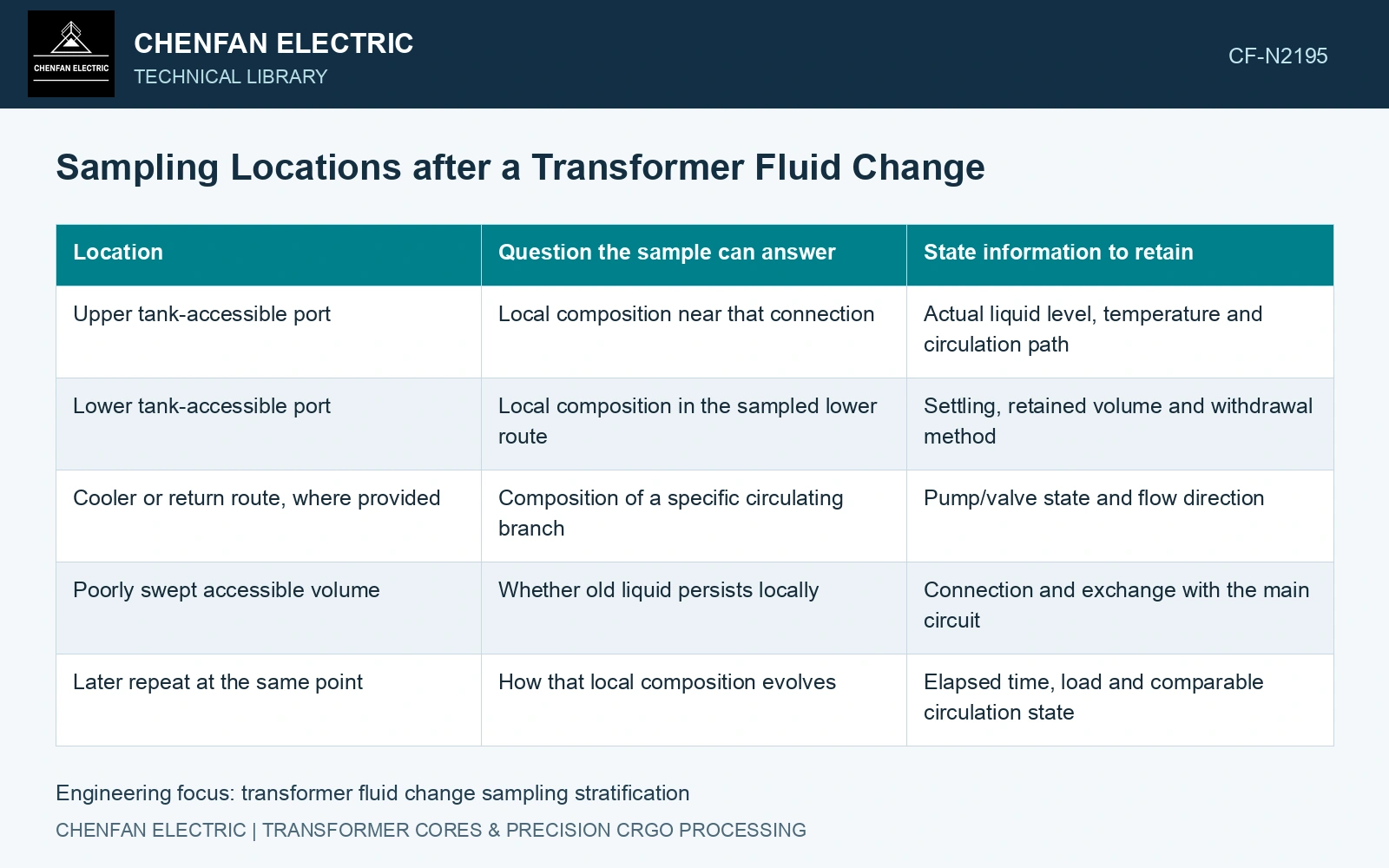
Connect each sample to a location and circulation state
| Location | Question the sample can answer | State information to retain |
|---|---|---|
| Upper tank-accessible port | Local composition near that connection | Actual liquid level, temperature and circulation path |
| Lower tank-accessible port | Local composition in the sampled lower route | Settling, retained volume and withdrawal method |
| Cooler or return route, where provided | Composition of a specific circulating branch | Pump/valve state and flow direction |
| Poorly swept accessible volume | Whether old liquid persists locally | Connection and exchange with the main circuit |
| Later repeat at the same point | How that local composition evolves | Elapsed time, load and comparable circulation state |
Use an appropriate composition marker
Select a qualified analytical method that distinguishes the identified liquids in the relevant range. Color or density alone may not uniquely identify ratio, particularly after aging or contamination. Record calibration, uncertainty and whether the method reports mass or volume fraction.
Illustratively, assume three valid local measurements give ester fractions of 0.60, 0.66 and 0.73 on the same basis. Their observed range is xmax − xmin = 0.13, or 13 percentage points. That is evidence of sampled variation under the stated uncertainty, not a volume-weighted inventory average.
Preserve the sampling method
Retain container preparation, port conditioning and the permitted withdrawal procedure. A port can contain residual fluid that differs from the adjacent circulating route. Sampling equipment can introduce another liquid or contamination unless its history is controlled.
Compare locations as nearly as practical under a defined equipment state. If measurements are separated by changing pump states or a long warm interval, the difference may combine spatial variation with ongoing mixing and release of retained liquid.
Decide what representativeness has been demonstrated
Converging results at selected points can support increased uniformity in the sampled routes. They do not inspect every paper-held or inaccessible volume. A later shift can reflect continuing exchange even after the bulk samples initially agree.
Use a project-specific composition requirement and sampling evidence appropriate to the intended property claim. No universal post-fill waiting time or acceptable location spread is proposed.
Resolve a sample-to-inventory difference through its flow route and measurement boundary. Tie the final property or calibration claim to representative composition evidence.
Decide whether sampled variation exceeds the stated resolution
IEC 60475 covers sampling insulating liquids in containers and electrical equipment, including mineral and non-mineral liquids [2]. Select its applicable procedure; the following comparison intervals are assumptions. Retain the before/after sampling and changed component records in the retrofill handover [3].
For assumed ester fractions 0.60, 0.66 and 0.73, the range is 0.13, or 13 percentage points. If each method result has an assumed ±0.02 absolute comparison interval, the extreme intervals are 0.58–0.62 and 0.71–0.75 and do not overlap. Investigate the circulation and sampling locations before assigning one representative composition.
References
- M. Lyutikova, S. Korobeynikov, U. Mohan Rao and I. Fofana, Mixed Insulating Liquids with Mineral Oil for High Voltage Transformer Applications: A Review, IEEE Transactions on Dielectrics and Electrical Insulation, 2022. DOI: 10.1109/TDEI.2022.3157908.
- IEC, IEC 60475:2022, Method of sampling insulating liquids.
- Cargill, FR3 Fluid Retrofilling Power Class Transformers Guide, R2040, 2020.