

Mixed-fluid breakdown testing needs representative samples and matched electrode conditions. Control handling and test geometry to distinguish chemistry-related changes from differences introduced by the measurement route. [1]
Calculation basis. Project-specific values and gates in the illustrative screens below are assumptions; cited catalogue values retain their source test conditions.
Identify the applicable liquid test method and the laboratory’s actual procedure. Electrode geometry, gap, voltage application and specimen handling define the result. A number obtained under one method should not be compared directly with a number under another as though both measured a universal liquid strength.
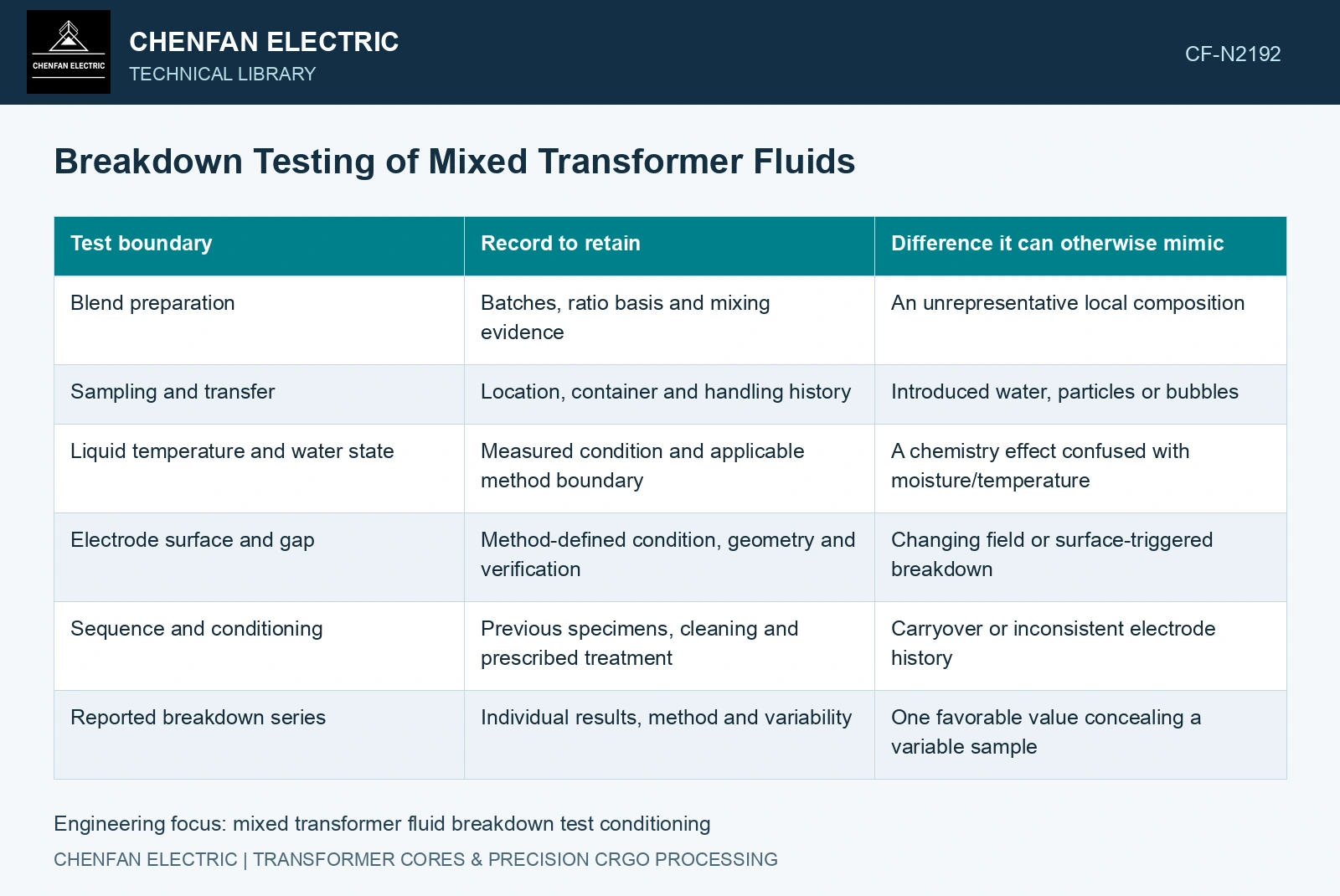
Control the sample and electrode histories
| Test boundary | Record to retain | Difference it can otherwise mimic |
|---|---|---|
| Blend preparation | Batches, ratio basis and mixing evidence | An unrepresentative local composition |
| Sampling and transfer | Location, container and handling history | Introduced water, particles or bubbles |
| Liquid temperature and water state | Measured condition and applicable method boundary | A chemistry effect confused with moisture/temperature |
| Electrode surface and gap | Method-defined condition, geometry and verification | Changing field or surface-triggered breakdown |
| Sequence and conditioning | Previous specimens, cleaning and prescribed treatment | Carryover or inconsistent electrode history |
| Reported breakdown series | Individual results, method and variability | One favorable value concealing a variable sample |
Establish that the sample represents the blend
Check composition where incomplete mixing or retained previous liquid can matter. A bottle filled from one convenient port does not prove uniformity through a recently converted circuit. Sampling evidence should match the question: a local sample or a representative inventory claim.
Use the specified handling and conditioning method. Unrecorded degassing, filtration or drying can change the sample being compared. A treated blend and an untreated pure liquid do not isolate the effect of mixture composition.
Keep electrodes within the defined method
Record electrode preparation, prior use and verification without substituting an improvised polishing or gap adjustment. The appropriate condition belongs to the applicable procedure and apparatus.
Carryover from a previous liquid can alter the next specimen. Use qualified cleaning and specimen sequencing, and retain relevant blanks or references. Repeated breakdowns can also change the liquid/electrode state, so the prescribed sequence is part of the result rather than an incidental detail.
Interpret variation before declaring a material difference
Retain the method-required individual results and reporting rule. A mean can hide wide dispersion; one low or high reading needs interpretation within the actual method and sample history. Use uncertainty and repeatability appropriate to the comparison rather than selecting the most favorable event.
Water concentration and relative saturation require blend- and temperature-specific interpretation. They support the breakdown investigation but do not replace the actual electrode test.
Report the liquid specimen, electrode method and handling controls with the breakdown series. Investigate a liquid-specific explanation after those comparison conditions are matched.
Check the distribution behind the reported breakdown average
IEC 60156 specifies a power-frequency breakdown method in a defined apparatus [2]. The two invented six-result sets below illustrate reporting variation; the applicable laboratory procedure determines the actual test sequence.
Assume two six-shot breakdown sets, in kV under one controlled method: A = 50, 50, 50, 50, 50, 50; B = 30, 40, 50, 50, 60, 70. Both average 50 kV, but their observed minima are 50 kV and 30 kV. Retain individual shots and preparation history; equal means do not establish equal breakdown behaviour or an acceptance threshold.
References
- M. Lyutikova, S. Korobeynikov, U. Mohan Rao and I. Fofana, Mixed Insulating Liquids with Mineral Oil for High Voltage Transformer Applications: A Review, IEEE Transactions on Dielectrics and Electrical Insulation, 2022. DOI: 10.1109/TDEI.2022.3157908.
- IEC, IEC 60156:2025, Insulating liquids — Determination of the breakdown voltage at power frequency — Test method.