

Drying changes the handling state of a paper-insulated transformer lead. Track curvature, overlap and restraint through that process to preserve the installed insulation envelope and coverage. [1]
Calculation basis. Project-specific values and gates in the illustrative screens below are assumptions; cited catalogue values retain their source test conditions.
Comparing only the radius marked on the drawing misses two distinctions: the radius used while a forming tool holds the lead and the radius after that tool is removed; and the conductor’s curvature versus the shape of the paper layers around it.
Keep the process states comparable
Identify paper type, build, overlap, conductor section and the drying history represented by a sample. Record whether it is dry, conditioned or impregnated when bent and inspected. A sample that has regained moisture during storage may no longer represent the post-drying assembly state.
Do not presume that drying always changes flexibility in one direction. Establish the relevant behavior using representative material and the actual process sequence. A successful bend made before drying supplies no direct evidence of the state that the assembly team handles after drying.
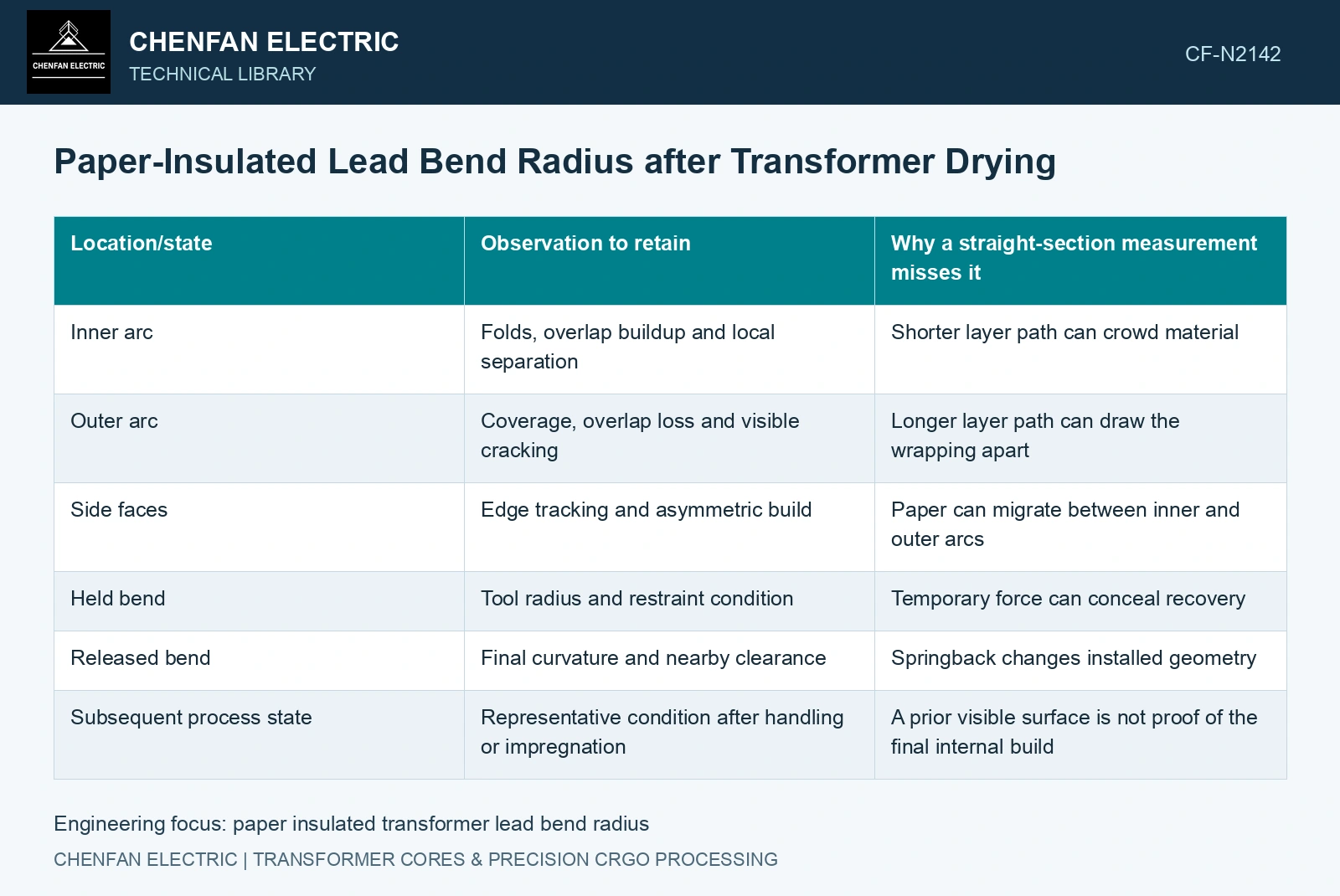
| Location/state | Observation to retain | Why a straight-section measurement misses it |
|---|---|---|
| Inner arc | Folds, overlap buildup and local separation | Shorter layer path can crowd material |
| Outer arc | Coverage, overlap loss and visible cracking | Longer layer path can draw the wrapping apart |
| Side faces | Edge tracking and asymmetric build | Paper can migrate between inner and outer arcs |
| Held bend | Tool radius and restraint condition | Temporary force can conceal recovery |
| Released bend | Final curvature and nearby clearance | Springback changes installed geometry |
| Subsequent process state | Representative condition after handling or impregnation | A prior visible surface is not proof of the final internal build |
What a bending-strain estimate can establish
For an ideal, fully bonded beam in pure bending, longitudinal strain at distance y from the neutral axis is ε = y/R, with y and neutral-axis radius R in the same length units. In an illustrative geometry, y = 6 mm and R = 120 mm give ε = 0.05, or 5%.
That is a kinematic estimate under a stated constraint, not an allowable strain for transformer paper. Real wrapping can slip, open at overlaps or wrinkle. The conductor can deform plastically, and the neutral axis need not be inferred from the paper thickness alone. Those mechanisms can reduce one layer’s tensile strain while creating another insulation defect.
Use the estimate to identify the region requiring observation and to compare geometries under equivalent assumptions. A paper elongation value by itself cannot certify coverage after a wrapped lead has been bent, released and handled.
Measure recovery without losing the insulation reference
Establish fixed datums on the conductor or approved fixture so that held and released shapes can be compared. Measure curvature and the position of the bend’s outer envelope, not just the endpoint displacement. An endpoint can return close to its target while the tightest local curvature changes.
Inspection must not compress the wrapping into apparent compliance. Where internal layer seating is inaccessible, representative sections or another qualified development method should include the same bend, build and material state. A smooth outer surface cannot exclude an internal fold.
When released curvature or coverage misses the qualified geometry, check paper state, overlap and restraint history. Verify the installed envelope after the revised forming process.
Treat the bend strain as a qualified-material question
Identify the moisture/temperature history represented by the dried specimen [2]; the following bending strain is a geometric model, not a property supplied by the drying study.
For the assumed bonded-beam screen with outer-fibre distance 6 mm and neutral-axis radius 120 mm, strain is 5%. Increasing radius to 180 mm reduces that screen to 3.33%. Neither value establishes an allowable strain for dried paper wrapping. Use the actual sliding, layer restraint and conditioned-material evidence to qualify the formed lead.
References
- IEC, IEC 60076-3:2013+AMD1:2018, Power transformers — Part 3: Insulation levels, dielectric tests and external clearances in air.
- Y. Brahami, A. Betie, F. Meghnefi, I. Fofana and Z. Yeo, Development of a Comprehensive Model for Drying Optimization and Moisture Management in Power Transformer Manufacturing, Energies 18, 789, 2025. DOI: 10.3390/en18040789.