

Transformerwood-to-steel fit depends on drying, moisture and heating history. Establish the dimensional envelope of the qualified layup through those states to allocate clearance and contact in the assembly. [1]
Calculation basis. Project-specific values and gates in the illustrative screens below are assumptions; cited catalogue values retain their source test conditions.
Identify the direction of each controlled dimension relative to the veneers and layer planes. Then define the assembly datum. A part free to move symmetrically between guides produces a different clearance distribution from one fixed firmly against a single face.
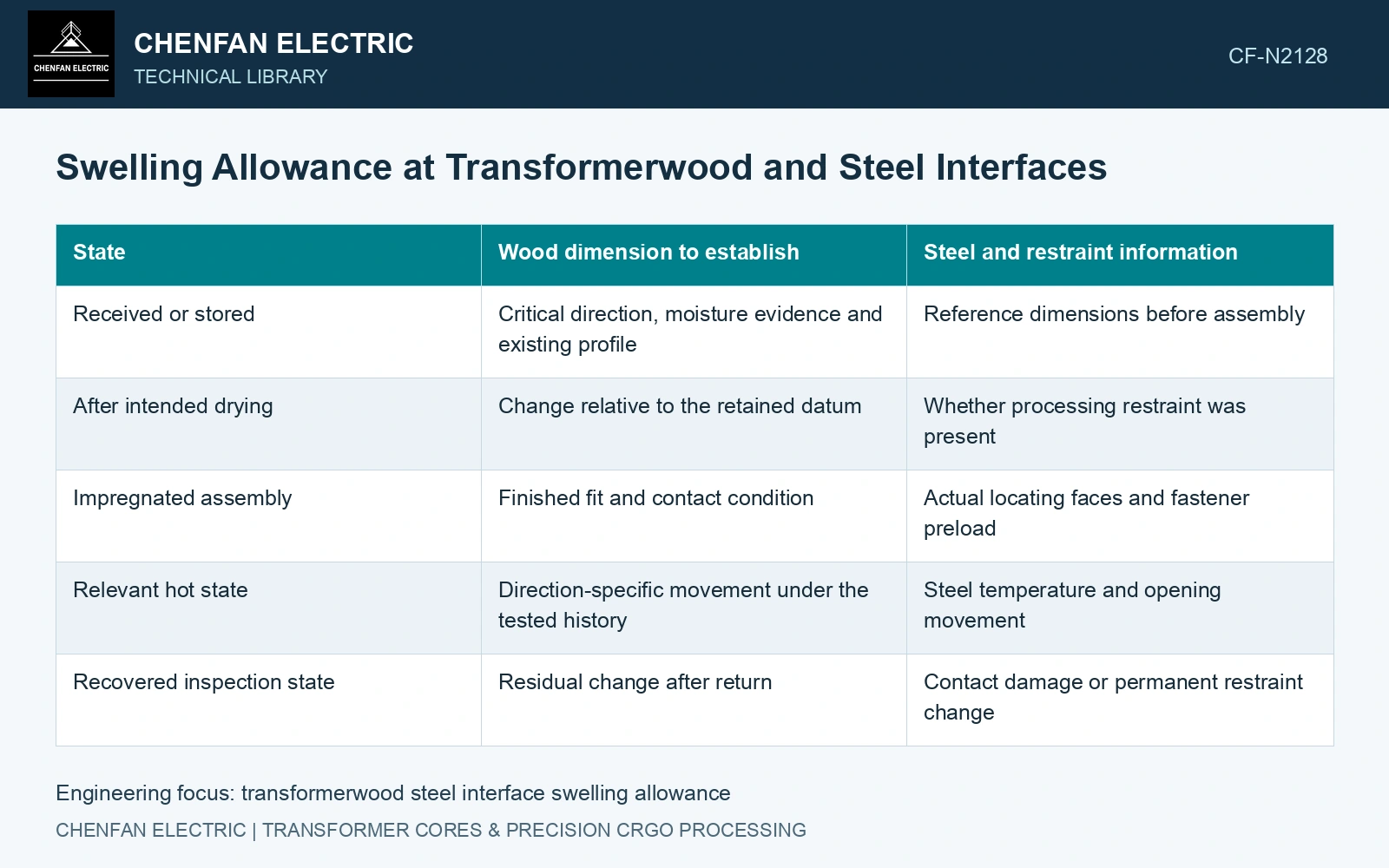
A dimension-state map for the joint
| State | Wood dimension to establish | Steel and restraint information |
|---|---|---|
| Received or stored | Critical direction, moisture evidence and existing profile | Reference dimensions before assembly |
| After intended drying | Change relative to the retained datum | Whether processing restraint was present |
| Impregnated assembly | Finished fit and contact condition | Actual locating faces and fastener preload |
| Relevant hot state | Direction-specific movement under the tested history | Steel temperature and opening movement |
| Recovered inspection state | Residual change after return | Contact damage or permanent restraint change |
In a fictional free-geometry budget with a specified datum, an initial 1.00 mm gap gains 0.05 mm because the steel opening grows and loses 0.30 mm because the wood envelope grows. The calculated remaining gap is 0.75 mm. These inputs are assumed dimensional changes, not material coefficients or acceptable clearances.
Once contact closes, subtracting free expansions cannot predict the force. The result depends on joint and member stiffness, local compression, fastener behaviour and any permitted movement.
Separate the mechanisms in the trial
Use controlled comparisons to identify thermal movement, moisture-related movement and irreversible processing change. State the sequence: a sample heated after drying is not the same history as a stored sample heated with a different initial moisture state.
Measure free witnesses alongside representative restrained joints where practical. Free specimens characterise dimensional tendencies; restrained assemblies reveal contact pressure, local indentation and movement allowed by the design. Neither observation replaces the other.
Röchling’s handling note for L X-2-E3-HQ distinguishes edge moisture uptake from large-stock dimensional tolerance [2]. It covers another construction from the L I/2 grade data sheet. Use the actual supplied grade’s handling and part requirements; neither note establishes a finished interface’s permitted fit.
Inspect the contact surfaces after the relevant cycle for compression damage, splitting and displacement. A joint that returns to its original overall width may still have lost preload or developed local damage during the hot state.
Specify fit at the governing assembly material state and its subsequent dimensional envelope. Recheck the affected movement when layup, densification or storage route changes.
Close the directional swelling allowance at the interface
Match the material identity and relevant test direction before comparing densified-wood evidence [3].
For the assumed 1.00 mm initial gap, 0.05 mm steel-opening growth and 0.30 mm wood-envelope growth, remaining clearance is 0.75 mm. Adding an assumed 0.20 mm worst-direction assembly tolerance leaves 0.55 mm. Against an assumed 0.60 mm finished-gap requirement, 0.55 mm is 0.05 mm short. Resolve the actual correlated dimensional and restraint state before accepting the fit.
References
- Röchling Industrial, Lignostone L I/2-E3-HQ (P2R), Technical Data Sheet, version 2.0, released 20 September 2023.
- Röchling Industrial, Product Handling Information Sheet, Lignostone L X-2-E3-HQ, version 4.0, released 30 June 2025, section 5.
- IEC, IEC 61061-2:1992, Specification for non-impregnated, densified laminated wood for electrical purposes — Part 2: Methods of test.