

Flexible pressboard dimensions need a defined support and measuring-force state. Tie width and flatness to that repeatable setup so inspection represents the fit the assembly requires. [1]
Calculation basis. Project-specific values and gates in the illustrative screens below are assumptions; cited catalogue values retain their source test conditions.
Separate three questions: how much material lies between two features, what shape the released barrier takes and whether it fits the assembly contacts. A single calliper reading across unsupported edges can mix all three.
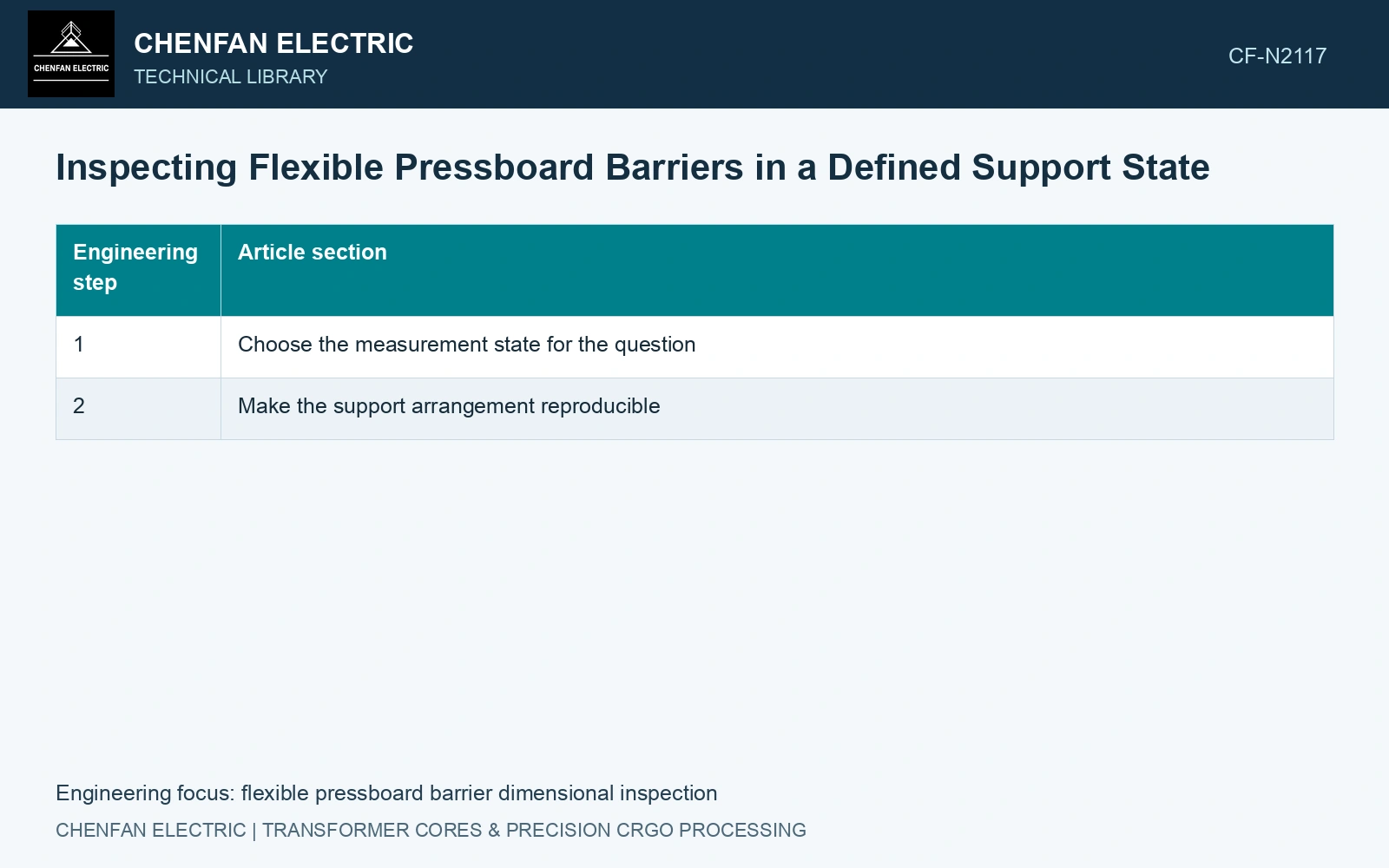
Choose the measurement state for the question
- Developed material dimension
- Use a qualified low-force arrangement that follows or suitably supports the material without imposing an unrecorded strain. State how curvature is accommodated.
- Released profile
- Support the part at identified locations and orientations. Record gravity direction and the surfaces left free to move.
- Assembly envelope
- Reproduce the relevant locating contacts and restraint. Distinguish a checking fixture from an arrangement that forces a defective part to fit.
The same barrier may legitimately have different reported dimensions in these states. The inspection specification should name which one applies to each characteristic rather than leave the choice to the operator.
Make the support arrangement reproducible
Draw the support positions and their contact shapes on the inspection plan. Include the primary locating feature and the allowed direction of movement at other supports. Overconstraining a flexible part can conceal bowing or create a deformation that the assembly will not impose.
Record measuring force where contact instruments or probes can deflect the material. A device resolution much smaller than the tolerance does not make the measurement accurate if the probe moves the edge being measured.
Inspect reference points before and after repositioning the barrier. This separates instrument repeatability from the variability introduced by replacing the part on its supports. For qualification, different operators should follow the same support and contact procedure.
Conditioning belongs in the setup. Pressboard mechanical experiments show that moisture, temperature and loading history affect response. Their results do not specify the fixture stiffness or measuring force for a large barrier, but they explain why parts from different states should not be compared as though support were the only variable.
Where assembly restraint intentionally changes the shape, measure the required fitting effort or contact condition using a qualified method. A part that reaches the checking fixture only after excessive force has not demonstrated acceptable free geometry. Equally, rejecting every released bow without considering the intended restraint can misapply the drawing.
Use photographs of the supported arrangement to preserve practical details such as an unsupported overhang or a contact near a cutout. These details can change a flexible profile while the nominal fixture datum remains the same.
Report each dimension with its support and force definition. Use that repeatable state for supplier comparison and assembly-fit acceptance.
Fix the support state of a flexible barrier measurement
Keep conditioning, loading direction and aging state with pressboard comparisons [2].
Assume the same barrier measures 100.0 mm unsupported and 99.2 mm in its specified inspection fixture. The 0.8 mm difference is support-state sensitivity. If the assumed assembly-fit window is 99.0–99.5 mm, only the fixture-defined reading is directly comparable. Keep fixture contacts, orientation and conditioning with the dimensional result.
References
- IEC, IEC 60641-2:2004, Pressboard and presspaper for electrical purposes — Part 2: Methods of tests.
- C. Oria, I. Carrascal, D. Ferreño, C. Méndez and A. Ortiz, Experimental dataset on the compressive mechanical properties of high-density pressboard used in power transformers spacers, Data in Brief 50, 109471, 2023. DOI: 10.1016/j.dib.2023.109471.