

Shared tooling can lower the total cost of a transformer core family. Evaluate packet widths, joints and locating features across ratings to identify common features that each construction can actually use.
Family optimization begins with a different unit of comparison: the complete model mix served by a proposed set of tools. Each model must remain technically feasible, while shared features earn their value over the production programme.
Define what the tooling actually shares
A common baseplate does not imply a common cutting tool, stacking guide or lifting attachment. Record the function and reference surfaces of each item. Distinguish an unchanged tool from one requiring inserts, adjustments or a replacement contact element.
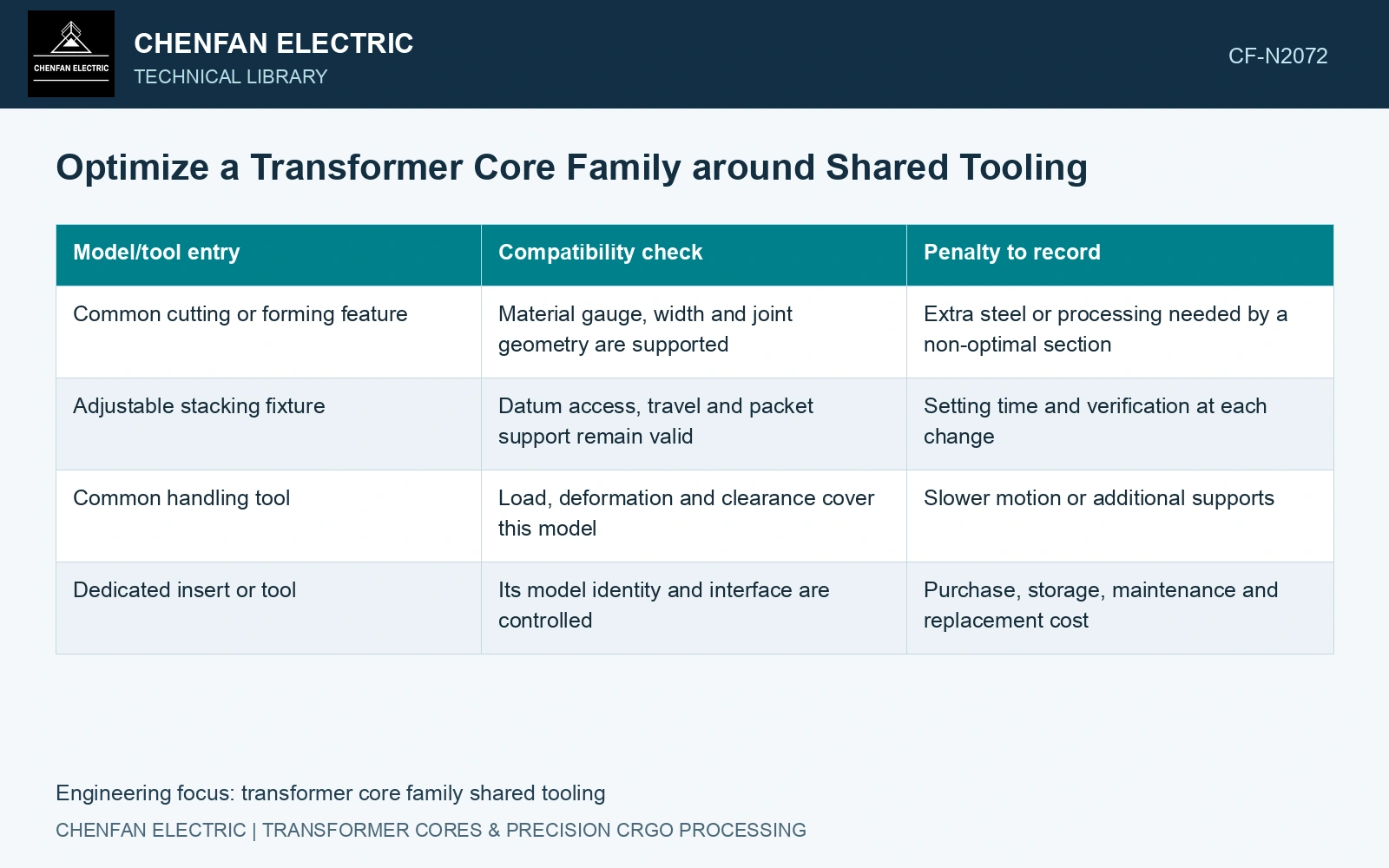
| Model/tool entry | Compatibility check | Penalty to record |
|---|---|---|
| Common cutting or forming feature | Material gauge, width and joint geometry are supported | Extra steel or processing needed by a non-optimal section |
| Adjustable stacking fixture | Datum access, travel and packet support remain valid | Setting time and verification at each change |
| Common handling tool | Load, deformation and clearance cover this model | Slower motion or additional supports |
| Dedicated insert or tool | Its model identity and interface are controlled | Purchase, storage, maintenance and replacement cost |
Fill the matrix for every rating and construction variant. “Adjustable” should name the adjustment range and verification method. A fixture that locates a small core accurately may deflect excessively under a larger one even when its travel is sufficient.
Evaluate the production mix
A useful cost structure is the sum of the selected tools’ fixed costs plus Σqici, where qi is the production quantity of model i and ci its variable cost under that tool allocation. Add changeover and maintenance effects where they are material.
Compare the shared arrangement with credible dedicated arrangements. Record each model’s added mass, loss, labour or inspection burden. A small penalty repeated on the highest-volume rating can outweigh the tooling saved on several rare ratings.
Vary the production mix rather than assuming one permanent forecast. A common section that is attractive for a balanced family may cease to be attractive when one rating dominates. Capacity at a shared station also matters: saving a tool while creating the programme’s bottleneck is an incomplete calculation.
Qualify the limiting entries
Test the variants controlling load, travel, visibility and dimensional setting, including their transitions. Qiao and Weiss address robot tool-centre position/orientation errors and measurement uncertainty [1]. For robot handling tools, verify those quantities under the actual payload and posture. Separately qualify mechanical changeover datums and contacts; an empty docking cycle does not establish loaded placement performance.
The catalogue 0.23 mm gauge and 7,650 kg/m³ density define a material basis for shared tooling. [2] Assume one 1.0 m lamination at 0.30 m width: steel mass is 0.52785 kg. A common 0.32 m width for the same length and gauge uses 0.56304 kg, adding 0.03519 kg per sheet. For an assumed family build of 20,000 such sheets, the increase is 703.8 kg. At an assumed steel cost of 3 currency units/kg, common tooling must save more than 2,111.4 currency units in setup, yield and handling to recover that added steel cost. Compare the full family volume, not a single convenient variant.
Common tooling still needs approved width identities, cutting programmes and joint schedules for every family member. Keep variant verification separate from the commercial saving in changeovers.
Release common tooling for the entries demonstrated compatible and retain dedicated tools for justified exceptions. Keep their material, changeover and validation costs visible in the family comparison.
References
- G. Qiao and B. A. Weiss, Industrial Robot Accuracy Degradation Monitoring and Quick Health Assessment, Journal of Manufacturing Science and Engineering 141, 2019. DOI: 10.1115/1.4043649.
- Nippon Steel Corporation, Grain-Oriented Electrical Steel Sheets, catalogue D004je, April 2020, specification and typical-property tables.