

Manufacturing pass probability connects core efficiency with the cost of achieving it in production. Evaluate packet, joint and material variation around the nominal design to identify a buildable performance margin. [1]
Manufacturing yield here means the fraction of completed cores meeting the defined acceptance conditions. It is separate from the fraction of a coil converted into useful strips.
Start with process variation and a response model
Collect input variation from a stable, relevant production route. Keep lot, machine, operator and setup effects distinguishable. Multiple readings on one core do not reveal between-core manufacturing variation.
Propagate those inputs through a response model that has been checked near the acceptance boundaries. Where interactions are important, perturbing each input separately is insufficient. A thickness change can alter fit and magnetic area together; changing joint pressure can alter several responses at once.
Compare margin with spread
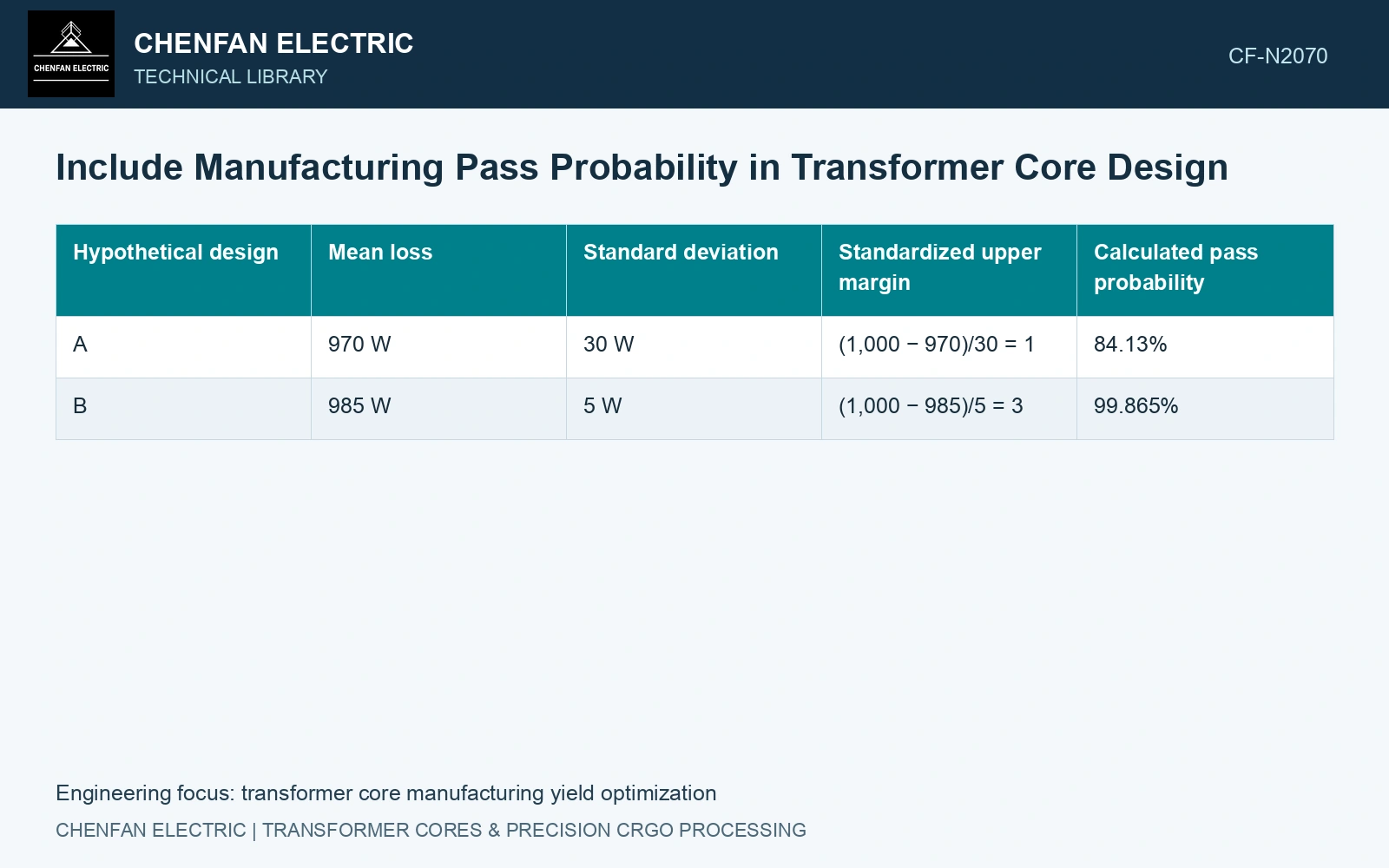
The following is an illustrative statistical example, not measured production performance. Assume that finished-core loss is normally distributed and that the sole acceptance limit is 1,000 W.
| Hypothetical design | Mean loss | Standard deviation | Standardized upper margin | Calculated pass probability |
|---|---|---|---|---|
| A | 970 W | 30 W | (1,000 − 970)/30 = 1 | 84.13% |
| B | 985 W | 5 W | (1,000 − 985)/5 = 3 | 99.865% |
A has lower mean loss, but B has a much lower hypothetical risk of crossing this limit. The difference comes from spread, not from a claim that 985 W is intrinsically a better nominal design. The normal assumption is doing substantial work: a skewed distribution or mixed production populations can change these probabilities.
Evaluate the joint acceptance event
Real cores may need to pass loss, excitation, dimensions and other conditions simultaneously. Count the simulated or measured cases passing all criteria. Multiplying the separate pass probabilities assumes independence, which is often unjustified when outputs share material and geometry inputs.
Report sampling and model uncertainty around the estimated yield. An attractive tail prediction from a small data set is not a defect-rate guarantee. Measurement uncertainty and the agreed acceptance decision rule also affect which units are classified as passing.
Price the manufacturing consequence
Compare accepted-unit cost with the actual disposition of failures. Reworkable units, scrapped cores and recoverable steel have different consequences. A simple build-cost/pass-probability ratio is useful only under its declared all-or-nothing assumptions.
Use catalogue density 7,650 kg/m³ and assume 0.100 m³ steel per attempted core: 765 kg [2]. At an assumed 3 currency units/kg plus 600 conversion cost, an attempt costs 2,895. Continue the same assumed normal-loss designs above: pA = Φ(1) = 0.8413447 and pB = Φ(3) = 0.9986501. With identical attempt costs and no rework or scrap recovery, accepted-unit costs are 2,895/pA = 3,441.63 and 2,895/pB = 2,898.91. B can therefore absorb up to 542.72 additional currency units per accepted core before losing this cost advantage under these assumptions. Add actual recovery, measurement decisions and other acceptance constraints before selecting the route.
Measure pass probability for the actual burr, overlap, dimensional and magnetic criteria. A broad supplier yield percentage cannot replace the probability that this core schedule passes its specified release tests.
Price the process variation that the design tolerates, together with the failure cost it avoids. Validate that response on independent constructions and update the model when new lots or setups change the demonstrated yield.
References
- NIST/SEMATECH, e-Handbook of Statistical Methods, What is Process Capability?, section 6.1.6.
- Nippon Steel Corporation, Grain-Oriented Electrical Steel Sheets, catalogue D004je, April 2020, specification and typical-property tables.