

A threshold controller can alternate near a boundary because of noise or coordinated load release. Jain’s EV controller study shows delay and partial response belong in the controller model [1]; it does not establish a universal hysteresis or hold time.
Distinguish measurement chatter from fleet-induced oscillation
Compare the signal before and after switching. Rapid crossings with little physical load change differ from cycles synchronized with commands. Use a common verified time base for measurements, decisions and applied states; NIST OT guidance explains why inaccurate clocks undermine event correlation [2].
Thermal inertia adds another timescale. A current reduction can occur before the transformer has cooled sufficiently for the next sustained load. A release rule based solely on present current may therefore recreate a constrained thermal trajectory even if electrical chatter has stopped.
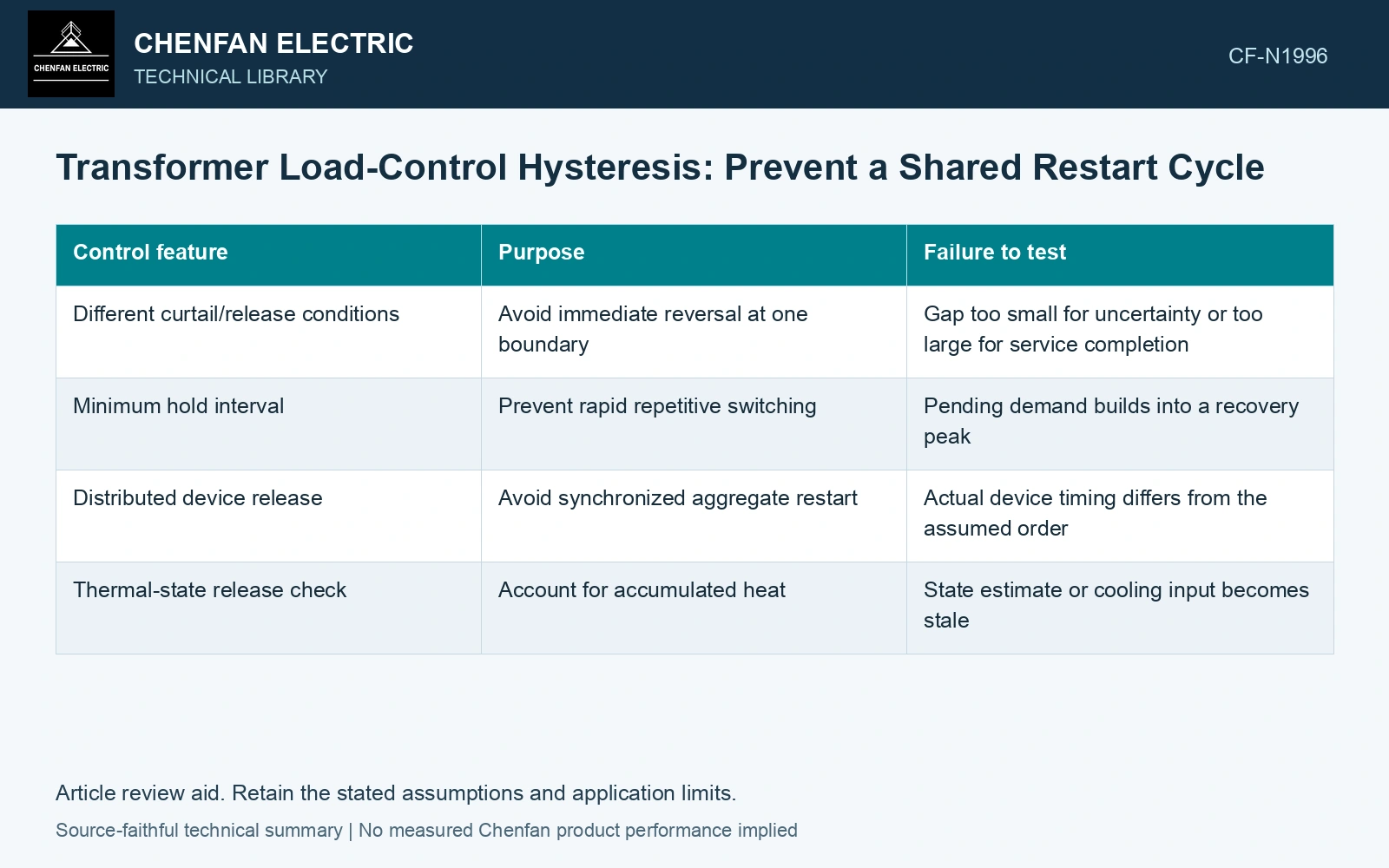
| Control feature | Purpose | Failure to test |
|---|---|---|
| Different curtail/release conditions | Avoid immediate reversal at one boundary | Gap too small for uncertainty or too large for service completion |
| Minimum hold interval | Prevent rapid repetitive switching | Pending demand builds into a recovery peak |
| Distributed device release | Avoid synchronized aggregate restart | Actual device timing differs from the assumed order |
| Thermal-state release check | Account for accumulated heat | State estimate or cooling input becomes stale |
Treat thresholds and hold time as interacting choices
A larger hysteresis gap can reduce switching but use more capacity margin. A longer hold interval can stabilize commands but leave less opportunity to meet charging deadlines. Evaluate the choices with the same service requirements, load history and uncertainty model. There is no universally correct fixed gap or interval.
Include delayed and partial device response. If the controller issues another decision before earlier commands are applied, the observed crossing may result from pending actions. A hold rule that ignores execution status can still synchronize the population at its next release.
Use an adversarial but credible trial history
Test a slowly varying background load near the boundary, a rapid load increase, noisy observations and a common restart opportunity. Retain phase concentration and a credible thermal starting condition. Compare switching count, constraint excursions, achieved service and recovery peaks across proposed settings.
If oscillation disappears only because more service remains unfinished, retain that tradeoff in the comparison. Examine the signal, state transitions and achieved fleet response on one timeline. A quieter command log is useful only if the transformer limits and service requirements remain satisfied.
References
- A. Jain and M. Karimi-Ghartemani, Mitigating Adverse Impacts of Increased Electric Vehicle Charging on Distribution Transformers, Energies 15, 9023, 2022. DOI: 10.3390/en15239023.
- K. Stouffer et al., NIST SP 800-82 Revision 3, Guide to Operational Technology (OT) Security, September 2023, sections 3.1 and 6.2.12. DOI: 10.6028/NIST.SP.800-82r3.