

Jain’s particular EV reactive-power controller uses transformer reactive-power measurements and EV connection status [1]. Start a minimal-data architecture from its own decisions and observability, rather than assuming every household history is required.
Assign each field to a specific control decision
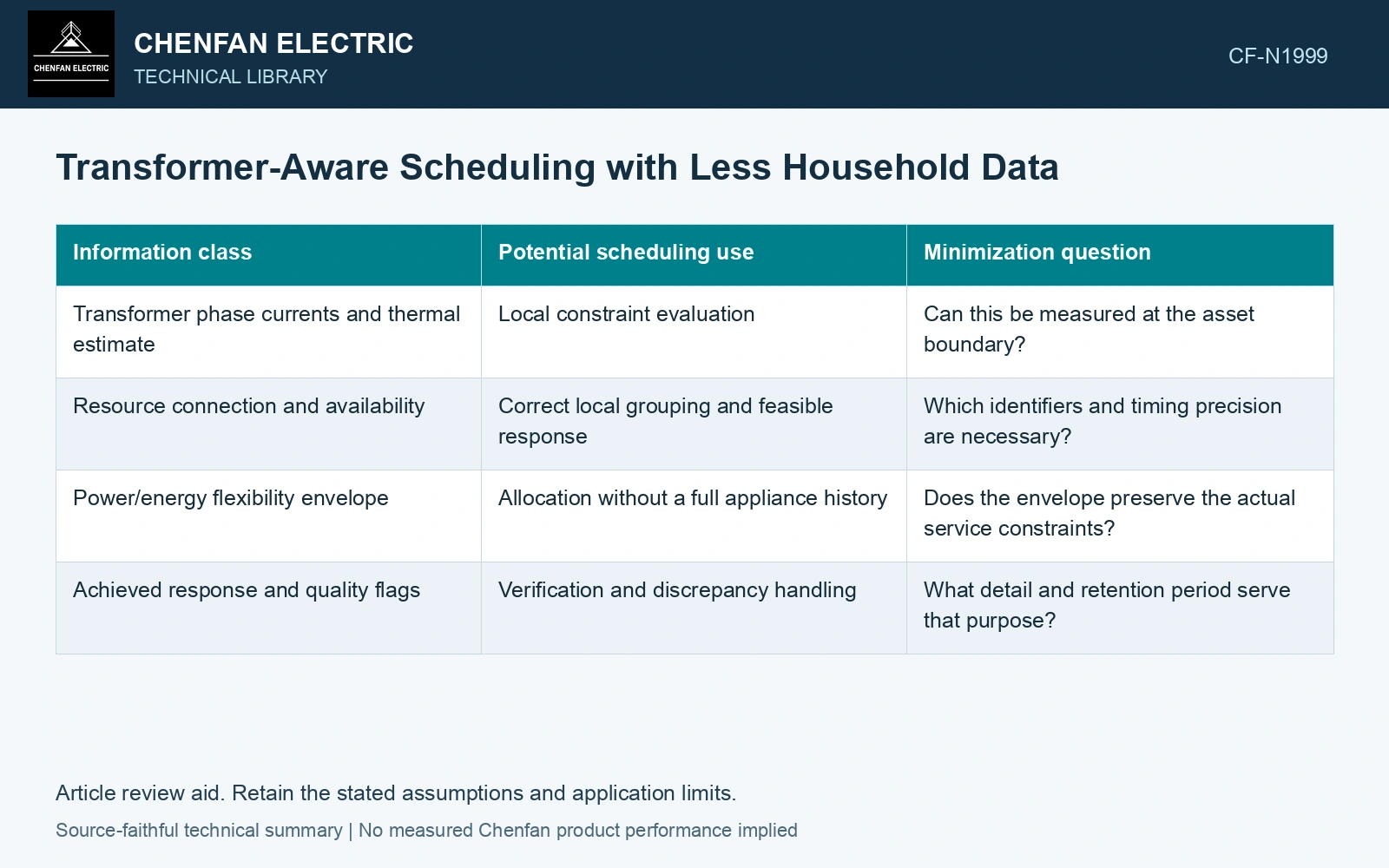
List the fields needed to check the transformer boundary, allocate resource response and verify execution. Distinguish a device’s flexibility offer from its private underlying consumption history. A useful offer may state a power range, available interval and required completion constraint, but its adequacy depends on the scheduling model.
| Information class | Potential scheduling use | Minimization question |
|---|---|---|
| Transformer phase currents and thermal estimate | Local constraint evaluation | Can this be measured at the asset boundary? |
| Resource connection and availability | Correct local grouping and feasible response | Which identifiers and timing precision are necessary? |
| Power/energy flexibility envelope | Allocation without a full appliance history | Does the envelope preserve the actual service constraints? |
| Achieved response and quality flags | Verification and discrepancy handling | What detail and retention period serve that purpose? |
Test constraint observability after minimization
Removing household detail must preserve detection of aggregate loading and uncertain future demand/response. Compare a reduced-data controller with its reference on the same realised histories; minimisation does not justify treating unobserved demand as zero.
Compare a proposed minimal-data architecture with a reference that has the additional fields, using the same realized test histories. Check phase-current violations, thermal-state uncertainty, service completion and execution discrepancies. If a field is necessary for one decision, document that need; if removing it has no material consequence, reconsider retaining it.
Limit collection and retention separately
NIST’s Privacy Framework treats data management, deletion and audit minimisation separately from limiting linkability and inferred behaviour [2]. A field needed during dispatch need not be retained indefinitely. Define recipient, purpose and retention for the actual operating and review decision.
Data reduction is not a formal privacy guarantee. Aggregated information can still reveal patterns, and repeated flexibility offers can expose behavior. Assess the information actually observable over time; encryption in transit does not by itself change what an authorized receiver learns.
Tie each collected field to the decision it supports, the recipient, timing and retention. Then test whether the reduced-data controller still detects its local constraints. Collecting less information is a concrete design choice; it does not establish mathematical privacy properties that have not been proved.
References
- A. Jain and M. Karimi-Ghartemani, Mitigating Adverse Impacts of Increased Electric Vehicle Charging on Distribution Transformers, Energies 15, 9023, 2022. DOI: 10.3390/en15239023.
- NIST, NIST Privacy Framework: A Tool for Improving Privacy through Enterprise Risk Management, Version 1.0, January 2020, Appendix A, CT.DM-P and CT.DP-P. DOI: 10.6028/NIST.CSWP.01162020.