

A heat-pump fleet needs mode-specific electrical demand. NREL’s preliminary 2024 modelling review identifies omitted auxiliary-heater energy during defrost as a model shortcoming [1]. It supplies no universal event increment or feeder coincidence.
Use an operating-mode record rather than a single multiplier
Identify the equipment types and record what each controller does during defrost. Check whether auxiliary resistance heat is fitted, when it is permitted to operate and whether the measured electrical channel includes it. Do not assume every installation has the same sequence or that a defrost label identifies a fixed power increment.
Align appliance modes with transformer current, voltage and weather. PNNL’s end-use modelling retains time-varying thermostatic behaviour rather than a static demand multiplier [2]. Preserve short events and the longer heating history.
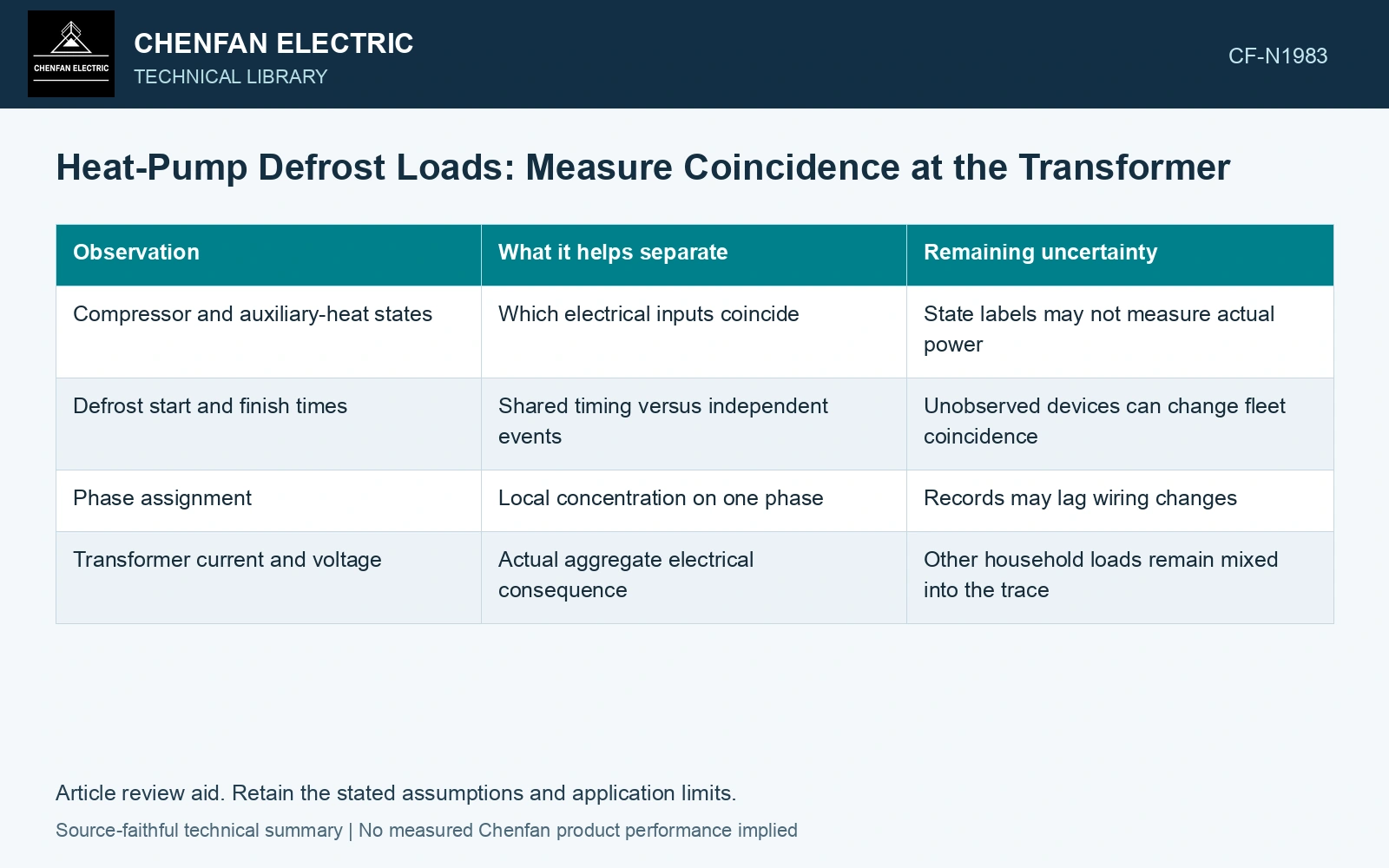
| Observation | What it helps separate | Remaining uncertainty |
|---|---|---|
| Compressor and auxiliary-heat states | Which electrical inputs coincide | State labels may not measure actual power |
| Defrost start and finish times | Shared timing versus independent events | Unobserved devices can change fleet coincidence |
| Phase assignment | Local concentration on one phase | Records may lag wiring changes |
| Transformer current and voltage | Actual aggregate electrical consequence | Other household loads remain mixed into the trace |
Test dependence instead of assuming diversity
Construct an independent-timing comparison only as a reference case. Then compare it with the measured joint timing. If cold, humid conditions affect many devices together, independent random starts may understate coincidence. If installations use different controls, assuming universal synchronization may overstate it. Neither assumption should be selected solely because it produces a convenient rating.
A useful event statistic is the number of observed devices in each operating mode over the same interval, accompanied by the corresponding aggregate phase current. Report how many devices were monitored and how they were selected. A small convenience sample cannot define a feeder-wide diversity factor without an explicit sampling argument.
Separate short voltage duty from accumulated heating
Use the measured or modeled current sequence in the transformer thermal assessment, including ordinary heating operation before and after the events. Check voltage at the affected loads separately. A short coincident event and a sustained cold-weather load can bind different requirements even when their peak currents are similar.
Assume twenty heat pumps each add 3 kW during a defined event. Coincidence 25% gives 15 kW, while 75% gives 45 kW. With assumed available active-power headroom 30 kW, the first screen passes and the second exceeds it by 15 kW. Do not adopt either fictional percentage. Measure joint event timing/phase currents under relevant weather and qualify the resulting thermal/voltage envelope before committing fleet flexibility.
Extend monitoring where the records miss a relevant appliance mode or leave coincidence unresolved. Where the coincidence pattern is established, carry its phase-resolved timeline into the thermal assessment. Neither step can be replaced by multiplying one appliance’s nameplate power by the number of homes.
References
- J. Winkler, NREL, House characteristic-based design guidance on heat pump selection, sizing, and setup for decarbonization, DOE Building Technologies Office Peer Review, 2024, slide 13.
- K. P. Schneider, J. C. Fuller, F. K. Tuffner and R. Singh, Evaluation of Conservation Voltage Reduction (CVR) on a National Level, PNNL-19596, July 2010.