

An enclosed electrical connection between a transformer and GIS does not establish a shared gas volume. Retain the actual partitions, valves and monitoring points in the controlled configuration [1], alongside the electrical diagram.
For the installed transformer and connected GIS, identify each actual gas-compartment boundary, valve and monitoring point before defining an outage or handling sequence. An electrical connection does not establish a shared gas volume. Retain separate inventories and isolation states wherever the construction separates the compartments.
Draw the gas volumes beside the single-line diagram
Give every volume a compartment identifier. Mark the partition, seal or isolating component at each connection and distinguish a permanent gas barrier from a valve that can be operated. Include the connecting duct itself; it may be a separate compartment rather than merely an extension of either major asset.
For each partition, record pressure on both sides and the permitted differential-pressure states. Normal operation may put the two sides near the same pressure. Maintenance can produce the larger differential when one side is depressurized and the other remains charged. The reverse state can matter as well.
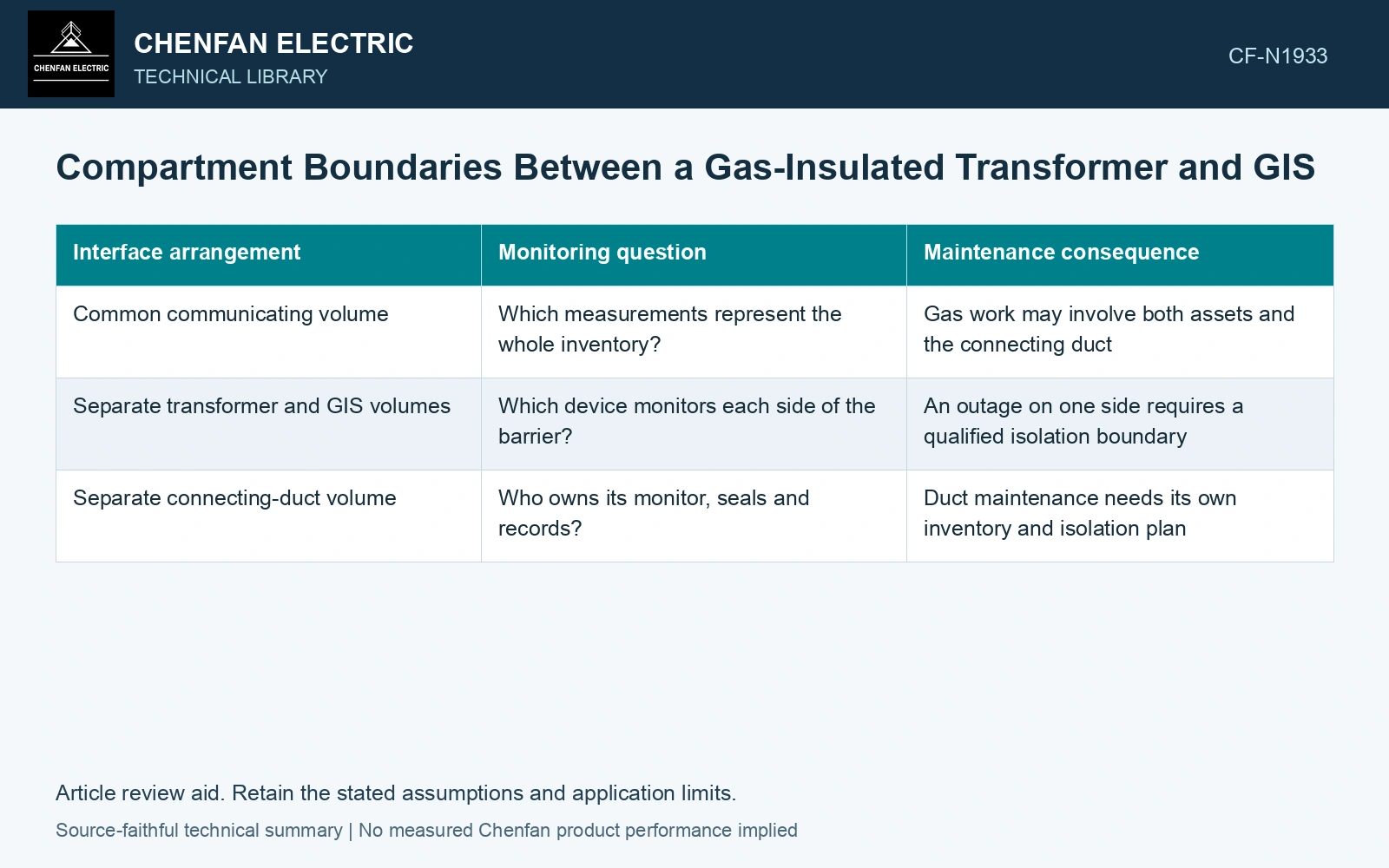
| Interface arrangement | Monitoring question | Maintenance consequence |
|---|---|---|
| Common communicating volume | Which measurements represent the whole inventory? | Gas work may involve both assets and the connecting duct |
| Separate transformer and GIS volumes | Which device monitors each side of the barrier? | An outage on one side requires a qualified isolation boundary |
| Separate connecting-duct volume | Who owns its monitor, seals and records? | Duct maintenance needs its own inventory and isolation plan |
A gas partition does not establish electrical isolation
Keeping gas in the GIS while servicing the transformer is possible only if the complete design supports that state. A gas-tight barrier by itself does not prove safe electrical isolation, discharge arrangements or mechanical access. Those are separate functions that must appear on the operating drawings.
Likewise, an electrical disconnector does not automatically stop gas communication. The gas diagram and electrical diagram need to describe the same physical interface without substituting one boundary for another.
Follow a fault across the interface
For a credible internal fault, ask which volumes can receive pressure, hot gas or decomposition products, and which barriers remain effective under the specified fault conditions. Do not equate a partition’s normal differential-pressure capability with an internal-fault containment rating. The relevant evidence is the designed fault response of the assembly.
Assign ownership of alarms, gas additions, recovery records and barrier inspections by compartment identifier. A density alarm reported under the GIS asset name can still require transformer-side action if the volumes communicate. An isolated transformer compartment, in contrast, should not have its inventory reconciled against GIS gas additions.
Assume compatible gas in 2/1 m³ compartments at 300/200 kPa absolute, initially and finally at the same uniform temperature. Summing ideal-gas inventories [2] in the fixed total volume gives final pressure 266.67 kPa if the barrier is opened. Transformer density decreases and GIS density increases. Hold a proposed shared-volume state until compatibility, both pressure envelopes, fault separation and handling authorization are verified; the calculation supplies no permission to open a boundary.
The boundary is settled when a technician can locate the affected volume, the responsible owner and the allowed maintenance state from the drawings. Without that mapping, a compact physical connection can conceal a much larger outage and gas-handling obligation.
References
- NASA, NASA Systems Engineering Handbook, section 6.5, Configuration Management, official online text.
- U.S. Department of Energy, DOE-HDBK-1012/1-92, Thermodynamics, Heat Transfer, and Fluid Flow, Volume 1, 1992, Compression Processes.