

A welded seam and a bolted sealing joint respond differently to a temperature cycle. NASA’s fastener manual describes differential expansion/contraction changing joint load [1]. A stable-temperature tightness result leaves the hot/cold assembly states unresolved.
Cooling changes pressure even without leakage
For fixed gas mass/composition in fixed volume, the ideal-gas screen gives Pabs/T constant with kelvin [2]. Correct the atmospheric reference before comparison. Real-gas and volume corrections remain separate inputs.
Actual insulating gas may need a real-gas correction, and the enclosure volume can change slightly with temperature. Temperature gradients add another uncertainty: a sensor near a warm cover does not necessarily represent the average gas temperature. A compensated density monitor and an uncorrected pressure gauge should not be treated as interchangeable records.
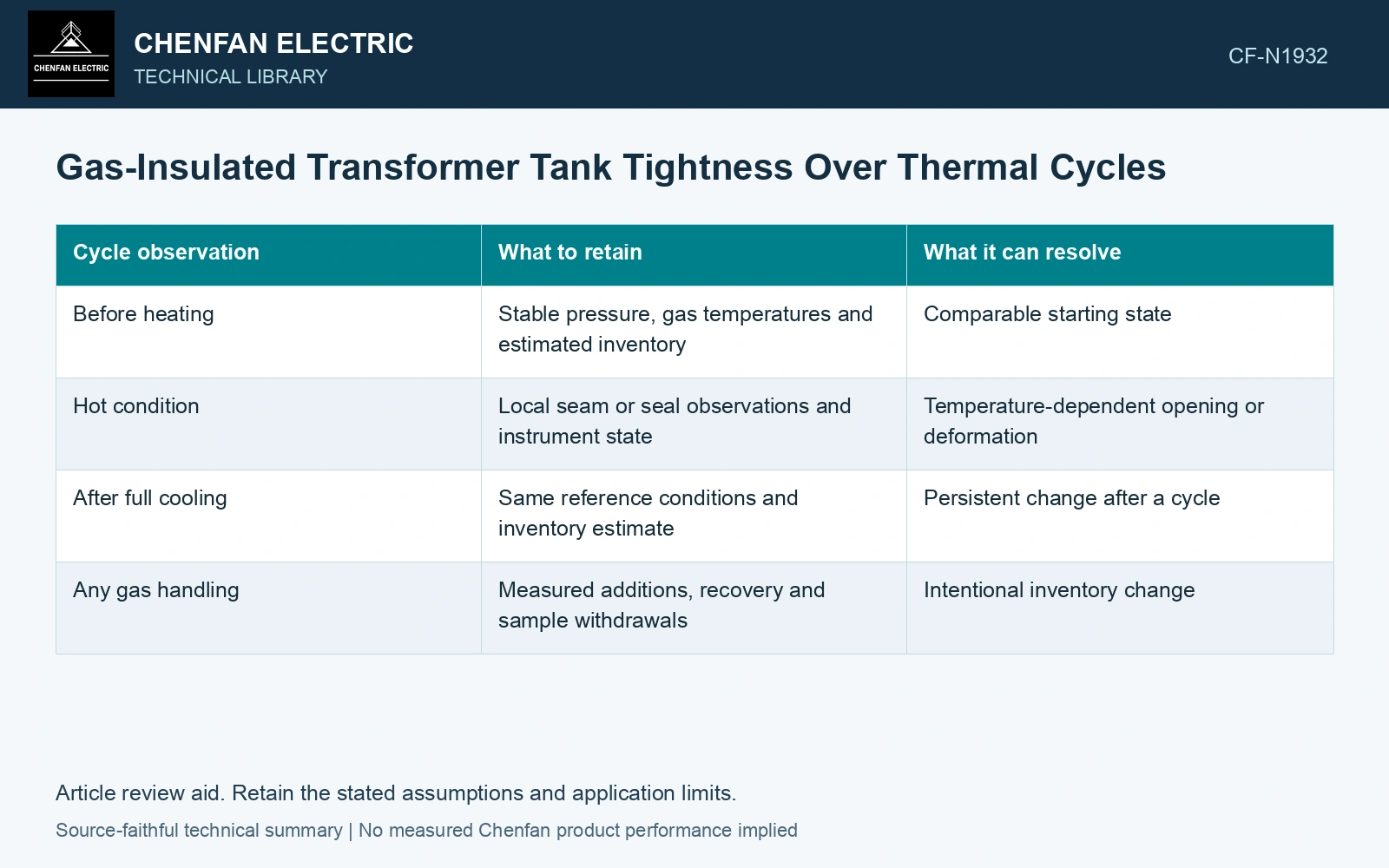
Keep a cycle-by-cycle inventory
| Cycle observation | What to retain | What it can resolve |
|---|---|---|
| Before heating | Stable pressure, gas temperatures and estimated inventory | Comparable starting state |
| Hot condition | Local seam or seal observations and instrument state | Temperature-dependent opening or deformation |
| After full cooling | Same reference conditions and inventory estimate | Persistent change after a cycle |
| Any gas handling | Measured additions, recovery and sample withdrawals | Intentional inventory change |
Use the accounting relation mexpected,end = mstart + madd − mrecovered − msampled. All terms are masses in kilograms. Compare this expected value with an independently estimated end inventory. An unexplained deficit is evidence to investigate; it is not automatically the amount lost through one particular joint. Measurement bias and unrecorded handling can produce the same discrepancy.
Distinguish a joint result from a tank result
A localized test may identify a seal that leaks only when hot. A total inventory trend can detect a cumulative deficit while failing to locate its source. Conversely, a short localized test may find no leak even though slow loss has accumulated over many cycles. Both observations belong in the assessment, with their sensitivity and test duration.
Classify each location as a weld, permanent joint, serviceable seal or instrument penetration. Record which was disturbed between tests. If a cover was reopened and resealed, the later result describes a different assembly condition.
Assume initial 300 kPa at 293.15 K and final 308 kPa at 303.15 K. Ideal normalization gives 297.840 kPa at the initial temperature, a 2.160 kPa (0.72%) deficit [2]. Assume independent standard uncertainties of 0.5 kPa for each pressure and 0.2 K for each temperature. Propagating derivatives of P1−P2T1/T2 [3] gives u = 0.751 kPa; its k = 2 lower bound is 0.658 kPa. Investigate inventory, handling and property-model error because this assumed interval excludes zero; it neither locates a leak nor identifies its joint. Record actual sensitivity/covariance before making that decision.
A convincing cycle record explains reversible pressure movement, accounts for deliberate gas handling and identifies any persistent unexplained loss within stated uncertainty. That makes it possible to distinguish a temperature effect from a seal problem without treating every pressure dip as failed tightness.
References
- R. T. Barrett, Fastener Design Manual, NASA Reference Publication 1228, 1990.
- U.S. Department of Energy, DOE-HDBK-1012/1-92, Thermodynamics, Heat Transfer, and Fluid Flow, Volume 1, 1992, Compression Processes.
- B. N. Taylor and C. E. Kuyatt, NIST Technical Note 1297, Guidelines for Evaluating and Expressing the Uncertainty of NIST Measurement Results, 1994, sections 5 and 6.