

IEC 60376 addresses technical-grade SF6 and complementary gases for mixtures [1]. A delivered-gas certificate identifies that supply, not the completed transformer compartment. Preserve source, residual and handling populations through the controlled final assembly state [2].
Preserve the chain from gas source to the compartment sample used for acceptance. That chain should show which populations could mix and what the sampling result actually represents.
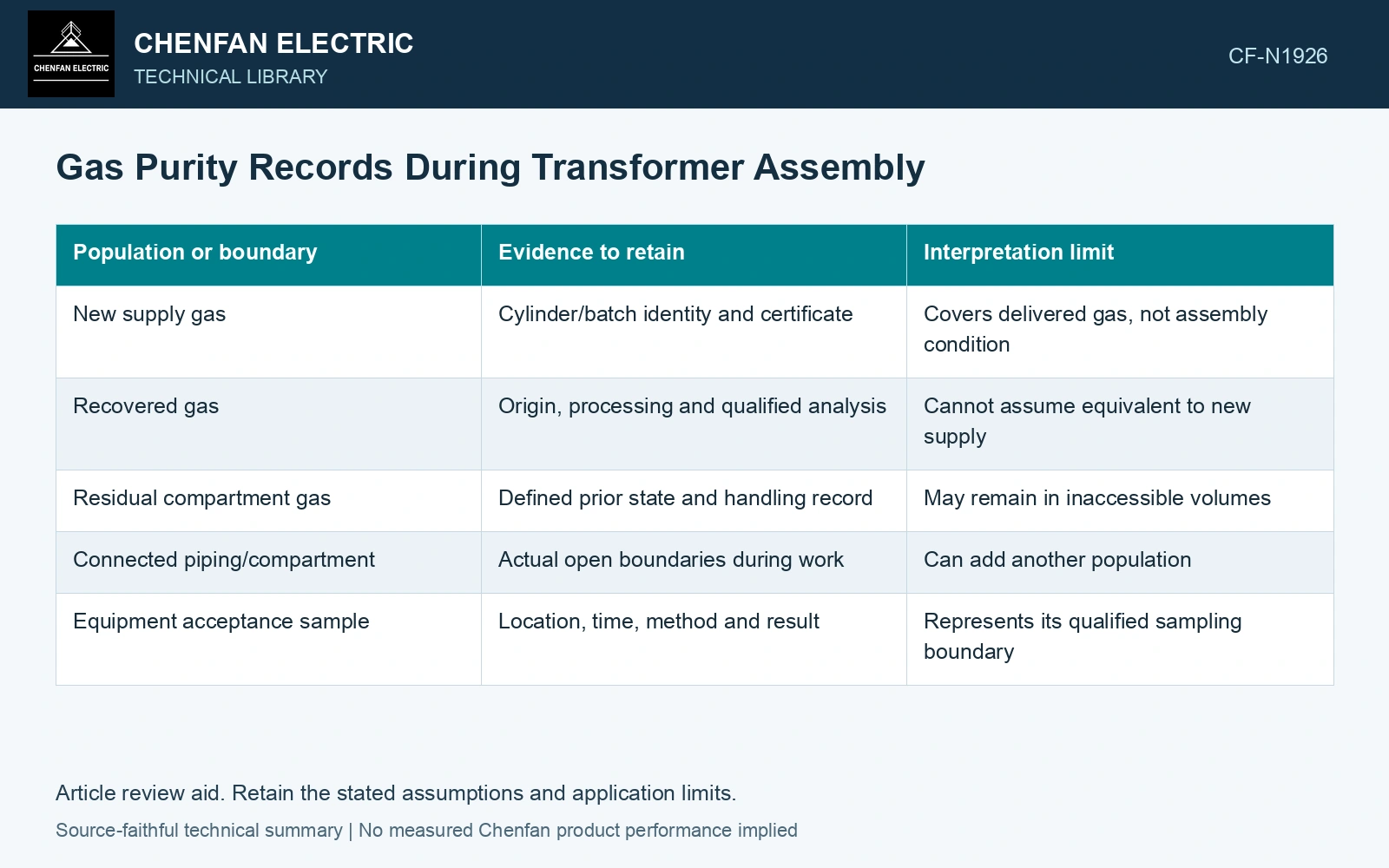
Give every gas population an identity
| Population or boundary | Evidence to retain | Interpretation limit |
|---|---|---|
| New supply gas | Cylinder/batch identity and certificate | Covers delivered gas, not assembly condition |
| Recovered gas | Origin, processing and qualified analysis | Cannot assume equivalent to new supply |
| Residual compartment gas | Defined prior state and handling record | May remain in inaccessible volumes |
| Connected piping/compartment | Actual open boundaries during work | Can add another population |
| Equipment acceptance sample | Location, time, method and result | Represents its qualified sampling boundary |
Do not merge recovered gas records solely because the nominal gas name matches. History and verified processing determine what can be claimed.
Separate process evidence from condition evidence
A completed handling record shows which approved operations were performed. It does not automatically establish the resulting concentration everywhere. The qualified sampling plan should address representative locations and connected volumes.
Conversely, a favorable sample needs its method and location. It may not represent a stagnant region or a compartment isolated before sampling. Record those boundaries rather than extending the result silently.
Keep purity and moisture distinct
A purity result and a moisture result can answer different questions. Dryness should not be inferred from a gas-name or composition certificate. Material and surface moisture can also influence the later gas condition.
If another gas or additive is present by design, use the actual mixture criteria and method. A test calibrated for one medium may not interpret another correctly.
Preserve the final assembly state
Record additions, transfers and sampling after the acceptance sample. A later operation can change the condition, especially if another compartment or line is connected. The final record should identify which sample supports which completed state.
Assume 100 kg incoming gas has 10 ppm mass fraction of a specified contaminant and 2 kg residual gas has 500 ppm. Complete mass-based mixing gives 19.61 ppm. Against a fictional 15 ppm mass-fraction review cap, incoming gas passes but the filled state fails. Hold that state for the specified acceptance analysis and disposition; retain residual/treatment records and do not compare ppm mass directly with a volume-fraction limit. All example concentrations/cap are assumptions, not IEC limits.
This evidence chain makes a purity declaration reviewable without converting a supplier certificate into a measurement it never made. It gives the owner a known gas population inside the completed transformer, with the remaining uncertainty attached to a specific compartment rather than hidden behind a clean cylinder label.
References
- IEC, IEC 60376:2018, Specification of technical grade sulphur hexafluoride (SF6) and complementary gases to be used in its mixtures for use in electrical equipment.
- NASA, NASA Systems Engineering Handbook, section 6.5, Configuration Management, official online text.